
DIY Sofa Table Behind Couch: Build & Style Guide
Turn the empty space behind your couch into a functional, stylish surface with a custom-built sofa table you can assemble in a single weekend.
Why build a sofa table behind your couch? That narrow strip of dead space behind your sofa is one of the most underused areas in the living room. A well-built sofa table adds a landing spot for drinks and lamps, hides unsightly cables, and anchors your seating arrangement without taking up floor space in front of the couch. In this guide, you will find exact measurements, material options organized by quality tier, a complete build sequence, and styling ideas to finish the project like a professional.
What Is a Sofa Table Behind a Couch?
A sofa table—also called a console table or couch table—is a long, narrow table positioned against the back of a sofa. Its primary job is to create a usable surface where there was none: a place for a table lamp, a tray of drinks, books, a charging station, or seasonal decor. Because it sits behind the seating rather than in front of it, it does not interfere with foot traffic or the view of the room.
In open-plan homes, a sofa table doubles as a subtle room divider. It visually separates the living zone from a dining area or hallway without the weight of a full wall or shelving unit. For renters and homeowners alike, a DIY version is attractive because you control the exact length, height, and finish—something off-the-shelf furniture rarely delivers for irregular wall lengths or unusual couch heights.
If you are still deciding between building and buying, our companion guide on a DIY behind-the-couch table covers alternative approaches, including repurposed dressers and floating shelf designs.
Benefits of a DIY Sofa Table
Reclaims Dead Space
A 12-inch-deep table behind the couch adds a full display and utility surface without sacrificing an inch of walkable floor area.
Exact Dimensions
Build to the precise length of your couch and the exact height of its backrest. No awkward gaps, no overhang into walkways.
Hidden Wiring
Route lamp cords and charging cables behind the tabletop and down the legs for a clean, uncluttered look.
Open-Plan Zoning
Creates a visual boundary between living and dining zones in open floor plans without blocking sightlines.
Beginner-Friendly
A rectangular top with four legs is one of the simplest furniture builds—an ideal first or second woodworking project.
Finish Matching
Stain, paint, or oil the table to coordinate with your existing coffee table, shelving, or trim for a cohesive room.
Key Measurements Before You Build
Getting the dimensions right is the single most important step. A sofa table that is too tall hides the couch back and looks unbalanced; one that is too short disappears behind the cushions. Measure your couch first, then size the table to it.
| Measurement | Recommended Range | How to Measure |
|---|---|---|
| Table length | 10–20 inches shorter than the couch width | Measure the full outside width of the couch, then subtract a small margin on each end so the table does not overhang. |
| Table depth | 10–14 inches | Deep enough for a lamp base and a tray, shallow enough to leave walkway clearance behind. |
| Table height | 1–3 inches above the couch back | Measure from the floor to the top of the couch backrest, then add 1–3 inches. |
| Clearance behind couch | 2–4 inches | Gap between the couch back and the table's front edge for cleaning and recline clearance. |
| Leg inset | 2–4 inches from each edge | Inset legs slightly for stability and a more finished look; keep at least 2 inches for screw purchase. |
Pro tip: If your couch reclines, place it in the fully reclined position before measuring. The backrest moves, and a table set too close will collide with the frame. For reclining models, review our notes on reclining loveseat console layouts to see how built-in consoles solve the same problem.
Material Options by Quality Tier
Material choice drives durability, weight, and the final look. The table below groups common options by market position so you can match the build to your long-term plans. These descriptors are relative—each tier is a legitimate choice depending on how long you intend to keep the piece.
| Tier | Top Material | Leg / Base Options | Best For |
|---|---|---|---|
| Starter tier | Plywood with iron-on edge banding | Ready-made metal hairpin legs | First builds, rental units, and temporary setups where portability matters. |
| Essential tier | 1x pine boards joined edge-to-edge | Turned wood legs or pipe legs | Everyday living rooms that need a solid, repairable surface with a natural grain look. |
| Mid-tier | Poplar or birch butcher block | Tapered hardwood legs with aprons | Family rooms where the table will see daily use and occasional spills. |
| High-end tier | Solid oak or walnut | Mortise-and-tenon hardwood frame | Statement pieces intended to last decades and be passed on. |
| Luxury tier | Book-matched hardwood slab | Custom steel or cast metal base | Design-forward homes where the table is a focal element in its own right. |
A mid-range hardwood top paired with a reinforced apron is generally the sweet spot: sturdy enough for daily use, straightforward to finish, and forgiving of small measuring errors. If you prefer a fully upholstered look instead of wood, explore how durable couch construction principles apply to padded console surfaces.
Tools and Hardware Checklist
You do not need a full workshop. The list below covers the minimum for a clean, safe build, plus optional upgrades for a more refined result.
- Essential: tape measure, carpenter's square, drill with pilot bits, screwdriver, sandpaper (120 and 220 grit), wood glue, clamps.
- Recommended: circular saw or miter saw for accurate crosscuts, random orbital sander, safety glasses, dust mask.
- Optional upgrades: pocket-hole jig for hidden joints, router for edge profiles, Kreg-style corner braces for wobble-free legs.
- Hardware: 2.5–3 inch wood screws, 1.25 inch screws for aprons, adjustable furniture glides or felt pads, optional metal L-brackets for wall anchoring.
- Finish: wood stain or paint, clear polyurethane or hardwax oil, foam brushes, lint-free rags.
Safety first: Always anchor tall or narrow tables to the wall with an L-bracket, especially in homes with children or pets. A 12-inch-deep table is stable, but anchoring eliminates tip-over risk entirely.
Step-by-Step Build Sequence
This sequence assumes a rectangular top with four legs and a simple apron frame. Adjust the leg style to your chosen material tier. Work on a flat, protected surface.
-
Cut the top to size.
Cut your top board to the final length and depth determined in the measurement step. If joining narrow boards, glue them edge-to-edge, clamp, and let cure overnight before sanding flush.
-
Cut the legs and aprons.
Cut four legs to the finished table height minus the top thickness. Cut two long aprons (length minus twice the leg thickness) and two short aprons (depth minus twice the leg thickness).
-
Sand all components.
Sand every piece to 220 grit before assembly. Pay special attention to end grain on the legs and the edges of the top, where finish absorbs unevenly.
-
Assemble the apron frame.
Attach the aprons to the legs with wood glue and screws or pocket-hole joinery. Check for square by measuring diagonally across the frame—both diagonals should match. Clamp and let the glue set.
-
Attach the top to the frame.
Center the top on the frame, then drive screws up through the aprons into the underside of the top. Pre-drill to prevent splitting. Use washers or figure-eight fasteners if you want to allow for seasonal wood movement.
-
Fill, sand, and finish.
Fill screw holes with wood filler, sand smooth, and wipe away dust. Apply stain or paint according to the manufacturer's directions, then seal with two to three coats of polyurethane or hardwax oil, sanding lightly between coats.
-
Install glides and anchor.
Add felt pads or adjustable glides to the leg bottoms to protect flooring. Anchor the finished table to the wall if it sits in a high-traffic zone or if you have young children.
-
Position and cable-manage.
Set the table behind the couch with the planned 2–4 inch clearance. Route lamp cords through adhesive cable clips along the back of the apron, then down the rear leg to an outlet.
Styling the Finished Sofa Table
A sofa table is a narrow stage—edit your styling to avoid clutter. The strongest arrangements follow a simple rhythm: one tall anchor, one horizontal element, and one organic accent.
- Anchor with light: a slim table lamp at one end provides warmth and balances the visual weight of the couch. Our floor lamp guide covers complementary lighting if you prefer taller ambient light.
- Add a tray: a shallow tray corrals remote controls, coasters, and a small plant, keeping the surface from becoming a catch-all.
- Layer texture: stack two or three books and top them with a small ceramic object. Avoid tall stacks that block sightlines into the room.
- Seasonal swap: rotate in a small vase, a candle, or a bowl of seasonal fruit. Keep the palette tied to your living room's existing colors.
- Pull cushions forward: if the table sits flush behind the couch, bring a throw or lumbar cushion over the back to visually connect the two pieces.
For broader styling direction, our couch styling guide and throw pillow selection articles show how to echo colors and textures from the tabletop decor back onto the seating.
Design Variations to Consider
Hairpin-Leg Console
The fastest build: a finished butcher-block top plus four screw-in metal hairpin legs. Ideal for a starter-tier project with a modern, airy look.
Pipe-Leg Industrial Table
Black iron pipe legs and a thick pine top create a rugged industrial feel. The pipe flanges screw directly into the top for a sturdy, low-tool build.
Two-Tier Shelf Console
Add a lower shelf between the legs for baskets and books. Great for open-plan rooms where you need hidden storage as well as a display surface.
Wall-Mounted Floating Top
If floor space behind the couch is nonexistent, a wall-mounted floating shelf at couch-back height delivers the same function without legs.
Dresser Repurpose
A shallow dresser or sideboard placed behind the couch adds drawers and doors. Check the height against your couch back before committing.
Curved Sofa Companion
For curved couches, a gently bowed top follows the backrest line. Use a jigsaw for the curve and a flexible edge banding for a clean finish.
Recommended Sofa Tables & DIY Materials
⚠️ AFFILIATE DISCLOSURE: This website contains affiliate links. As an affiliate Associate, we earn from qualifying purchases. If you make a purchase through these links, we may receive a small commission at no additional cost to you. Read our full affiliate policy.

Huuger 78.7" Console Table with Outlets, 22.8"-33.3" Height Adjustable | Behind Couch Table with 2 Power Stations & USB-C Ports, Extra Long Sofa Table, Slim Entryway Table
Check price on Amazon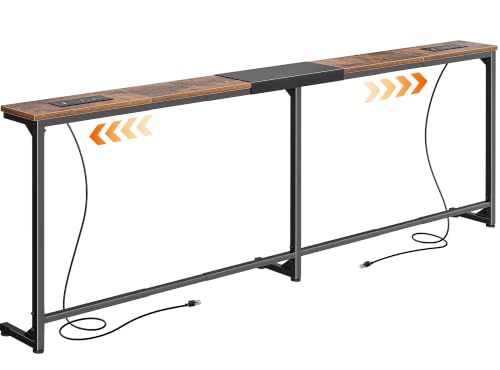
Huuger 63.4-78.3'' Extendable Behind Couch Table with Outlets, Rustic Brown | Stepless Length Adjustment, 2 Power Stations with USB-C Ports, Long Console Table, Slim Sofa Table 1ST082Z
Check price on Amazon
39.4" Sofa Table Behind Couch Table with Adjustable Height & Power Outlets | 23" to 31" Adjustable Height, Narrow Console Table for Hallway Bedroom Living Room Decor Foyer Furniture Rustic, Brown
Check price on Amazon
SUPERJARE 78.8 inch Narrow Behind Couch Table with 2 Charging Stations | 2 AC Outlets with USB-C Ports, Extra Storage Behind Sofa, Sofa Table Console Table for Entryway Living room, Rustic Brown
Check price on Amazon
Huuger 70.8 Inch Console Table, Skinny Sofa Table with Charging Station | Narrow Behind Couch Table with Outlet, for Living Room, Sofa Back,Rustic Brown
Check price on Amazon
BROTTAR 78.7" Flip Top Behind Couch Table with Outlets and Storage, Brown | Narrow Console Table, Long Sofa Table with Charging Station, Entryway Tables for Living Room, Hallway
Check price on Amazon
GRLEAF 102 Inch Narrow Sofa Table with Power Outlets, Extra Long Console Table Behind Couch Table with Charging Station, Skinny Entryway Table Thin Table for Living Room, Narrow Spaces (Rustic Brown)
Check price on Amazon
Huuger 102.4 Inch Sofa Table with Power Outlets, Skinny Behind Couch Table | Console Table with USB-C Ports, 23.9’’-34.4’’ Height Adjustable Range, Sofa Tables Narrow Long for Small Spaces, Rustic Brown
Check price on AmazonFrequently Asked Questions
What is the ideal height for a sofa table behind a couch?
The ideal height is usually 1 to 3 inches above the back of your couch. For most standard couches with a back height of 30 to 34 inches, a table height of 32 to 36 inches works well. This keeps the tabletop visible and functional while maintaining a balanced visual line.
How much clearance should I leave between the couch and the sofa table?
Leave about 2 to 4 inches of clearance between the back of the couch and the front edge of the sofa table. This allows access for cleaning and prevents the table from pressing against the upholstery. If your couch reclines, check the recline clearance before finalizing the table position.
Can I build a sofa table without power tools?
Yes. You can build a basic sofa table using pre-cut lumber from a home improvement store, a hand saw, a drill or screwdriver, and sandpaper. Many stores will cut lumber to your specified dimensions, which reduces the tools you need. Pre-finished boards and ready-made legs further simplify the project.
What materials work best for a DIY sofa table?
Solid pine, poplar, and oak are common choices for the top. For legs, turned wood, metal hairpin legs, and pipe legs are popular. Plywood with edge banding is an entry-level option, while solid hardwood represents a premium tier. Choose a finish that matches your living room's style and your couch's upholstery.
How do I hide cables behind the sofa table?
Use adhesive cable clips along the back of the apron and down the rear leg. Bundle excess cord with a velcro strap and secure it out of sight. For lamps with inline switches, position the switch within arm's reach above the tabletop.
Ready to Build Your Sofa Table?
Browse our curated selection of console tables, hairpin legs, and butcher-block tops—or explore related living room guides to finish the whole space.