
Thinking about a green couch? You're in good company. Green sofas have moved from niche design choice to mainstream favorite, and for good reason — they bring natural calm, surprising versatility, and a confident focal point to any living room. This guide walks you through every decision you'll face: which shade works for your space, which upholstery suits your lifestyle, and how to style the finished piece so it feels intentional rather than accidental.
What's Covered in This Guide
Why a Green Couch Works in Almost Any Living Room
Green occupies a unique position in interior design: it reads as a neutral in many palettes while still delivering personality. A green sofa can sit quietly against warm wood floors and cream walls, or it can anchor a bold, color-forward room. That flexibility is why designers return to it season after season.
Beyond aesthetics, green has a psychological pull. It's associated with restfulness and nature, which makes it a natural fit for the room where you unwind. If your living room currently feels flat or overly matched, a green couch introduces depth without requiring you to repaint or re-floor the entire space.
There's also a practical argument. Green hides everyday wear better than very light neutrals, and darker greens especially forgive the small marks that come with real life. If you're weighing a green sofa against a white or beige one, the green option often holds its appearance longer between cleanings.
One thing to keep in mind: green is a broad family, not a single color. The difference between a sage sofa and an emerald sofa is enormous in person. The next section breaks that down so you can narrow your search before you ever visit a showroom.
Choosing Your Green Shade: A Practical Breakdown
Before you fall in love with a photo online, understand that screen color and fabric color rarely match perfectly. Use the categories below to identify the direction you want, then request fabric swatches whenever possible.
Sage and Muted Greens
Sage, olive, and moss tones are the safest entry point into green upholstery. They behave like neutrals, pair effortlessly with whites, creams, warm woods, and brass, and don't dominate a room. If you're nervous about committing to color, start here. These shades also photograph well and tend to age gracefully as trends shift.
Emerald and Jewel Greens
Emerald, forest, and deep teal-leaning greens make a statement. They work beautifully in rooms with strong architectural features or in spaces where the sofa is meant to be the focal point. Jewel tones pair well with velvet and with metallic accents like gold or brass legs. They can make a small room feel moody and intentional, but they demand more deliberate lighting — a dark green sofa in a poorly lit corner can read as almost black.
Bright and Playful Greens
Lime, apple, and grassy greens are the boldest choice. They suit contemporary, eclectic, and playful interiors and work best when the rest of the room stays relatively restrained. If you love color but want a single hero piece, a bright green couch delivers without overwhelming the whole scheme.
Blue-Greens and Teals
Teal and blue-green shades blur the line between green and blue, which makes them unusually adaptable. They pair well with both warm and cool palettes and feel fresh in coastal and modern settings alike. If you can't decide between green and blue, a teal-leaning couch can satisfy both instincts.
| Shade Family | Best For | Pairs Well With | Consideration |
|---|---|---|---|
| Sage / Olive / Moss | Neutral-leaning rooms, first-time color buyers | Cream, warm wood, linen, brass | Can read flat in low light — choose texture |
| Emerald / Forest | Statement focal points, formal living rooms | Velvet, gold legs, dark wood, jewel accents | Needs good lighting to avoid looking black |
| Lime / Apple | Eclectic, contemporary, playful spaces | White walls, light wood, bold art | Demands restraint elsewhere in the room |
| Teal / Blue-Green | Coastal, modern, transitional interiors | Navy, sand, rattan, chrome | Can skew blue depending on lighting |
If you're leaning toward a rich, textured look, a green velvet couch is worth exploring — velvet intensifies color and adds a tactile dimension that flat weaves can't match. For a more relaxed, family-friendly direction, a green corduroy couch offers durability with visible texture.
Upholstery Materials: What Works Best for a Green Couch
The fabric you choose affects how the green reads, how the couch wears, and how much effort it takes to keep clean. Here's how the main options compare.
Velvet
Velvet is the classic pairing for deep greens because it catches light and creates tonal variation across the surface. It feels luxurious and looks premium, but it requires more attentive care — it shows crushing and marks more than flat weaves, and pet claws can snag it. Best suited to adults-only or low-traffic living rooms, or to households willing to brush and maintain it regularly.
Performance Fabric
Performance weaves have improved dramatically. Many now offer stain resistance and easy-clean surfaces without the plasticky feel of older treated fabrics. If you have kids or pets, this is often the most practical route to a green couch. Look for tight weaves in sage or olive tones, which hide texture-level soiling better than smooth surfaces.
Leather
Green leather is less common than fabric but makes a striking, long-lasting choice. Leather develops a patina over time and is straightforward to wipe clean. It's a strong option for high-traffic rooms, though it feels cooler to the touch and less cozy in cold climates. Deep forest and olive leathers are the most versatile.
Linen and Cotton Blends
Natural weaves give green a softer, more casual character. They suit relaxed, coastal, and farmhouse interiors. The trade-off is that light-colored linens show stains, and natural fibers can fade in direct sun. If you love the look, choose a mid-to-dark green and keep the couch out of harsh afternoon light.
Corduroy and Textured Weaves
Textured fabrics add visual interest and hide wear well. Corduroy in particular has a retro appeal that suits green beautifully. These weaves are generally durable and forgiving, making them a solid mid-tier choice for everyday family use.
Quick rule of thumb: the lighter and smoother the green fabric, the more visible every mark will be. The darker and more textured the fabric, the more forgiving it is. Match the fabric's forgiveness to the reality of your household, not to a magazine photo.
Couch Styles and Configurations
Green works across nearly every silhouette, but some pairings are stronger than others.
Sectionals
A green sectional is a confident choice for open-plan living. A green L-shaped couch defines a seating zone without the need for walls, and the color helps the large piece feel deliberate rather than bulky. In very large rooms, a sectional in a deep green can visually anchor the space. If you want the sectional to feel lighter, choose a low-profile frame and raised legs.
Standard Sofas and Loveseats
A three-seater green sofa is the most flexible format. It works as a standalone focal point or as part of a layered seating arrangement. In smaller rooms, a green loveseat delivers the color impact with less visual weight.
Sleeper and Pull-Out Couches
Green sleeper sofas let a guest room double as a design feature. A green pull-out couch keeps the room looking intentional even when it's functioning as a bedroom. If the couch will be used for overnight guests regularly, prioritize the mattress quality as much as the upholstery.
Sofa Beds
A green sofa bed couch is a practical choice for studio apartments and multi-use rooms. The green upholstery helps the piece read as a sofa first and a bed second, which matters in a room where you don't want the furniture to announce its dual purpose.
If you're drawn to the velvet direction specifically, the green velvet couch living room ideas collection is a useful reference for how different shades behave in real rooms, and the green velvet couch with gold legs look shows how hardware choices shift the entire mood of the piece.
Matching Green to Room Size and Light
Color behaves differently depending on the space it occupies. A shade that feels perfect in a bright showroom can feel oppressive in a dim apartment, and vice versa.
Small Rooms
In compact living rooms, lighter greens — sage, muted olive, soft teal — keep the space feeling open. Pair the couch with leggy frames and light floors so the piece doesn't visually block the room. A dark green couch in a small, dim room can make the space feel smaller than it is. If you love deep green, place it against a lighter wall and keep surrounding furniture minimal.
Large and Open Rooms
Large rooms can handle deeper, more saturated greens. An emerald or forest sectional gives a big space a center of gravity. In open-plan layouts, the green couch can also act as a visual divider between living and dining zones.
Lighting Considerations
Green changes dramatically under different lighting. Warm bulbs push green toward yellow-olive; cool daylight pushes it toward blue. North-facing rooms tend to make green look cooler and darker, while south-facing rooms warm it up. Always evaluate a swatch in the actual room, at the actual time of day you'll use the space most.
Flooring and Wall Interactions
Warm wood floors make green pop and feel grounded. Gray floors push green cooler. Cream and white walls let the green lead; dark walls require a lighter green to maintain contrast. If your walls and floors are both neutral, the green couch becomes the room's defining color decision — treat it as such.
Styling Your Green Sofa
Once the couch is in place, styling determines whether it looks like a showroom piece or a lived-in favorite. The good news is that green is forgiving and works with several distinct directions.
Pillows and Throws
For sage and olive couches, cream, rust, and warm terracotta pillows add warmth without competing. For emerald and forest couches, gold, mustard, and blush pink create a jewel-toned layered look. A neutral throw blanket in a textured weave breaks up large green surfaces and adds coziness. Limit yourself to two or three accent colors so the green remains the hero.
Rugs and Flooring
A natural fiber rug — jute, sisal, or a wool flatweave — grounds a green couch and keeps the palette earthy. If you want contrast, a patterned rug with a hint of green ties the scheme together. Avoid rugs that fight the couch for attention; let the furniture lead.
Lighting and Accents
Brass and warm metal accents flatter green, especially deep greens. A floor lamp with a warm bulb placed beside the couch can pull the green forward at night. Wood side tables and ceramic planters continue the natural theme. A plant near a green couch can either echo the color beautifully or create a muddy cluster — choose a plant with distinctly different leaf color if the couch is a strong green.
Art and Wall Treatments
Green couches pair well with warm-toned art, botanical prints, and abstract pieces with earthy palettes. If the couch is the only strong color in the room, keep the art complementary rather than competitive. If the room already has color, let the couch be one voice in the chorus rather than the soloist.
Care and Maintenance for a Green Couch
Green upholstery is generally forgiving, but the right routine extends its life and keeps the color true.
- Vacuum weekly. Use a soft brush attachment to lift dust from the weave before it settles. This matters most for velvet and textured fabrics.
- Rotate cushions. Flip and rotate seat and back cushions monthly so wear and fading distribute evenly.
- Keep out of direct sun. Prolonged UV exposure fades all fabrics, and green is no exception. Use curtains or blinds during peak afternoon light.
- Address spills immediately. Blot, don't rub. For velvet, blot and then brush the nap back into place once dry.
- Follow the manufacturer's cleaning code. Fabric cleaning codes (W, S, WS, X) tell you which methods are safe. Using the wrong solvent can set stains or damage the weave.
- Condition leather periodically. If you chose green leather, apply a leather conditioner every few months to prevent drying and cracking.
For deeper cleaning guidance by fabric type, the site's couch care section covers fabric-specific methods in detail. If you notice frame issues over time, the frame repair guide explains what's fixable and what isn't.
Green Couch Buying Checklist
Before you commit, run through these points. They're the difference between a couch you love for years and one you second-guess within a month.
- Measure the delivery path. Doorways, stairwells, and tight corners matter more than the room itself. A couch that can't reach the room is a return waiting to happen.
- Request a fabric swatch. Evaluate it in your room, in daylight and at night, before ordering.
- Confirm the frame material. Hardwood frames outlast softwood and particleboard. Ask directly if it isn't listed.
- Test the seat depth. Deep seats are cozy but can be hard to get out of for shorter users. Match depth to the primary sitter.
- Check the cushion fill. Foam, foam-and-down, and spring-based cushions behave differently. Foam holds shape; down feels softer but needs more fluffing.
- Review the return policy. Upholstered furniture returns are often restricted. Know the terms before delivery.
- Consider the household. Pets, kids, and frequent guests should influence both fabric and configuration choices.
Recommended Green Couch Options
⚠️ AFFILIATE DISCLOSURE: This website contains affiliate links. As an affiliate Associate, we earn from qualifying purchases. If you make a purchase through these links, we may receive a small commission at no additional cost to you. Read our full affiliate policy.

Tenglyptical 109" Modular Boneless Cloud Couch Sectional for Living Room | Oversized Modular L Shaped Sofa with Ottoman, Deep Seat Chenille Couch, Convertible Sofa Bed, Cloud-Like Comfort, Olive Green
Check price on Amazon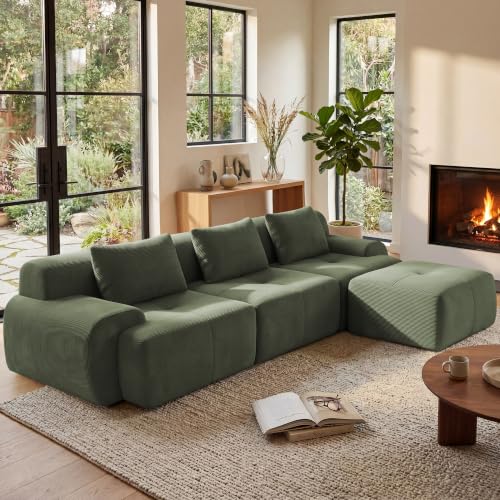
GRUSIGN 108'' Modular Boneless Sofa,Sectional Couch for Living Room | Tufted Oversized L Shape Deep Seat Sectional Sofa with Ottoman & 3 Throw Pillows,Corduroy Cloud Couch,Green
Check price on Amazon
WAYTRIM 108" Sectional Couches for Living Room U-Shaped Modular Sofa Convertible Couch with Double Chaise,Removable Pillows Upholstered 4-Seat Couch for Apartment (Green)
Check price on Amazon
94.5" L-Shaped Minimalist Boneless Sofa for Living Room (Green, Left) | Corduroy Fabric, Modern Cloud Couch, with Chaise, Pillows and Side Pockets, No Assembly Required
Check price on Amazon
107" L shaped Sectional Couches for Living Room with Cup Holder | Corner Sectional Couch,Deep Seat Cloud Couch with Storage Ottoman & USB,V Shaped Sectional Couch (Green)
Check price on Amazon
POYISOU Convertible Sectional Couches for Living Room, 3 Seats L Shaped Sofa with Storage Ottoman and 2 Cup Holders, Modern Corduroy Couch Small Sofas for Small Space Apartment Office, Green
Check price on Amazon
110" Cloud Sectional Couches for Living Room, Convertible L-Shape Couch with Ottoman, 3 Seater Modular Sectional Sofa, Boat-Shaped Fluffy Chenille Couch with Comfy Deep Seats, Green
Check price on Amazon
TROMIRY U-Shaped Sectional Couches for Living Room | 112 Inch Modern Sectional Couch | Green Chenille Sofa with Double Chaise for Apartment
Check price on AmazonFrequently Asked Questions About Green Couches
Is a green couch hard to match with existing furniture?
Not if you choose the right shade. Sage, olive, and teal greens behave like neutrals and pair with most wood tones, creams, grays, and whites. Deep emerald and forest greens are more assertive but work well in rooms with neutral surroundings. The key is to let the couch be the focal color and keep the rest of the palette restrained.
What's the most practical green fabric for a family with pets?
Performance fabric in a mid-to-dark green is usually the most practical route. Tight weaves resist snags, and darker greens hide everyday marks. Leather is also a strong option for pet households because it wipes clean easily, though claws can still scratch it. Velvet is the least practical choice for homes with cats.
Will a green couch make my living room look smaller?
Only if you choose a very dark green in a small, poorly lit room. Lighter greens and mid-tone greens keep small rooms feeling open, especially when paired with raised legs and light floors. If you love deep green in a compact space, keep the surrounding walls and furniture light to preserve contrast.
Can I use a green couch in a bedroom or guest room?
Yes. A green sleeper or sofa bed works well in guest rooms because it reads as intentional furniture rather than a temporary bed. Green also pairs nicely with warm bedding tones like cream, rust, and blush. Just make sure the room's lighting flatters the shade you choose.
How do I know which green shade is right before ordering online?
Order fabric swatches whenever the retailer offers them. Evaluate the swatch in your room at different times of day. If swatches aren't available, look for customer photos in reviews — real-room images are more reliable than studio photography. When in doubt, choose a mid-tone shade; it's the most forgiving across lighting conditions.
Does green furniture go out of style?
Green has been a recurring favorite in interior design for decades because it connects to nature and functions as a versatile neutral in many palettes. While specific shades trend in and out, the color family itself is durable. Choosing a mid-tone or muted green reduces the risk of the piece feeling dated.
Ready to Bring Green Into Your Living Room?
Start with a swatch, measure your space, and match the fabric to your household. Then explore the recommended options above to find the green couch that fits your room and your life.
Explore Green Couch Options