
L-Shaped Modular Couch: The Complete Buying Guide
An L-shaped modular couch combines the spatial efficiency of a sectional with the flexibility of interchangeable seating. This guide explains module configurations, room planning, upholstery choices, and comfort factors so you can evaluate options with confidence before you commit.
Written for buyers in the research stage who already know they want an L-shaped modular setup and need clear, practical direction.
Explore Recommended ModelsWhat an L-Shaped Modular Couch Actually Is
An L-shaped modular couch is a sectional seating system assembled from discrete modules — typically a corner piece, two or more straight seat modules, arm modules, and often a chaise or ottoman module. When joined, these pieces form an L footprint that wraps around a corner of the room, defines a seating zone, and usually accommodates more people per square foot than a standard three-seater.
The defining feature is interchangeability. Unlike a fixed sectional welded into one frame, modular pieces can be reordered, split into separate seating, or extended later by adding modules from the same collection. This is why modular designs have become a default choice for renters, movers, and households whose room layouts change over time.
If you are still deciding between a fixed and modular approach, our broader breakdown of L-shaped leather couches for sale covers how material choice interacts with layout flexibility. The key point here: the L-shape solves the corner problem, and the modular build solves the change-of-plans problem.
Why the Modular L-Shape Wins on Flexibility
A traditional L-shaped sectional is committed to one geometry. A modular L-shaped couch is committed only to the modules you currently own. That difference matters in several practical scenarios:
- Moving: Modules pass through narrow doorways and stair turns that a one-piece sectional cannot clear. This is often the single biggest reason buyers switch to modular.
- Reconfiguration: The same set can become a long straight sofa plus a separate chaise, or two facing seating groups, without buying new furniture.
- Expansion: Add a module when the household grows or when a larger room becomes available, provided the collection remains in production.
- Repair: A damaged module can be replaced or reupholstered individually rather than replacing the entire couch.
- Deep cleaning: Separating modules gives access to seams, connectors, and floor areas that fixed sectionals conceal.
The trade-off is that modular systems depend on connector hardware and consistent module dimensions. A well-engineered system stays tight and aligned; a poorly engineered one drifts apart under daily use. We cover what to check in the frame section below.
Module Configurations Explained
Most L-shaped modular collections are built from a small set of module types. Understanding them lets you read a product listing quickly and judge whether the configuration fits your room.
| Module Type | Function | Best For |
|---|---|---|
| Corner module | Joins the two arms of the L; usually a square seat with a back on two sides | Every L configuration; the anchor piece |
| Straight seat module | Standard one- or two-seat section with back | Extending either arm of the L |
| Chaise / ottoman module | Extended seat depth without a back; can be a lounger or a footrest | Lounging, small rooms, convertible layouts |
| Arm module | Left or right arm cap; some collections offer armless ends | Finishing the open ends of the L |
| Storage module | Seat with lift-up or drawer storage | Small rooms needing concealed storage |
| Sleeper module | Pull-out or fold-out bed mechanism | Guest use; see our guide to the L-shaped couch that turns into a bed |
A typical mid-size L-shaped modular couch uses one corner module, two straight seat modules, one chaise or ottoman, and two arm modules. Larger setups add straight modules to either arm. Compact setups drop a straight module and rely on a chaise to complete the L.
If you need the couch to double as guest sleeping space, modular systems with a sleeper module are worth prioritizing. Our overview of the L-shaped sectional with pull-out bed explains how the mechanism affects seat comfort and module depth.
Measuring Your Room Correctly
Measurement errors are the most common reason an L-shaped modular couch disappoints after delivery. The L footprint is larger than most buyers estimate because both arms must be measured, plus the corner square where they meet.
Step-by-step measurement
- Measure both arms fully: from the outer back edge to the outer front edge of each arm of the L, including arms and any chaise extension.
- Measure the corner footprint: the corner module usually occupies a square larger than a standard seat; record its depth and width.
- Add walkway clearance: plan at least 18–24 inches of clear path around the open sides of the L for traffic flow.
- Coffee table gap: leave 14–18 inches between the seat front and the coffee table edge for comfortable reach.
- Check delivery path: measure doorways, hallway widths, stair turns, and elevator interiors. Modular pieces help, but each module still has a minimum dimension.
- Map power and vents: avoid blocking floor vents, radiators, and outlets that the couch will cover.
Sketch the room on graph paper or use a floor-plan app and place the exact module footprints before ordering. A 1:20 scale sketch takes ten minutes and prevents the most common regret.
Left-Arm vs Right-Arm Orientation
Modular L-shaped couches are usually sold as left-arm-facing or right-arm-facing. Orientation describes where the chaise or extended arm sits when you stand facing the front of the couch.
- Left-arm facing: the chaise or extended arm is on your left as you look at the couch from the room.
- Right-arm facing: the chaise or extended arm is on your right from the same viewing position.
Choose based on the room's entry point and focal wall, not on a photo. A configuration that looks balanced in a showroom can block a doorway or face the wrong wall in your home. If the collection offers reversible chaise modules, orientation becomes a non-issue — but confirm that the back cushions and connectors are truly reversible, not just the ottoman.
For buyers working with unusual room shapes, our guide to the left-arm facing sectional with chaise walks through a typical orientation decision in a narrow room, and the grey 3-seater couch with chaise page shows how the same footprint reads in a neutral palette.
Seat Depth, Foam Density, and Comfort Tiers
Comfort in a modular couch comes from three variables: seat depth, foam density, and back support. Getting these right matters more than upholstery aesthetics, because they determine daily usability.
Seat depth
- Shallow (around 20–22 inches): upright seating; good for formal living rooms and smaller adults.
- Standard (around 23–25 inches): the most versatile range; works for sitting and light lounging.
- Deep (26 inches and above): lounge-style seating; comfortable for tall users but can leave shorter users with feet off the floor.
Foam and support tiers
Modular collections generally fall into three quality tiers, and the descriptors are consistent across the market:
- Entry-level tier: lower-density foam and lighter frames; suitable for occasional-use rooms or short-term rentals. Expect softening within a few years of daily use.
- Mid-range tier: high-resilience foam, pocket springs in some modules, and hardwood or engineered hardwood frames. The balanced choice for most households.
- Premium tier: high-density foam with down or down-alternative wraps, kiln-dried hardwood frames, and reinforced connectors. Built for daily family use over many years.
Mid-range models usually offer a noticeably more consistent seat feel than entry-level tier pieces, while premium tier buys longevity and a more tailored look. Match the tier to how hard the couch will be used, not to how it photographs.
If you want adjustable back support for reading or working, look for collections with adjustable lumbar features — our notes on the couch with adjustable lumbar support explain how that mechanism integrates with modular backs.
Upholstery and Fabric Selection
Modular pieces are handled more often than fixed couches — separated, reconnected, and cleaned individually — so upholstery durability matters more than usual. Consider the household before the color palette.
- Performance fabric: stain-resistant and cleanable; the practical choice for kids, pets, and daily use. Verify the cleaning code and whether covers are removable.
- Woven fabric (cotton, linen blends): breathable and textured; comfortable in warm climates but less forgiving of spills unless treated.
- Leather: durable and easy to wipe down; develops patina over time. Full-grain and top-grain leathers sit in the premium tier, while bonded leathers are entry-level and less durable. See the L-shaped leather couch options for material comparisons.
- Velvet: visually rich but requires careful cleaning; best in low-traffic rooms or adult-only households.
- Microfiber: soft, resilient, and relatively easy to maintain; a solid mid-tier choice for family rooms.
Check whether cushion covers are removable and machine-washable or dry-clean only. Removable covers extend the usable life of a modular couch considerably, because individual modules can be refreshed rather than replaced.
For a neutral base that suits most palettes, an off-white sectional couch in performance fabric offers flexibility; if you prefer a darker, more forgiving base, grey couches pair easily with accent modules and throws.
Frame and Connector Quality
The frame and connectors determine whether a modular couch stays tight and comfortable or drifts apart. This is the part of the buying decision most often overlooked, because it is invisible in photos.
- Frame material: kiln-dried hardwood is the durable standard; engineered hardwood is acceptable in mid-range tier; particleboard and softwood frames belong in entry-level tier and should be inspected carefully.
- Joinery: corner blocks, dowels, and screws indicate solid build; stapled-only joints are a warning sign.
- Connectors: look for metal brackets, interlocking plates, or heavy-duty straps. Plastic clips are common in entry-level tier systems and can loosen over time.
- Legs and base: solid wood or metal legs with floor protectors; a fully upholstered base hides damage but makes inspection harder.
- Weight: a heavier module generally indicates more frame material, though foam density also contributes.
A practical test: ask whether replacement connector hardware is available. If the manufacturer supports the system with spare parts, the design is usually engineered for long-term reconfiguration.
Matching L-Shapes to Room Types
Small living rooms
Use a compact L with a chaise instead of a full second arm. Keep seat depth shallow to standard and choose open-leg designs so floor is visible, which makes the room read larger. A two-module L plus ottoman is often enough. Our pull-out bed configuration notes are useful if the small room also serves as a guest space.
Open floor plans
The L defines the seating zone and creates a natural boundary to the dining or kitchen area. Use the longer arm to anchor the focal wall and the shorter arm to enclose the conversation area. A U-shaped sectional is an alternative if the room is wide enough, but the L usually leaves better traffic flow in open plans.
Family rooms
Prioritize mid-range to premium tier foam, performance fabric, and a sleeper or storage module. Modular pieces let you separate seating for play space and reconnect for movie nights. For households with pets, check the microfiber couch set material notes — microfiber remains one of the more forgiving options.
Rental apartments
Modular is the practical choice because it moves. Favor entry-level to mid-range tier pieces with removable covers and confirm the delivery path dimensions. A sectional couch in a box format can simplify delivery in buildings with narrow hallways.
Care and Long-Term Durability
Modular couches reward a simple maintenance routine. Because modules separate, deep cleaning is easier than with fixed sectionals — use that advantage.
- Rotate and flip cushions every few months to distribute wear evenly.
- Vacuum seams and crevices monthly; crumbs and grit abrade foam and fabric over time.
- Clean spills promptly using the method appropriate to the upholstery code; blot, do not rub.
- Check connectors every few months and tighten hardware to keep modules aligned.
- Separate modules for deep cleaning so you can reach the frame and floor beneath the couch.
- Protect from direct sun with blinds or UV-filtering film to slow fabric fading.
If a single module becomes worn or damaged, replace or reupholster it individually. This is the modular system's biggest long-term advantage — the couch does not need to be replaced as a whole.
Modular vs Fixed Sectional: A Quick Comparison
| Factor | L-Shaped Modular Couch | Fixed L-Shaped Sectional |
|---|---|---|
| Delivery and moving | Modules pass through tight spaces | Often requires wide doorways and open paths |
| Reconfiguration | High — pieces rearrange, split, or extend | None — geometry is fixed |
| Seat feel | Depends on connector fit; can feel segmented | Continuous, unified seat |
| Repair | Replace individual modules | Repair or replace the whole piece |
| Best for | Renters, movers, changing households | Long-term fixed layouts |
If your living situation is stable and the room will not change, a fixed sectional can feel more cohesive. If there is any chance of moving, reconfiguring, or expanding, modular is the safer long-term choice.
Recommended L-Shaped Modular Couches
⚠️ AFFILIATE DISCLOSURE: This website contains affiliate links. As an affiliate Associate, we earn from qualifying purchases. If you make a purchase through these links, we may receive a small commission at no additional cost to you. Read our full affiliate policy.

Korser 108" L-Shaped Modular Sectional Sofa with Chaise, Boneless Comfy Corduroy Fluffy Couch with Deep Seat and Side Pockets, Flexible Module Combination for Living Room, No Assembly, Side Pockets
Check price on Amazon
Cloud Sectional Boneless Couch, L-Shaped Modular Couch, Dark Grey | Deep Seat, Supportive Backrest, Plush Corduroy, Left-Facing Modular, Family-Friendly Comfort, Apartment Use, No Assembly
Check price on Amazon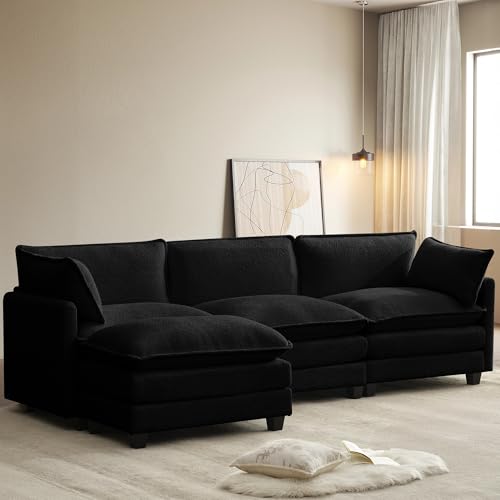
ROWHY 112'' Modular Sectional Cloud Couch with Movable Ottoman, 4 Seat Modern Chenille Sofa, Deep Seat L Shaped Couch for Living Room Bedroom Apartment,Jet Black
Check price on Amazon
GRUSIGN Cloud Sectional Boneless Couches for Living Room, Modular L Shaped Couch with Deep Seat Oversized Right Facing Chaise, Memory Foam Compressed Spineless 3 Seater Sofa for Apartment, Black
Check price on Amazon
ROWHY 112'' Modular Sectional Cloud Couch with Movable Ottoman, 4 Seat Modern Corduroy Sofa, Deep Seat L Shaped Couch for Living Room Bedroom Apartment, Beige
Check price on Amazon
108'' Modular Sectional Sleeper Sofa Couches for Living Room, Dark Grey | L/U Shaped Sleeper Sofa, Pull Out Couch Bed, Hidden Storage, Modular Design, Comfy Corduroy, Removable Cover, Movable Ottoman
Check price on Amazon
Boneless Couch, L Shaped Cloud Couch Sofa | Modular Sectional Couches for Living Room, Comfy Corduroy Sectional Sofa Set with Side Pockets, No Assembly
Check price on Amazon
Korser 108" L-Shaped Modular Sectional Sofa with Chaise, Boneless Comfy Corduroy Fluffy Couch with Deep Seat and Side Pockets, Flexible Module Combination for Living Room, No Assembly, Side Pockets
Check price on AmazonReady to Compare L-Shaped Modular Options?
Use the recommended models above to compare module configurations, tier positioning, and upholstery choices. If you need a sleeper setup, review the convertible options first; if you want leather, check the material comparison before deciding.
Frequently Asked Questions
What is an L-shaped modular couch?
An L-shaped modular couch is a sectional seating system built from separate interchangeable modules that form an L configuration, typically combining a longer seating run with a chaise or corner extension. Modular construction allows reconfiguration, replacement of individual pieces, and adaptation to different room layouts.
How do I measure a room for an L-shaped modular couch?
Measure the full footprint of both arms of the L, including the corner, then add at least 18 to 24 inches of clearance for walkways and 14 to 18 inches between the couch and a coffee table. Account for doorway widths, stair turns, and elevator dimensions before ordering, since modular pieces still need to reach the room.
Which arm orientation should I choose?
Choose left-arm or right-arm facing based on where the chaise or corner sits when you face the couch from the room's main entry or focal point. A left-arm-facing configuration places the chaise on your left as you look at the couch. Confirm orientation with a floor plan sketch before ordering to avoid a costly mismatch.
Are modular couches good for small living rooms?
Yes, when configured carefully. A compact L-shaped modular couch can define a seating zone without blocking traffic, and modular pieces can be split into separate seating for flexibility. Avoid deep chaises and oversized corner modules in narrow rooms; prioritize shallow seat depths and open leg designs.
How do I maintain a modular couch?
Rotate and flip cushions regularly, vacuum seams and crevices, and clean spills promptly with methods appropriate to the upholstery. Modular pieces can be separated for easier deep cleaning. Check connector hardware periodically and tighten as needed to keep modules aligned.