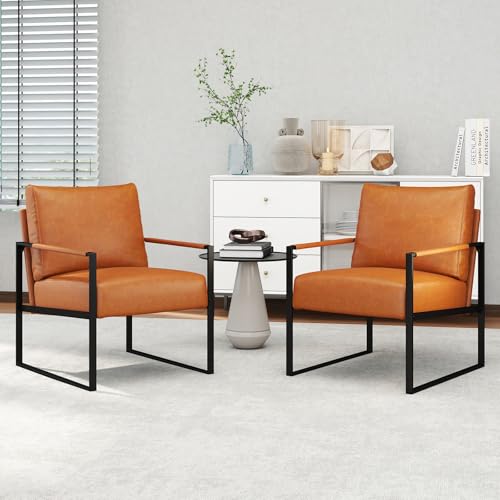
Why a Modern Accent Chair Pair Belongs in Your Living Room
Accent chairs are the flexible seating layer of a living room. A single chair fills a gap, but a modern accent chairs set of 2 does something more structural: it creates a second seating cluster that balances the visual weight of your main sofa. In open floor plans, the pair becomes the anchor of a secondary conversation zone. In smaller rooms, two slim chairs placed opposite a loveseat can replace a bulky sectional entirely.
The appeal of the modern silhouette is its discipline. Clean lines, tapered legs, and restrained upholstery keep the pair from competing with the rest of the room. If your existing seating leans traditional, a modern pair introduces contrast; if your room is already minimal, the chairs reinforce the calm geometry. For readers weighing how accent seating interacts with a larger piece, our guide on accent chairs that go with a grey couch breaks down color and proportion pairings in detail.
What Defines a "Modern" Accent Chair
Modern is a broad label, but a few structural traits consistently separate modern accent chairs from traditional or transitional designs. Knowing these markers helps you evaluate a set quickly, whether you are browsing online or sitting in a showroom.
Exposed, Tapered Legs
Wood or metal legs that splay outward or taper toward the floor lift the chair visually and signal a mid-century or contemporary lineage.
Low, Clean Armrests
Arms that track straight back or angle subtly, often with a single seam, rather than rolled or heavily padded traditional arms.
Tight or Simple Cushioning
A single seat cushion with a straight or gently angled backrest. Tufting, if present, is geometric and minimal rather than deeply buttoned.
Restrained Upholstery
Solid colors, tonal textures, and performance weaves dominate. Bold patterns are used sparingly as an accent rather than the baseline.
Frame Construction: The Part You Cannot See
The frame determines whether your pair survives years of daily sitting or develops a wobble within months. In a set of two, both frames should be identical in build quality — a common failure point in mismatched bundles. Look for kiln-dried hardwood or high-grade engineered wood joined with dowels, screws, and corner blocks. Entry-level sets often rely on stapled particle board, which is acceptable for occasional seating but not for a chair that doubles as a main seat.
Sinuous spring or web suspension distributes weight evenly across the seat. A mid-range set usually upgrades to pocket coils or a denser webbing pattern, which translates to less sagging over time. If you plan to place the chairs in a high-traffic family room, prioritize frame and suspension over decorative details — the upholstery can be refreshed later, but a failing frame cannot be repaired economically.
Upholstery Options for a Matched Pair
Upholstery choice drives both the look and the maintenance burden of your accent chairs. The right fabric depends on who sits in the chairs and how often.
| Upholstery | Best For | Maintenance Consideration |
|---|---|---|
| Performance Weave | Families, pets, daily use | Wipeable, stain-resistant; holds color well |
| Velvet | Low-traffic formal zones | Requires brushing; shows pressure marks |
| Bouclé | Texture-forward modern rooms | Snag risk from pet claws; spot clean only |
| Top-grain Leather | Long-term investment seating | Condition periodically; patinas over time |
| Linen Blend | Warm, relaxed modern interiors | Wrinkles naturally; limited stain resistance |
Whichever material you choose, confirm that both chairs in the set are cut from the same dye lot. Slight color variation between two chairs that sit side by side is far more noticeable than variation across a room. If you are comparing a leather pair against fabric alternatives, our overview of leather sofas explains how top-grain and full-grain grades age differently — the same principles apply to leather accent chairs.
Quality Tiers: What Changes as You Move Up
Accent chair pairs span a wide range of build quality. Rather than anchoring on numbers, it helps to understand what each tier delivers in construction and comfort.
| Tier | Construction | Comfort Profile | Best For |
|---|---|---|---|
| Entry-level | Engineered wood frame, stapled joints, basic foam | Firm, shallow seat; occasional use | Decorative corners, staging, guest seating |
| Mid-range | Hardwood frame, doweled joints, sinuous springs | Balanced foam density; daily-usable | Primary living room seating for couples |
| Premium | Kiln-dried hardwood, corner blocks, pocket coils | Supportive with a broken-in feel | Long-term daily seating, open floor plans |
| Luxury / commercial-grade | Hardwood frame, hand-tied springs, reinforced joinery | Full-depth cushioning, tailored upholstery | High-traffic lounges, design-led interiors |
As a rule, mid-tier sets offer the strongest balance: the frames are durable enough for everyday sitting, and the upholstery options are broad enough to match most modern palettes. Entry-level sets make sense when the chairs are purely visual, while premium and luxury tiers are worthwhile investments when the pair will function as primary seating.
Proportions: Matching the Pair to Your Room
Two accent chairs that are correctly sized will make a room feel larger; two oversized chairs will make the same room feel cramped. Before ordering, confirm three dimensions: seat height, seat depth, and overall width.
- Seat height should align within a couple of inches of your sofa seat so the pair feels part of the same seating family.
- Seat depth between 20 and 23 inches suits most adults; deeper seats favor lounging but shorten the effective walkway.
- Overall width plus 4 to 6 inches of clearance per chair keeps traffic paths open and prevents the pair from crowding side tables.
- Back height under 36 inches keeps sightlines open — important in open floor plans and small living rooms.
For narrow rooms, consider a pair with a slim profile and a swivel base. For rooms where the chairs will frame a coffee table opposite a sofa, a standard club-style proportion works best. If your layout involves a larger sectional as the main seat, the pair can sit perpendicular to the sectional to close the conversation loop — our guide on L-shaped couches for the living room shows how secondary seating fits into that geometry.
Layout Ideas for a Set of Two
A matched pair is most effective when it has a clear job in the room. Four placements consistently work well:
Facing the Sofa
Place both chairs side by side opposite the sofa, angled slightly inward toward the coffee table. This closes the conversation zone and balances the visual weight of the larger piece.
Flanking a Focal Point
Symmetry around a fireplace, console, or large window. Keep equal spacing on both sides and mirror the angle of each chair.
Open Floor Plan Divider
Back-to-back with the dining zone or placed along an imaginary line between living and kitchen areas to define territory without walls.
Reading Corner Pair
Two chairs angled toward each other with a shared side table between them. Works in bay windows and quiet corners.
Whichever layout you choose, keep the two chairs at the same distance from the focal point. Uneven spacing is the most common styling mistake with matched pairs and instantly reads as accidental.
Buying Checklist Before You Order
- Confirm both chairs ship as a matched set from the same production batch.
- Verify the frame material and joinery method in the product specifications.
- Check that seat height aligns with your existing sofa and side tables.
- Measure doorway and hallway clearance — assembled chairs are often wider than expected.
- Confirm upholstery care instructions and whether cushion covers are removable.
- Review the return policy for furniture sets specifically; pair returns are handled differently from single items.
- Check that leg finish matches across both chairs, especially on wood tones.
If you are furnishing a rental or a first apartment, a mid-range pair with performance upholstery will serve you across multiple moves. For readers building out a full room, our collection of living room furniture sets shows how accent chairs fit into coordinated packages.
Frequently Asked Questions
What should I look for in a modern accent chairs set of 2?
Focus on frame construction, upholstery material, seat cushion density, and leg design. A matching pair should share identical dimensions, upholstery, and finish so they read as a coordinated set rather than two unrelated chairs.
Where can I place a pair of accent chairs in a living room?
Common placements include flanking a fireplace, framing a coffee table across from a sofa, creating a conversation zone in an open floor plan, or filling a reading corner. The pair works best when both chairs face the same focal point or angle toward each other.
Are accent chairs comfortable for daily use?
Mid-range and premium accent chairs with high-density foam, sinuous spring support, and a properly angled backrest are comfortable for daily use. Entry-level decorative chairs are better suited for occasional seating.
How do I measure a space for an accent chair pair?
Allow at least 30 inches of walkway clearance around each chair and confirm the seat height suits the surrounding tables. Measure the chair width plus a few inches of breathing room on each side so the pair does not crowd doorways or traffic paths.