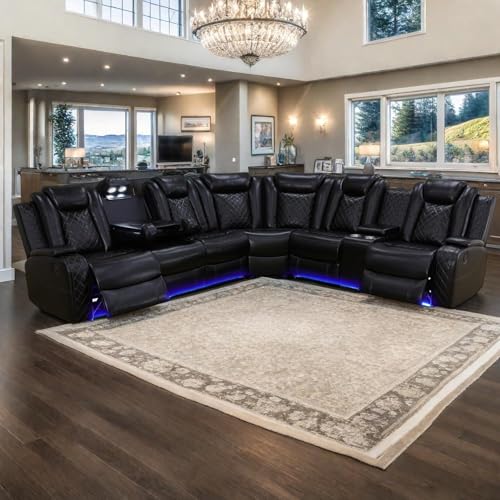
What Is a Navy Leather Sectional with Recliners?
A navy leather sectional with recliners is a multi-seat sofa configuration upholstered in deep blue leather — typically a large L-shaped, U-shaped, or straight reclining sectional — where one or more seats include a built-in reclining mechanism. These sofas usually combine a stationary section with powered or manual recliners, and often include console units, cup holders, USB ports, or power headrests.
The appeal is straightforward: leather is durable and easy to wipe clean, navy is a timeless color that hides everyday wear better than lighter tones, and recliners turn the sectional into the most comfortable seat in the house. For households that host movie nights, watch sports, or simply want a living room that doubles as a relaxation zone, this combination is hard to beat.
If you want to compare configurations more broadly, our guide to a large sectional couch with recliners covers sizing and seat-count considerations, while the navy blue leather reclining sectional overview focuses on color-specific styling and coordination.
Why Choose Navy Leather?
Color choice is one of the most consequential decisions in furniture buying, because it dictates how the rest of the room comes together. Navy leather offers several practical and aesthetic advantages:
- Timeless neutrality: Navy functions as a near-neutral. It works with warm and cool palettes alike, so repainting walls or changing rugs later won't force a sofa replacement.
- Hides wear gracefully: Dark leather conceals minor scuffs, denim transfer, and everyday smudges far better than cream, tan, or light gray upholstery.
- Grounds a room: A dark anchor piece visually stabilizes large, open-plan spaces and makes surrounding lighter furniture feel intentional.
- Sophisticated in artificial light: Under evening lighting, navy leather takes on a rich, almost black-blue depth that feels upscale without being stark.
- Pairs well with metals: Brass, bronze, and matte black all harmonize with navy — useful when choosing lamp bases, table legs, and hardware.
One practical note: navy leather shows dust more readily than medium browns, so plan a quick weekly wipe-down. It's a two-minute routine that keeps the finish looking polished.
Understanding Leather Grades
Not all leather is equal, and the grade directly affects durability, breathability, and how the surface ages. Before you commit, understand the three broad categories you'll encounter:
| Tier | What It Means | Best For |
|---|---|---|
| Entry-level (bonded / split leather) | Reconstituted or lower layers of hide with a polyurethane coating. Uniform surface, limited breathability. | Low-traffic rooms, occasional seating, households that prioritize easy cleanup over long-term patina. |
| Mid-range (top-grain leather) | Upper layer of the hide, lightly sanded and finished. Good balance of durability, softness, and resistance to fading. | Primary family seating, everyday use, households with pets or children. |
| Premium (full-grain leather) | Intact grain with natural markings. Develops a patina over time, breathes well, and is the most durable hide category. | Long-term investment pieces, formal living rooms, buyers who value natural character. |
For a reclining sectional, mid-range top-grain leather is generally the most practical choice: it holds up to frequent mechanism use, resists cracking at flex points, and still feels supple. If you're weighing leather against fabric more generally, our genuine leather sofa couch article explains the trade-offs in detail.
Recliner Mechanisms Explained
The reclining system is the heart of this sofa type, and it's where quality differences are most visible. There are three main categories:
Manual Recliners
Manual recliners use a lever or side handle to release the footrest and recline the back. They're mechanically simple, have fewer electronic failure points, and are typically lighter to move. The trade-off is that they require physical effort and offer fewer infinite-position options.
Power Recliners
Power recliners use quiet electric motors controlled by a side button or wand. They allow smooth, gradual adjustment to any position and are especially helpful for people with limited mobility. Power recliners require proximity to an outlet (or a battery pack accessory) and add one more component that can fail over time — though reputable motors are generally rated for many thousands of cycles.
Power Headrest & Extended Footrest
Higher-tier models add power-adjustable headrests and extended footrests, which let you tilt the head support independently of the back. This is a meaningful upgrade for reading, laptop work, or watching TV from a reclined position. You can see how these features layer into a more premium build in the leather power reclining sectional with power headrest comparison.
Layout & Configuration Options
Sectionals come in several shapes, and the right one depends on your room's dimensions and traffic flow. Here are the most common configurations for navy leather reclining models:
- L-shaped with chaise: The most popular layout. A chaise at one end provides a lounging seat without the bulk of a full recliner row. Ideal for medium rooms and open floor plans.
- U-shaped sectional: Wraps around a coffee table and creates a strong conversation zone. Best suited to larger rooms with at least one open side for entry.
- Straight reclining sofa with console: A three-seat row with a center console between recliners. Great for dedicated media rooms and narrower spaces.
- Recliners on each end: A balanced configuration where the two outer seats recline and the middle seats are stationary. Good for symmetrical rooms.
If you're planning a media-focused room, our guide to a leather sectional couch with recliners on each end explains seat allocation and sightline planning. For rooms where the sofa needs to double as guest sleeping space, a sectional couch with recliners and hide-a-bed is worth considering.
Measuring Before You Buy
Reclining sectionals need extra clearance behind and in front. As a rule of thumb, allow 6–10 inches of wall clearance behind the frame for reclining models, and confirm the fully extended footrest depth so it doesn't collide with a coffee table. Measure doorways and stair turns before delivery day — a sectional that fits the room but not the hallway is a common and avoidable problem.
Comfort & Ergonomics Checklist
Comfort is subjective, but a few objective factors separate a sofa you'll love from one you'll tolerate:
- Seat depth: 20–22 inches suits upright sitting; 23–25 inches suits lounging and reclining. Deeper seats may require a footrest for shorter users.
- Seat height: Around 18–20 inches from floor to seat top is comfortable for most adults and easier for older family members to rise from.
- Cushion foam density: High-resilience foam (often rated 2.0 lb/ft³ or above) resists sagging better than low-density foam. Ask about the foam spec if it isn't listed.
- Frame material: Hardwood frames (kiln-dried) outperform particleboard or softwood over time, especially for reclining seats that bear repeated load.
- Armrest height: Should sit at roughly elbow height when you're seated so you can rest your arms naturally.
- Recline angle range: A good recliner should support a near-flat position for napping and an upright position for conversation.
If you have back concerns, look for models with adjustable lumbar support. Our article on a couch with adjustable lumbar support explains what to look for.
Pros and Cons at a Glance
| Pros | Cons |
|---|---|
| Leather wipes clean easily and resists stains | Navy leather shows dust and light scratches more than mid-brown tones |
| Recliners add substantial comfort for lounging and media use | Reclining mechanisms need clearance and may limit placement against walls |
| Navy is a timeless, versatile anchor color | Dark leather can feel heavy in very small or dim rooms |
| Sectionals seat more people than standard sofas | Delivery and assembly are more involved than for a two-seater |
| Leather develops character and often outlasts fabric upholstery | Premium full-grain leather sits in the top tier of the category |
Buying Checklist
Use this checklist before finalizing your choice:
- Measure twice: Room dimensions, doorway widths, stair turns, and elevator size if applicable.
- Confirm leather grade: Ask specifically whether it's bonded, top-grain, or full-grain.
- Test the mechanism: Sit in every reclining seat, extend fully, and listen for grinding or uneven motion.
- Check the frame warranty: A long frame warranty signals confidence in construction.
- Verify power needs: Count outlets near the sofa position; consider a battery pack for power recliners if outlets are scarce.
- Review the return policy: Sectionals are large items — understand restocking terms before ordering.
- Plan delivery access: Confirm the delivery team can bring it inside, not just to the curb.
For a broader planning framework, our buying guides section covers measurement, material selection, and delivery preparation in more depth.
Care & Maintenance
Leather is low-maintenance but not maintenance-free. A simple routine keeps navy leather looking rich rather than tired:
- Weekly: Wipe with a dry microfiber cloth to remove dust. Dust settles into the grain and dulls the finish.
- Monthly: Clean with a leather-specific cleaner and condition with a pH-balanced leather conditioner. Avoid household sprays and alcohol-based wipes.
- Spills: Blot immediately with a clean cloth; don't rub. Most spills on finished leather sit on the surface and lift easily.
- Sun exposure: Keep the sofa out of direct, prolonged sunlight, which can fade navy over years. Use blinds during peak afternoon sun.
- Recliner tracks: Vacuum crumbs from the mechanism area monthly; debris in the tracks causes uneven motion over time.
For a deeper walkthrough, see our couch care and maintenance hub, which covers leather conditioning and stain treatment in detail.
Styling Your Navy Leather Sectional
Navy leather is a strong base, so styling should add warmth and texture rather than compete with it. A few directions that work well:
- Warm neutrals: Camel, oatmeal, and rust throw pillows soften the coolness of navy. Linen or bouclé textures add contrast to smooth leather.
- Metallic accents: Brass or bronze lamp bases, side table frames, and tray edges create a polished, upscale feel.
- Rugs: A light or patterned rug under the sectional prevents the dark leather from visually dragging the floor down.
- Plants: A large indoor plant near the sofa introduces organic green that plays well against navy.
- Throw blankets: A textured throw draped over one arm adds coziness and breaks up the large leather surface.
For more ideas, explore our couch decor and styling section and the throw pillows collection for color pairing inspiration. If you're starting from scratch on a room plan, the living room layout guides cover traffic flow and focal-point arrangement.