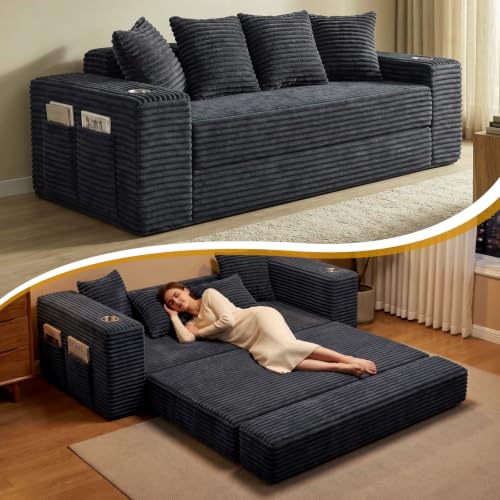
What Exactly Is a Pull Up Couch?
A pull up couch (sometimes written as pull-up couch or pullup couch) is a sofa whose backrest and seat can be lifted and adjusted by hand into multiple positions. Unlike a standard fixed-back sofa, the pull up mechanism lets you raise the back to sit more upright for conversation, reading, or working, then lower it into a relaxed reclining angle for lounging. Unlike a pull out couch, which contains a hidden mattress that folds out for sleeping, a pull up couch adjusts the posture of the seat itself rather than adding a sleeping surface. Some modern designs combine both features, but the core idea of a pull up couch is positional flexibility for sitting.
This category is closely related to multi-position sofas and manual recliners. If you have been comparing a couch you can sleep on with a reclining model, a pull up couch sits between the two: it offers adjustable comfort without the fold-out mattress complexity. It is a strong fit for living rooms, home offices, guest corners, and any space where a single piece of furniture needs to behave like several.
How the Pull Up Mechanism Works
Understanding the mechanism is the single most useful piece of research you can do before buying. A pull up couch typically uses one of two systems:
- Ratchet-style back adjustment: The backrest locks into several preset angles. You lift the back to raise it, and release a lever or lift slightly further to lower it. This is the most common design and generally the most durable.
- Continuous friction or gas-assisted adjustment: The backrest moves smoothly and holds its position through friction hinges or gas springs. These feel more fluid but rely on higher-grade hardware.
In both systems, the seat base stays fixed while the back changes angle. The quality of the mechanism determines how smoothly the couch transitions and how long it stays reliable. Entry-level models usually use simpler ratchet hinges, while mid-range and premium pull up couches add reinforced brackets, metal-to-metal locking points, and smoother release triggers. If you plan to adjust the position daily, prioritize the mechanism tier over cosmetic details.
Common Pull Up Couch Configurations
Pull up couches are sold in several seating formats, each suited to a different room and use case:
| Configuration | Best For | Notes |
|---|---|---|
| Two-seat pull up couch | Apartments, offices, reading corners | Compact footprint; often pairs with a small side table |
| Three-seat pull up couch | Family living rooms, guest seating | Most common format; check seat depth before choosing |
| Pull up sectional | Open-plan rooms, lounging zones | Multiple adjustable sections; heavier frame needed |
| Pull up loveseat | Small living rooms, bedrooms | Great companion to a larger seating piece |
If your room is tight, compare the pull up couch against a small couch for office setup or a small apartment couch — the adjustable back often makes a pull up model more useful than a fixed sofa of the same size. For larger spaces, a 3 seater couch with a pull up back gives you a conversation seat and a lounging seat in one footprint.
Frame, Upholstery, and Build Quality to Look For
The adjustable mechanism places extra stress on the frame and upholstery, so build quality matters more than on a fixed sofa. Focus on these areas:
- Frame: Kiln-dried hardwood or a reinforced metal frame handles repeated adjustment far better than lightweight particle board. Look for corner blocks and metal brackets at the joints.
- Mechanism hardware: High-grade steel hinges and reinforced locking points are the difference between a couch that stays smooth for years and one that loosens within months. Premium and professional-grade models typically use heavier brackets and smoother release triggers.
- Upholstery: Performance fabric and tightly woven blends resist the creasing that comes with repeated back adjustment. If you want a softer feel, velvet and microfiber work well but need more frequent brushing along the fold lines.
- Cushion support: High-density foam wrapped in fiber holds shape better under frequent repositioning than low-density foam alone. Pocket-coil seat cores add longevity in mid-tier and high-end tier models.
If you are drawn to a softer surface, compare the fabric feel against the considerations in our guide to comfortable couches, which explains how cushion density and seat depth interact with long-term comfort. For leather fans, a big leather couch with a pull up back is a durable option, though leather creases along the hinge lines over time.
Placing a Pull Up Couch in Your Room
Because the backrest moves, you need a little clearance behind the couch so it can recline without pressing into a wall or windowsill. As a rule of thumb, leave roughly 15–25 cm of space behind the backrest at its lowest position, and more if the model reclines deeply. This is the most common setup mistake buyers make — measuring only the flat footprint and forgetting the swing of the back.
In a small living room, place the pull up couch perpendicular to the main wall so the back can move freely, and use a small side table that slides under the couch to keep the floor plan open. In an open-plan space, orient the adjustable side toward the TV or conversation area, and put the fixed side against a solid wall. Our couches for a small living room guide covers clearance rules in more detail. If you want a visual anchor under the seating, a low-pile area rug works better than a thick shag, which can catch the base when the mechanism moves.
Pre-Purchase Checklist for a Pull Up Couch
Verify these before you commit
- Measure the flat footprint and the reclined footprint — including the swing of the backrest.
- Test the mechanism in person if possible; listen for smooth locking and a clean release.
- Confirm the number of preset positions and whether the lowest position is comfortable for lounging.
- Check seat depth and seat height against your body and your room's traffic flow.
- Ask whether the mechanism is user-serviceable or covered by the frame warranty.
- Compare upholstery crease resistance if the back will be adjusted daily.
- Confirm doorway and stair clearance for delivery — adjustable backs often add a few centimetres of packaging depth.
For a broader pre-purchase walkthrough, pair this checklist with our couch with pull out bed comparison if you are weighing a dual-purpose design, or with the comfy pull out couch guide if guest sleeping is part of the plan.
Caring for a Pull Up Couch
The adjustable back creates fold lines where dust and crumbs collect, so a light monthly routine keeps the couch feeling new:
- Vacuum the hinge seam and the fold line along the backrest with a brush attachment.
- Wipe the mechanism hardware with a dry cloth; avoid lubricants unless the manufacturer specifies one.
- Rotate and flip removable cushions every few months to even out wear.
- Use a couch protection cover if pets or children use the seating daily, and spot-clean upholstery with a manufacturer-approved cleaner.
- For deep fabric cleaning, a professional upholstery cleaner is safer than DIY steam on adjustable seams.
If the back starts to sag or the locking points loosen, address it early — small hinge repairs are straightforward, but a neglected mechanism can stress the frame. Our couch saver guide covers protective habits that extend the life of adjustable seating.
Frequently Asked Questions
What is the difference between a pull up couch and a pull out couch?
A pull up couch adjusts the angle of the backrest and seat for sitting comfort. A pull out couch contains a concealed mattress that unfolds for sleeping. Some hybrid models combine both, which is why checking the mechanism description is essential before buying.
Is a pull up couch good for small spaces?
Yes. Because one piece of furniture can shift between upright seating and relaxed lounging, a pull up couch often replaces both a fixed sofa and a separate recliner. Just confirm the reclined footprint fits your room, not only the flat footprint.
How many positions does a pull up couch usually have?
Most ratchet-style models offer three to five preset angles. Continuous-adjustment models hold any angle within their range. Entry-level designs typically offer fewer positions; mid-range and premium models add smoother releases and more intermediate angles.
Can a pull up couch be used daily?
Yes, provided the frame and mechanism are rated for frequent adjustment. Look for reinforced metal brackets and a manufacturer warranty that explicitly covers the mechanism, not just the frame.
How much clearance should I leave behind the couch?
Leave roughly 15–25 cm behind the backrest at its lowest position, and more if the model reclines deeply. Measuring the reclined footprint — not just the flat footprint — prevents the most common placement mistake.
Making a Confident Decision
A pull up couch rewards buyers who research the mechanism and the room, not just the look. Prioritize a reinforced frame, smooth locking hardware, and an upholstery that resists creasing along the fold lines. Measure the reclined footprint, not only the flat one, and test the release trigger if you can. With those checks in place, a pull up couch becomes a genuinely versatile centerpiece — one that shifts from conversation seat to lounging spot without asking you to buy a second piece of furniture. If you are still comparing formats, explore our related guides on pull out couch with storage and couch that has pull out bed to see how dual-purpose designs compare with the adjustable-back approach.