
Queen Bed with Pull Out Bed: The Complete Guide
Everything you need to know about dual-purpose queen beds — from pull out mechanisms and mattress choices to room layout, guest comfort, and long-term durability.
Start ReadingWho this guide is for: If you are searching for a queen bed with a pull out bed, you likely need one sleeping system that handles both everyday rest and occasional guests. This guide explains how these beds work, what to measure, which tiers exist, and how to choose a model that fits your room and your routine.
What Is a Queen Bed with a Pull Out Bed?
A queen bed with a pull out bed is a dual-purpose sleeping system. The primary surface is a full queen mattress, and a secondary bed — often called a trundle, pull out, or pop-up bed — slides or unfolds from underneath or from within the frame. The result is two sleeping surfaces in the footprint of one bed, which makes this format popular in guest rooms, small apartments, home offices, and multi-use spaces.
Unlike a classic sofa bed, which prioritizes daytime seating, a queen bed with a pull out bed prioritizes a proper primary mattress. That distinction matters: the main sleeping surface can support daily use, while the pull out section is engineered for occasional or short-term guests. Understanding this split is the key to choosing the right model.
How the Pull Out Mechanism Works
Most models use one of three mechanisms. Each has a different footprint, comfort profile, and maintenance routine.
1. Slide-Out Trundle
The secondary bed sits on casters or rails beneath the queen frame and slides outward horizontally. The trundle can usually sit at the same height as the queen mattress or lower, depending on the model. Slide-out trundles are the simplest to operate and the easiest to maintain, but they require clear floor space beside or at the foot of the bed.
2. Pop-Up Trundle
A pop-up trundle also stores beneath the queen bed, but the frame lifts to align the secondary mattress with the primary mattress. This creates a connected, near-king sleeping surface when deployed. Pop-up designs are ideal for couples or guests who prefer an uninterrupted sleep surface, but the lifting mechanism adds complexity and needs periodic inspection.
3. Folding Pull Out Frame
A folding frame unfolds from the foot or side of the bed, often in a two-panel or three-panel configuration. This design can be more compact when stored, but the folding sections require a thinner secondary mattress. Folding frames are common in space-conscious designs and in beds that double as seating during the day.
Queen Bed with Pull Out Bed vs. Other Dual-Purpose Beds
Buyers often compare this format with sofa sleepers, futons, and bunk configurations. The table below summarizes the trade-offs using universal tier descriptors rather than numeric figures.
| Format | Best For | Primary Sleep Comfort | Guest Convenience |
|---|---|---|---|
| Queen bed with pull out bed | Guest rooms, small apartments, multi-use bedrooms | High — standard queen mattress on a dedicated frame | High — secondary bed deploys in minutes |
| Sofa sleeper / hide-a-bed | Living rooms that double as guest space | Moderate — depends on mattress quality and bar placement | Moderate — requires clearing seating area |
| Futon | Studios, casual seating, occasional guests | Moderate — firmer, flatter support | Moderate — folding and unfolding takes effort |
| Queen bunk bed with couch underneath | Kids' rooms, vacation rentals, very small rooms | High on top bunk, lower comfort underneath | Moderate — vertical access and ceiling height constraints |
If your priority is a proper mattress for nightly sleep with occasional guest overflow, a queen bed with a pull out bed is generally the strongest choice. If your priority is daytime seating in a living room, a sleeper sofa or a full size Murphy bed with couch may fit better. If vertical space is your constraint, a queen bunk bed with couch underneath is worth reviewing.
Sizes, Dimensions, and Clearance Planning
A standard queen mattress measures approximately 60 inches wide by 80 inches long. The pull out bed adds a second sleeping zone, so the extended footprint is what you must measure — not just the closed footprint.
| Configuration | Typical Width | Typical Length | Planning Note |
|---|---|---|---|
| Queen bed, closed | ~60 in mattress + frame | ~80 in mattress + headboard | Add frame thickness on all sides |
| Side slide-out trundle, open | ~120 in combined | ~80 in | Needs open floor on one side |
| Foot pull out, open | ~60 in | ~160 in combined | Needs open floor at the foot |
| Pop-up trundle, deployed | ~120 in combined | ~80 in | Check mattress height alignment |
Leave at least 24 inches of walkway clearance around the open configuration. If the room is tight, measure door swing, closet clearance, and radiator or vent placement before ordering. Our small space layout guide covers clearance planning in more detail.
Mattress Choices for the Primary and Secondary Surfaces
The primary surface usually accepts a standard queen mattress, giving you the full range of firmness, material, and depth options. The pull out section is different: it typically requires a thinner mattress, often 4 to 6 inches thick, so the frame can fold or slide without strain.
- Primary mattress: Choose the same mattress you would buy for a standalone queen bed. Innerspring, hybrid, and foam options all work if the frame supports them.
- Secondary mattress: Prioritize thickness compliance over plushness. A thinner, denser foam mattress usually folds and stores better than a thick pillow-top.
- Weight limits: Check the stated capacity for both surfaces. The pull out frame is usually rated lower than the primary frame.
If you plan to use the secondary surface frequently, look for models that accept a thicker secondary mattress and use a reinforced mechanism. Entry-level models often accept only thin mattresses, while mid-range and premium models offer more flexibility.
Tiers and What They Typically Include
This category spans a wide range of build quality. The descriptors below are relative positions in the market, not absolute figures.
| Tier | Typical Build | Best For |
|---|---|---|
| Entry-level | Basic metal or engineered wood frame, simple casters, thin secondary mattress | Occasional guests, light use, starter apartments |
| Mid-range | Reinforced frame, smoother slide or pop-up mechanism, better secondary mattress support | Regular guest use, home offices, multi-use bedrooms |
| Premium | Solid wood or high-grade steel frame, heavy-duty mechanism, upholstered finish, thicker secondary mattress option | Frequent hosting, primary guest room, long-term investment |
Mid-range models usually offer the best balance of mechanism smoothness, frame durability, and mattress flexibility. Premium models are worthwhile when the bed will be used often or when the room doubles as a seating area during the day.
Comfort and Guest Experience
Guest comfort depends on three factors: mattress quality, surface alignment, and bedding management.
- Surface alignment: Pop-up trundles that align with the primary mattress create a near-king surface, which is the most comfortable configuration for couples. Slide-out trundles that sit lower are fine for children or single guests.
- Mattress quality: A thin secondary mattress can feel firm. A mattress topper stored with the bedding improves comfort without compromising the fold.
- Bedding management: Keep a dedicated bedding set sized to each surface. Loose bedding strains folding mechanisms and shortens their lifespan.
Room Layout and Placement
Placement determines whether the pull out bed is convenient or frustrating. Three configurations work well:
- Corner placement with side clearance: Push the queen bed into a corner and deploy the trundle to the open side. This is the most common layout for guest rooms.
- Foot-of-bed clearance: Foot pull out frames need a clear runway at the end of the bed. Avoid placing a dresser or bench directly at the foot.
- Open-plan zoning: In studios, use a low bookcase or rug to separate the sleeping zone from the living zone. Our open floor plan guide covers zoning strategies.
Also account for lighting, outlets, and nightstand access. A pull out bed that blocks the only outlet in the room is a practical annoyance. A tall narrow side table with storage can hold a lamp and guest essentials without crowding the extended footprint.
Durability and Maintenance
The mechanism is the first component to wear. Protect it with a simple routine:
- Lubricate metal tracks and hinges according to the manufacturer schedule.
- Keep the storage cavity free of dust, toys, and stray bedding.
- Do not exceed the stated weight capacity on either surface.
- Check bolts and screws seasonally and tighten as needed.
- Store bedding loosely so the folding sections close without strain.
Upholstered frames need occasional vacuuming and spot cleaning. Fabric care varies by material, so follow the label. Our fabric cleaning guide covers common upholstery types.
How This Bed Fits Into a Larger Guest Room Plan
If the room also serves as a home office or lounge, pair the bed with a compact seating piece and a surface for work. A laptop couch desk or a narrow wood console table with drawers can double as a workspace and a landing spot for guest items. A one seater couch or a green accent chair set of 2 adds daytime function without competing with the bed footprint.
For rooms that need to switch between sleeping and lounging, compare this format with a queen couch bed frame or a queen futon couch bed. If the room must also host two separate sleepers, a queen bed that turns into a couch offers a different conversion pattern worth reviewing.
Common Buying Mistakes to Avoid
- Measuring only the closed footprint. The extended configuration is what determines whether the room works.
- Ignoring mattress thickness limits. A thick secondary mattress can prevent the frame from closing.
- Choosing based on the primary surface alone. The pull out mechanism and secondary mattress determine guest satisfaction.
- Skipping the clearance check. Door swing, closet access, and walkways matter as much as bed dimensions.
- Overlooking assembly requirements. Some frames arrive in multiple boxes and require two people.
Frequently Asked Questions
What is a queen bed with a pull out bed?
A queen bed with a pull out bed is a dual-purpose sleeping system where the primary queen mattress is paired with a secondary bed that slides or unfolds from underneath or from the frame itself. It is designed for guest rooms, small apartments, and multi-use spaces where seating and sleeping needs overlap.
How much floor space does a queen bed with a pull out bed require?
You should budget for the queen footprint plus the extended pull out area. A queen mattress is roughly 60 by 80 inches, and the pull out section typically extends another 60 to 80 inches outward. Always measure the full extended length and leave at least 24 inches of walkway clearance around the open configuration.
Can a queen bed with a pull out bed use a standard queen mattress?
The primary sleeping surface usually accepts a standard queen mattress, but the pull out section often requires a thinner mattress, typically 4 to 6 inches thick, to fold or slide correctly. Check the manufacturer specification for the secondary mattress thickness before buying a replacement.
Is a queen bed with a pull out bed comfortable for everyday sleeping?
The primary queen surface can be comfortable for daily use when paired with a quality mattress and a supportive frame. The pull out section is generally intended for occasional or short-term guest use. If the pull out will be used nightly, look for a model with a reinforced mechanism and a thicker secondary mattress.
How do I maintain the pull out mechanism?
Lubricate metal tracks and hinges according to the manufacturer schedule, keep the mechanism free of dust and debris, and avoid exceeding the stated weight capacity. Periodically check bolts and screws for looseness, and store bedding loosely so the folding sections close without strain.
Ready to Compare Models?
Browse our curated selection of queen beds with pull out beds and compare tiers, mechanisms, and features side by side.
Explore OptionsRecommended Queen Beds with Pull Out Beds
⚠️ AFFILIATE DISCLOSURE: This website contains affiliate links. As an affiliate Associate, we earn from qualifying purchases. If you make a purchase through these links, we may receive a small commission at no additional cost to you. Read our full affiliate policy.

FAVSH Queen Bed Frame with 2 Wooden Storage Drawers & Pull‑Out Trundle Bed,Upholstered Platform Bed Frame Queen Size with Adjustable Headboard,Wood Slats Support,No Box Spring Needed,Dark Gray
Check price on Amazon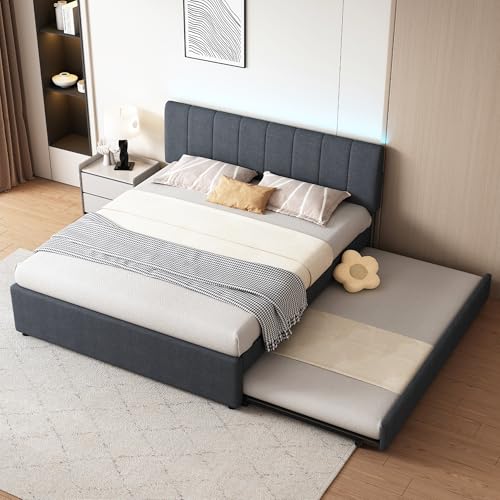
FAVSH Queen Size Upholstered Platform Bed with Pull-Out Trundle Bed | Twin Size Trundle, LED Lighting Controlled by APP, USB+Type-C Charging Ports, Linen Upholstered Bed Frame,Dark Grey
Check price on Amazon
ADORNEVE Queen Bed Frame with 6 Drawers and Trundle, Velvet Cream | Queen Trundle Bed with Storage Headboard and LED Lights for Small Apartment, Guest Room, No Box Spring Needed, Cream
Check price on Amazon
FAVSH Queen Size Upholstered Platform Bed w/Trundle Bed & 2Storage Drawers | Twin Size Trundle,Two Drawers,LED Lighting Controlled by APP, USB+Type-C Charging Ports,Linen Upholstered Bed Frame,Dark Grey
Check price on Amazon
Elyveont Queen Size Bed Frame with Twin Trundle and 2 Storage Drawers | Sherpa Upholstered Platform Bed Queen with Trundle & Nailhead Trim Headboard, Wood Slats Support, No Box Spring Needed, Grey
Check price on Amazon
ADORNEVE Full Bed Frame with 6 Drawers and Trundle, Velvet Black | Full Trundle Bed with Storage Headboard and LED Lights, Upholstered Bed for Small Apartment, Guest Room, No Box Spring Needed
Check price on Amazon
LIKIMIO Full Daybed with Trundle, Charging Station & LED, Black | Space-Saving Corner Design, Upholstered Storage Headboard, 1000LBs Sturdy Platform Metal Frame, Easy Assembly
Check price on Amazon