
Sectional Couch with Chaise and Sleeper: The Ultimate Buyer Guide
A sectional couch with chaise and sleeper delivers three living room essentials in one piece of furniture: generous everyday seating, a dedicated lounging zone, and a built-in bed for guests. This guide explains how to evaluate layouts, sizes, mechanisms, upholstery, and comfort so you can choose with confidence.
Explore Recommended ModelsWhy this combination matters: A chaise adds a lounge seat for reading, movie nights, and afternoon naps, while a sleeper mechanism turns the same footprint into a guest bed. For households that host visitors, work from home, or live in open-plan spaces, this dual-purpose design removes the need for a separate guest room or fold-away bed. The key is understanding how chaise orientation, sleeper type, and room dimensions interact before you commit.
What Is a Sectional Couch with Chaise and Sleeper?
A sectional couch with chaise and sleeper is a modular or one-piece sofa that combines three functions in a single footprint. The sectional portion provides multi-seat seating arranged in an L-shape or U-shape. The chaise is an extended seat section, usually at one end, that lets you stretch your legs without an ottoman. The sleeper mechanism, hidden inside the frame or under the seat cushions, unfolds into a flat sleeping surface.
These three-in-one designs are especially useful in multifunctional rooms. In a family room, the sectional seats the household during the day and the sleeper handles overnight guests. In a studio apartment, the chaise becomes a reading and lounging spot while the sleeper replaces a second bed. In a home office, the sofa anchors the room without sacrificing guest capacity. If you are comparing this layout with other convertible options, our guide to a L-shaped sectional with pull-out bed explains how orientation affects room flow.
Everyday seating
The sectional body seats three to six people depending on width, with the chaise adding a lounge position that feels more relaxed than a standard seat.
Guest sleeping
The sleeper mechanism converts part or all of the sofa into a flat bed, typically full or queen size, without a separate mattress to store.
Space efficiency
One piece of furniture serves living, lounging, and sleeping functions, which matters in apartments, condos, and open-plan layouts.
Design flexibility
Left-arm and right-arm chaise configurations let you match the sofa to window walls, doorways, and TV placement.
Chaise Orientation and Layout Options
The single most consequential decision is which side the chaise sits on. A chaise placed on the wrong side can block a walkway, crowd a doorway, or leave the TV at an awkward angle. Before ordering, sketch the room and mark the chaise position relative to the main traffic path.
| Layout | Best For | Trade-Offs |
|---|---|---|
| Left-arm chaise sectional | Rooms where the chaise should sit against a left wall or window | Limited flexibility if you rearrange the room later |
| Right-arm chaise sectional | Rooms with the main entry or walkway on the left | Requires accurate measurement of the right-side clearance |
| L-shaped sectional with chaise | Open-plan living and dining areas | Needs a clear corner and enough depth for the long side |
| U-shaped sectional with chaise | Large family rooms and conversation-focused layouts | Consumes more floor area and can feel enclosed in small rooms |
| Modular chaise sectional | Rentals and rooms that may be rearranged | Individual modules can shift and need periodic re-tightening |
If the chaise will sit near a window, confirm that the sleeper extension does not collide with radiators, curtains, or low sills. For rooms with a strong focal point, review our focal point arrangement guidance before finalizing the chaise side. Homeowners who prefer a compact footprint often compare a grey three-seater couch with chaise against full sectionals to see how much seating they actually gain.
Sleeper Mechanisms Compared
The sleeper mechanism determines how comfortable the bed feels, how much clearance the sofa needs when open, and how often the mechanism needs maintenance. There are four common types.
| Mechanism | How It Works | Best For |
|---|---|---|
| Pull-out (innerspring or memory foam) | A mattress folds out from under the seat on a metal frame | Frequent guests and nightly sleeping; the most bed-like feel |
| Click-clack | The backrest folds flat to create a sleeping surface | Occasional guests and smaller rooms; simple and lightweight |
| Fold-out futon | The seat and back unfold into a flat platform | Multi-use rooms and casual lounging; firm sleeping surface |
| Pop-up / trundle | A secondary sleeping platform rises or slides out | Compact rooms where the main sofa must stay in place |
Pull-out mechanisms with a dedicated mattress are the most comfortable for regular overnight use, but they require more open floor space in front of the sofa. Click-clack and fold-out designs are easier to operate and suit occasional hosting. If the sofa doubles as a primary bed, compare this layout with a dedicated sectional couch with pull-out queen bed to see whether a larger sleeping surface is worth the extra footprint. Households that want reclining comfort alongside sleeping capacity often look at a sectional couch with recliners and hide-a-bed.
Measuring Your Room and Delivery Path
Measurement mistakes are the leading cause of returns on large sectionals. Work through these checks in order before ordering.
- Room footprint: Measure the length and width of the seating area, then subtract at least 30 inches for walkways and 18 inches between the sofa and a coffee table.
- Chaise side clearance: Confirm that the chaise does not block a doorway, closet, or thermostat, and that it leaves room to walk past.
- Sleeper extension: Add the fully open sleeper depth to the sofa depth. A pull-out bed can extend 60 to 90 inches into the room.
- Doorways and hallways: Measure the narrowest door, stairwell turn, and elevator opening. Confirm the sofa's longest module fits through each.
- Ceiling and light fixtures: Check that a tall backrest or a lifted module clears low ceilings and pendant lights during delivery.
Our measurement guide walks through the full process with a printable checklist. If the room is tight, compare the footprint against a small couch to understand the minimum viable seating size before committing to a sectional.
Upholstery and Frame Materials
Upholstery determines how the sofa feels, how it wears, and how easy it is to clean. Frame construction determines whether the sofa stays sturdy after years of use and repeated sleeper conversions.
Performance fabric
Stain-resistant, tightly woven synthetic blends that handle pets, children, and daily spills. A strong default for family rooms and high-traffic spaces.
Leather and faux leather
Easy to wipe clean and resistant to odors. Genuine leather develops a patina over time; faux leather is lighter and more consistent in color.
Velvet and woven textiles
Softer and more design-forward, but require more careful cleaning. Best for low-traffic rooms or adult-only households.
Frame construction
Kiln-dried hardwood and reinforced engineered wood frames hold sleeper mechanisms best. Check for corner blocks, sinuous springs, and a supported center rail.
For rooms exposed to sunlight, confirm that the fabric is fade-resistant and consider UV-protective window treatments. If you choose leather, review our leather conditioning guidance to keep the surface supple. Pet owners should compare fabric choices in our pet owner guide before deciding.
Comfort, Cushions, and Support
Comfort in a sleeper sectional is a balance between seat softness and bed support. A sofa that feels plush to sit on may feel too soft as a bed, and a firm sleeper mattress may feel rigid during the day. Look for these features:
- High-resilience foam or pocket-coil seat cushions that recover their shape after sitting.
- Removable, reversible cushions that can be rotated to distribute wear.
- A sleeper mattress with at least medium firmness and a breathable cover for overnight comfort.
- Reinforced sleeper frame with a locking mechanism and a smooth pull-out action.
- Deep seat depth of 22 to 25 inches for lounging, and a back height that supports the shoulders.
If lumbar support matters to you, compare models with adjustable back cushions, similar to the approach in our couch with adjustable lumbar support guide. For households that also want powered recline, a leather power reclining sectional may suit the room better than a manual sleeper.
Quality Tiers Explained
Because furniture quality varies widely, it helps to classify models by tier rather than by any single specification. Use this framework consistently when comparing options.
| Tier | Typical Characteristics | Best For |
|---|---|---|
| Entry-level | Simpler frames, basic foam, click-clack or fold-out mechanisms, lighter upholstery | Occasional guest sleeping and first apartments |
| Mid-range | Hardwood or reinforced frames, pocket-coil or high-resilience foam, smoother pull-out mechanism | Everyday family use with regular overnight guests |
| Premium | Kiln-dried hardwood, performance or full-grain upholstery, premium sleeper mattress, reinforced center support | Primary living room seating with frequent hosting |
| Luxury | Custom modular configurations, top-tier foam and mattress systems, artisan upholstery, long warranty coverage | Design-led rooms and long-term daily use |
Mid-range models usually offer the most balanced combination of comfort, durability, and mechanism quality for most households. Entry-level models are a solid choice when the sleeper is used a few times a year. Premium and luxury tiers make sense when the sofa is the main seat in the home and guests stay often.
Care and Maintenance Basics
A sleeper sectional has more moving parts than a standard sofa, so maintenance should cover both upholstery and mechanism.
- Weekly: Vacuum upholstery and crevices, and rotate reversible cushions.
- Monthly: Open the sleeper mechanism fully, check hinges and bolts, and remove debris from the mattress platform.
- Quarterly: Tighten leg and frame bolts, and inspect seams for early wear.
- Spills: Blot immediately with a clean, dry cloth and follow the manufacturer's cleaning code.
- Annually: Deep clean upholstery according to the fabric type and lubricate metal mechanism joints if recommended.
For fabric-specific instructions, review our fabric cleaning and stain removal guides. Leather owners should follow the leather cleaning routine to avoid drying and cracking.
Recommended Sectional Couches with Chaise and Sleeper
Top Sectional Couch with Chaise and Sleeper Picks
⚠️ AFFILIATE DISCLOSURE: This website contains affiliate links. As an affiliate Associate, we earn from qualifying purchases. If you make a purchase through these links, we may receive a small commission at no additional cost to you. Read our full affiliate policy.

WUNSTANTE Sectional Sleeper Sofa with Pull Out Bed, Plush Corduroy 5 Seat Modular Sectional Sofa with Storage Chaise and Adjustable Backrest, Cloud Couches for Living Room, Apartment, Dark Grey
Check price on Amazon
GRUSIGN Cloud Sectional Boneless Couches for Living Room, Modular L Shaped Couch with Deep Seat Oversized Right Facing Chaise, Memory Foam Compressed Spineless 3 Seater Sofa for Apartment, Black
Check price on Amazon
93" L Shaped Sleeper Sofa Bed, Pull Out Sectional Couch with Storage Chaise/Reclining Backrest, Sectional Couches for Living Room with USB Port, Foldable Table, Cup Holder, Side Pocket, Light Grey
Check price on Amazon
Huatean Home Oversized Sleeper Sofa Couch, Sectional Sofa Bed, Black | 110 inch 2 in 1 Pull Out Couch with Double Storage Chaise, Sectional Sleeper Sofa Bed with Side Pocket for Living Room
Check price on Amazon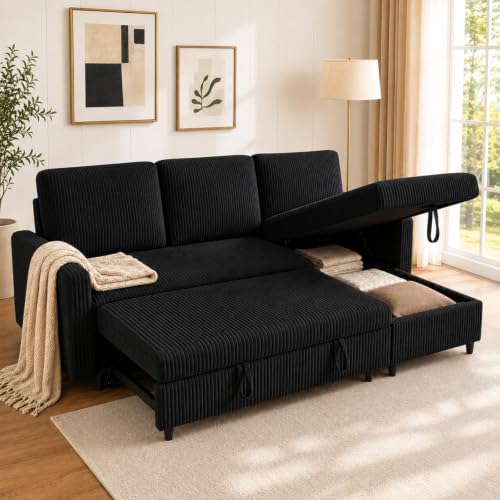
Walsunny 77" Sectional Sleeper Sofa with Pull Out Bed, Modern L-Shaped Corduroy Convertible Couch with Storage Chaise, Reversible 3-Seat Sofa Bed for Small Spaces, Apartment, Office, Black
Check price on Amazon
Eafurn Tufted Sectional Sleeper Sofa Pull Out Couch Bed Modern Sofabed | Sectional Sleeper Sofa with Pull Out Bed, L Shaped Couch with Reversible Chaise Lounge, Pull Out Couch for Living Room
Check price on Amazon
WorthFurni 92" Modular Sectional Sofa with Pull Out Bed, L Shaped 4 Seat Sectional Sleeper Couch with Storage Chaise, Machine Washable Chenille Cloud Couches for Living Room, Apartment (Dark Gray)
Check price on Amazon
JOCISLAND 104" Sofa Bed, Sectional Sleeper Sofa with Pull Out Bed-Gray | U Shaped 7 Seat Sectional Couches for Living Room, Sleeper Sofa with Storage, Side Pockets & Plush Armrest Pillow
Check price on AmazonFrequently Asked Questions
What is a sectional couch with chaise and sleeper?
It is a multi-function sofa that combines an L-shaped or U-shaped seating layout, an extended chaise section for lounging, and a built-in sleeper mechanism that converts part or all of the sofa into a bed for overnight guests.
How much floor space does a chaise sleeper sectional need?
Most chaise sleeper sectionals require a footprint of roughly 100 to 130 inches on the long side and 60 to 90 inches on the short side. Always measure the room, doorways, and the extended sleeper depth before ordering.
Which sleeper mechanism is best for daily use?
A pull-out mechanism with a memory-foam or innerspring mattress is generally more comfortable for nightly use. A click-clack or fold-out futon mechanism is simpler and works better for occasional guest sleeping.
Can a chaise sleeper sectional replace a guest bed?
Yes, in many households it can. A pull-out sleeper with a full or queen mattress provides a comfortable surface for short stays, while the chaise and sectional body handle everyday seating. For longer stays or frequent hosting, a dedicated bed may still be preferable.
How do I clean a sectional with chaise and sleeper?
Vacuum upholstery weekly, rotate and flip removable cushions, blot spills immediately with a clean cloth, and follow the manufacturer's cleaning code. For deeper maintenance, explore our couch care and maintenance guides.
Final takeaway: A sectional couch with chaise and sleeper is one of the most practical furniture investments for a multifunctional home. Choose the chaise side based on room flow, match the sleeper mechanism to how often guests stay, measure the full open footprint before ordering, and prioritize a mid-range or premium tier for regular use. With those decisions settled, the sofa will serve as seating, lounge, and guest bed for years.