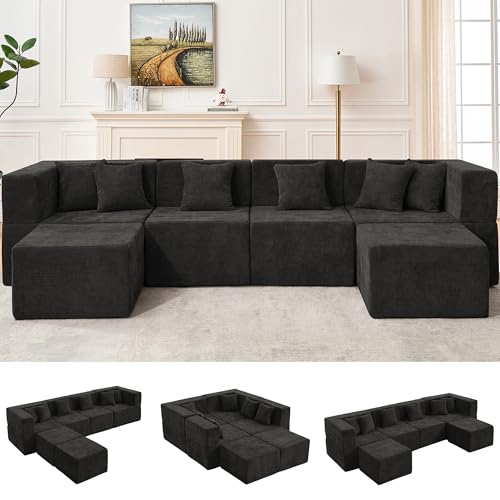
What Is a Sectional Couch with Individual Pieces?
A sectional couch with individual pieces — often called a modular sectional — is a seating system made of discrete units rather than one welded frame. Each module has its own base, cushion, and connector hardware. Common modules include a left-arm seat, a right-arm seat, an armless middle seat, a corner wedge, a chaise, and a standalone ottoman.
Because the pieces are independent, the same set can form an L-shape in one room and a U-shape or straight sofa in another. This is the core appeal of a sectional couch that you can rearrange: the furniture adapts to the floor plan instead of the other way around. Many modern sets also allow a sectional couch that you can change by swapping covers, arms, or colors without replacing the core frame.
Key Benefits of Modular Sectional Seating
Reconfigurable Layout
Rearrange modules into an L-shape, U-shape, or straight run as your room or needs change — no tools required on most connector systems.
Easy to Move
Individual pieces fit through narrow doorways, stairwells, and elevators far more easily than a monolithic sectional frame.
Replaceable Parts
If one cushion or module wears out, you can often replace just that piece instead of retiring the whole sofa.
Scalable Over Time
Start with a three-piece set and add modules later as your household or entertaining habits grow.
Better Fit for Awkward Rooms
Corners, angled walls, and open floor plans are easier to solve when you can compose the exact footprint you need.
Movement-Friendly
When you relocate, modular pieces travel as separate items — a practical advantage for renters and frequent movers.
Common Modular Configurations Explained
Most modular systems are built from a small vocabulary of pieces. Understanding these building blocks helps you compare listings and predict how a set will behave in your room.
- Left-arm and right-arm seats — end units that give the sectional a finished armrest on one side.
- Armless middle seats — the workhorses that extend seating length and lock between end units.
- Corner wedges — angled pieces that turn a straight run into an L-shape or U-shape.
- Chaise modules — extended-depth seats for lounging; often paired with a sectional couch with chaise lounge configuration.
- Ottomans — movable footrests or extra seats, frequently part of a sectional couch with ottoman bundle.
- Storage and sleeper modules — some pieces include hidden storage or a pull-out bed; see sectional couch with bed and storage options.
If you already know your preferred orientation, guides like the sectional with left-arm facing chaise and sectional with right-arm facing chaise explain how to read those labels before ordering.
How to Measure Before You Buy
Modular seating is forgiving, but the individual pieces still need to fit your space and each other. Work through these steps before committing:
-
Map the room footprint
Mark the maximum width and depth you can dedicate to seating, leaving at least 30–36 inches for main walkways and 14–18 inches between the sofa and a coffee table.
-
Check doorway and stair clearance
Measure the narrowest door, hallway, and stair turn on the delivery path. Individual modules are easier to move, but each piece must still clear these pinch points.
-
Confirm module dimensions
Compare seat width, seat depth, and back height across modules. Reference a sectional couch dimensions guide to interpret spec sheets accurately.
-
Plan the connector layout
Decide which modules sit adjacent and whether the system uses brackets, clips, or gravity alignment. Note whether arm pieces are required at both ends.
-
Account for future changes
If you plan to add modules later, confirm the collection is still in production or that spare pieces are available on the secondary market.
Materials and Build Quality by Tier
Modular sectionals span the full quality spectrum. The table below summarizes what to expect at each market position, using neutral tier descriptors rather than figures.
| Tier | Frame & Connectors | Cushion Construction | Upholstery | Best For |
|---|---|---|---|---|
| Entry-Level | Particle board or thin hardwood; simple gravity or plastic clip connectors | Foam with basic fiber wrap; lower-density cores | Standard polyester or microfiber; limited color range | Occasional use, starter apartments, temporary setups |
| Mid-Range | Kiln-dried hardwood or engineered wood; metal brackets and reinforced joints | High-resilience foam with pocket coils in seat cushions | Performance fabrics, durable weaves, removable covers on select modules | Everyday family use, balanced durability, flexible layouts |
| Premium | Solid hardwood frames; heavy-duty steel connector systems | Multi-layer foam and coil hybrids; individually wrapped springs | Premium performance fabrics, top-grain leather options, tight tailoring | High-traffic living rooms, long-term investment, design-led spaces |
| Luxury | Bench-made hardwood; precision-machined connectors and locking mechanisms | Custom foam densities, down-blend wraps, hand-tied spring systems | Designer textiles, full-grain leather, bespoke cover programs | Custom interiors, flagship living rooms, collector-grade furniture |
As a rule of thumb, moving from entry-level to mid-range typically brings noticeably sturdier connectors and denser cushion cores — the two factors that most affect how a modular sectional feels after years of daily use. Premium and luxury tiers add refinement in tailoring, fabric performance, and long-term serviceability.
Fabric, Leather, and Performance Upholstery
The upholstery choice matters more on modular pieces because each module can wear differently depending on traffic. Consider these directions:
- Performance fabric — stain-resistant weaves that suit households with kids or pets; look for removable, washable covers where available.
- Textured weaves — bouclé, chenille, and linen blends add visual warmth but need more careful cleaning.
- Leather — top-grain and full-grain leather age gracefully and wipe clean easily; bonded leather is best avoided on high-use modules.
- Velvet — rich and tactile, but directional pile shows marks; best reserved for lower-traffic rooms or premium builds.
If easy maintenance is a priority, explore sectional couch with washable cushion covers and sectional couch covers options, which let you refresh individual modules without replacing the set. For full replacement of worn cushions, see sectional couch cushions.
Layout Ideas for Modular Sectionals
Because you can recompose the pieces, layout planning becomes an exercise in zoning rather than fitting one fixed shape. Three reliable patterns:
- L-shape with chaise — anchor the room against two walls and place the chaise on the side with the best light or view. A right-arm facing L-shaped sectional is a common starting point.
- U-shape conversation zone — use two corner wedges and facing seats to create an enclosed seating area around a coffee table or fireplace.
- Open-plan divider — place the sectional perpendicular to the TV wall to separate living and dining zones without building a wall.
For tight footprints, a sectional couch for studio apartment layout often uses a two- or three-module setup with an ottoman that doubles as a coffee table. Pair the seating with a correctly sized rug — a rug size for couch with chaise guide helps prevent the floating-furniture look.
Rearranging, Expanding, and Maintaining Modular Pieces
One of the practical advantages of a sectional couch that you can rearrange is long-term serviceability. A few habits keep modular sets performing well:
- Rotate cushions — flip and rotate seat and back cushions every few months to distribute wear evenly.
- Re-tighten connectors — check brackets and clips periodically, especially after moving modules.
- Clean by module — treat stains on the affected piece immediately rather than waiting for a full-sofa clean.
- Protect high-traffic ends — end modules and chaise fronts take the most abrasion; a throw or cover can extend their life.
If you plan to expand later, note the collection name and module codes now — they make finding matching pieces far easier. For buyers considering the secondary market, a second-hand sectional couch can be a sensible way to add matching modules, provided you verify dimensions and fabric codes.
Who Should Choose a Modular Sectional?
A sectional couch with individual pieces is a strong fit if any of the following describe you:
- You rent or expect to move within a few years.
- Your living room has an awkward corner, angled wall, or open plan.
- You entertain often and want seating that adapts to group size.
- You prefer to invest gradually, adding modules over time.
- You want the option to replace a single worn piece rather than the whole sofa.
It is a weaker fit if you want a single, seamless silhouette with no visible seams between pieces, or if you rarely change your furniture layout and prefer the simplest possible assembly.
Final Checklist Before You Order
-
Confirm the module list
Verify exactly which pieces are included — arm seats, armless seats, corner, chaise, ottoman — and whether connectors are supplied.
-
Match arms to orientation
Left-arm and right-arm pieces are not interchangeable; double-check facing labels against your room layout.
-
Review cushion and cover policies
Check whether covers are removable and whether replacement cushions or covers are sold separately.
-
Plan delivery path
Even modular pieces need a clear route; measure doors, hallways, and stair turns in advance.
-
Keep documentation
Save the collection name, module codes, and fabric name so future additions or replacements match.