
Couch With Pull Out Footrest: The Complete Guide
Everything you need to know about sofas with pull-out footrests — how the mechanisms work, which upholstery suits your household, how to plan your layout, and how to choose the right tier for your living room.
Explore Top PicksWhy this guide matters: A couch with a pull-out footrest blends everyday seating with on-demand relaxation. Unlike fixed recliners, the footrest deploys only when you want it — keeping the silhouette clean during the day and comfortable in the evening. This guide walks you through the mechanism types, materials, sizing, and practical considerations so you can decide with confidence before you shop.
What Is a Couch With Pull Out Footrest?
A couch with a pull-out footrest is a sofa built with an integrated, extendable leg-rest mechanism. When fully deployed, the footrest creates a chaise-like surface that supports your legs and reduces pressure on your lower back. When retracted, the couch looks like a standard sofa — no protruding parts, no visual clutter.
These couches differ from traditional recliners in one important way: the footrest is a distinct feature that can be extended independently of the backrest on many models. That means you can recline the back, extend only the footrest, or combine both for full lounge comfort. For households that want flexibility without dedicating an entire wall to reclining furniture, this category is a strong fit.
If you are still comparing broader configurations, our guide to a couch with chaise and pull out ottoman explains how a fixed chaise differs from a deployable footrest, and where each layout works best.
How the Pull-Out Footrest Mechanism Works
There are three common mechanism families used in couches with pull-out footrests. Understanding them helps you match the couch to your daily habits and to the people who will use it.
1. Manual Push-and-Pull Mechanism
The simplest and most common design. You pull a handle or lift the seat edge, and the footrest extends on a metal linkage. These mechanisms are straightforward to maintain and tend to have fewer electronic failure points. Entry-level and mid-range models frequently use this system.
2. Lever-Actuated Mechanism
A side lever releases a spring-loaded or counterbalanced footrest. Lever-actuated models typically offer smoother movement than basic manual systems and are common in mid-range to premium tiers. The lever is usually recessed into the arm or seat side to avoid snagging.
3. Motorized or Power Footrest
Push-button or app-controlled motors extend the footrest at the touch of a switch. Power mechanisms are the smoothest option and are often paired with power reclining backs. They sit in the premium and luxury tiers, and they require access to a power outlet near the couch. Motorized systems also tend to have more components to service over time.
Upholstery and Build Materials That Matter
The footrest area takes more friction than the rest of the couch because your legs and feet rest on it every time it deploys. Choose a material that balances comfort with abrasion resistance.
Fabric Options
- Performance fabric: Tightly woven synthetics designed to resist spills and staining. A strong choice for households with children or pets.
- Microfiber: Soft, dense, and easy to spot-clean. Mid-range microfiber couches often feel more substantial than their tier suggests.
- Woven linen blends: Breathable and visually textured, but less forgiving against abrasion. Better for low-traffic living rooms.
- Velvet: Luxurious hand-feel, but the nap can flatten on a frequently used footrest. Reserve velvet for formal or occasional-use spaces.
Leather and Faux Leather
Leather resists wear well and wipes clean easily, making it a practical match for a footrest that sees daily use. Top-grain leather sits in the premium tier; bonded leather is more common in entry-level builds but tends to show wear sooner along high-friction edges. If you are comparing leather tones for a warm interior, our article on brown leather couches covers how undertones affect room styling.
Frame and Linkage
Look for kiln-dried hardwood or high-grade steel frames. The footrest linkage itself should be reinforced — thin-gauge metal linkages are the first component to fail on lower-tier couches. Heavy-duty linkage with a rust-proof finish is a marker of a well-built model. If durability is your top priority, our guide on couches that last a long time outlines the construction signals worth checking.
Comparing Pull-Out Footrest Tiers
The table below uses neutral tier descriptors instead of numeric figures. Use it to map your priorities — mechanism smoothness, material resilience, and long-term serviceability — against where a model sits in the market.
| Tier | Mechanism | Best For | Material Signals | Long-Term Outlook |
|---|---|---|---|---|
| Entry-Level | Manual push-pull | Guest rooms, occasional lounging | Microfiber, bonded leather | Solid starter choice; expect basic linkage |
| Mid-Range | Lever or refined manual | Primary family living room | Performance fabric, top-grain leather | Balanced tier with smoother operation |
| Premium | Power or premium lever | Daily use, dedicated relaxation space | Full-grain leather, high-grade steel | Worthwhile long-term investment |
| Luxury | Power with memory presets | Home theater, formal lounge | Premium hides, reinforced frames | Flagship tier with maximum refinement |
Tier descriptors reflect relative market positioning, not absolute quality. A well-specified mid-range couch can outperform a poorly built premium model.
Space Planning and Layout Considerations
A pull-out footrest adds functional footprint when deployed. Plan for roughly 20–28 inches of clearance in front of the couch so the footrest can extend fully without hitting a coffee table or walkway.
Small Living Rooms
In compact rooms, a couch with a pull-out footrest can replace both a standard sofa and a separate ottoman. That consolidation frees up floor area. If you are furnishing a tight space, our guides on couches for small spaces and couches for a small living room cover measurement strategies and visual tricks that keep the room feeling open.
Multi-Function Rooms
If the living room doubles as a guest space, a footrest couch is a natural companion to a sleeper configuration. Compare options in our article on a couch with pull out bed and chaise to see how sleep surfaces and footrests can coexist in a single piece.
Clearance and Flow
Keep walkways at least 30 inches wide on the main traffic side. Place the couch so the footrest extends toward the room’s focal point — typically the TV or fireplace — rather than into a doorway. If you are working through a full arrangement, our living room layout guides can help you sequence the sofa, tables, and lighting.
Who Should Choose a Pull-Out Footrest Couch?
This configuration suits a wide range of households, but it is especially strong in a few scenarios:
- People who recline intermittently: If you want leg support some evenings but prefer a clean sofa profile the rest of the time, a retractable footrest is more flexible than a fixed chaise.
- Small-space dwellers: One piece replaces a sofa plus an ottoman, reducing clutter.
- Households with older adults: Leg elevation reduces pressure on knees and lower back. Look for models with firm seat support and easy-to-reach handles.
- Home theater setups: Footrest couches pair naturally with media rooms. For a deeper look at seating configurations, see our guide on couches with ottoman.
If you prefer a couch that also converts for overnight guests, explore couches with pull out ottoman — the mechanism families overlap, and the right choice depends on how often you host.
Recommended Couch With Pull Out Footrest
⚠️ AFFILIATE DISCLOSURE: This website contains affiliate links. As an Amazon Associate, we earn from qualifying purchases. If you make a purchase through these links, we may receive a small commission at no additional cost to you. Read our full affiliate policy.

Eafurn Tufted Sectional Sleeper Sofa Pull Out Couch Bed Modern Sofabed | Sectional Sleeper Sofa with Pull Out Bed, L Shaped Couch with Reversible Chaise Lounge, Pull Out Couch for Living Room
Check price on Amazon
Ihanherry 86" Modular Sectional Sofa with Pull Out Bed, 4-Seater L Shaped Sectional Sleeper Couch with Storage Ottoman, Chenille Convertible Couches for Living Room, Apartment (Beige)
Check price on Amazon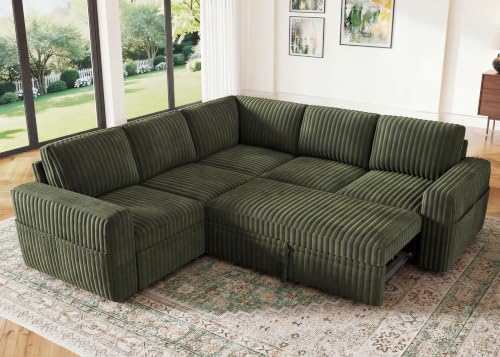
HONBAY Corduroy L Shaped Sectional Sleeper Sofa with Pull Out Bed,Green | modular design,built-In storage, couches for living room and apartment guest sleeping space,removable cushions
Check price on Amazon
KCGKCG 93" L Shaped Sleeper Sofa Bed, Pull Out Sectional Couch with Storage Chaise/Reclining Backrest, Sectional Couches for Living Room with USB Port, Foldable Table, Cup Holder, Side Pocket, Black
Check price on Amazon
108'' Modular Sectional Sleeper Sofa Couches for Living Room, Dark Grey | L/U Shaped Sleeper Sofa, Pull Out Couch Bed, Hidden Storage, Modular Design, Comfy Corduroy, Removable Cover, Movable Ottoman
Check price on Amazon
Dreamzie 65'' Convertible Sleeper Sofa Bed with Swivel Side Table, Chenille Pull Out Couch for Living Room, Loveseat Sleeper Couch with Hidden Storage Space | Charging Port | Cup Holders, Grey
Check price on Amazon
DURASPACE Sofa Bed, Sleeper Sofa Couch with Pull Out Bed for Living Room, L Shaped Couch with USB, Storage Chaise, Cup Holder(Beige)
Check price on Amazon
WUNSTANTE Sectional Sleeper Sofa with Pull Out Bed, Plush Corduroy 5 Seat Modular Sectional Sofa with Storage Chaise and Adjustable Backrest, Cloud Couches for Living Room, Apartment, Dark Grey
Check price on AmazonBuying Checklist: What to Verify Before You Decide
Use this checklist as a quick verification pass before committing to any model. It focuses on the details that separate a satisfying purchase from a frustrating one.
Mechanism and Comfort
- Confirm the footrest extends and locks without wobble.
- Check that the seat cushion does not compress excessively when the footrest is deployed.
- Verify the backrest recline angle is comfortable for reading and watching TV.
- Ask whether the mechanism is serviceable or replaceable if it fails.
Materials and Build
- Review the upholstery’s abrasion rating — especially for the footrest panel.
- Confirm the frame material and joint construction.
- Check the linkage gauge and finish (rust-proof is preferable).
- If leather, confirm whether it is top-grain, full-grain, or bonded.
Dimensions and Delivery
- Measure doorways and stair turns before ordering. Our guide on couches that fit through narrow doors can help you avoid a delivery surprise.
- Confirm the deployed footrest depth and plan clearance accordingly.
- Check whether assembly is required and what tools are included.
Household Fit
- For pet owners, favor tightly woven performance fabric or leather.
- For households with children, confirm the fabric is cleanable and the mechanism has no exposed pinch points.
- For heavier users, verify the weight rating and seat support structure. Our article on couches for heavy people covers reinforced construction cues.
Care and Maintenance for Pull-Out Footrest Couches
A footrest mechanism is a moving part, and moving parts benefit from routine attention. A few simple habits extend the life of the couch significantly.
- Vacuum the mechanism zone monthly: Dust and debris accelerate linkage wear.
- Lubricate per the manufacturer’s guidance: Use only the recommended lubricant — household oils can attract grit.
- Avoid standing on the footrest: It is designed for leg support, not body weight.
- Rotate seat cushions: Even wear keeps the seat level and the footrest aligned.
- Treat stains promptly: The footrest panel is a high-contact area. Our cushion covers guide explains removable cover options that make cleaning easier.
If the upholstery begins to show wear, re-covering the footrest panel early prevents the damage from spreading to the seat. For structural issues, address them before they compound — a small linkage adjustment is far simpler than a full replacement.
Frequently Asked Questions
Is a pull-out footrest couch the same as a recliner?
Not exactly. A recliner typically couples the backrest recline and footrest into one motion. A pull-out footrest couch often lets you deploy the footrest independently, which offers more seating positions and a cleaner profile when retracted.
How much clearance does the footrest need?
Plan for roughly 20–28 inches of open floor in front of the couch. Exact requirements vary by model, so check the deployed depth in the product specifications before you commit to a layout.
Can a pull-out footrest couch work in a small living room?
Yes — it often works better than a fixed chaise because the footrest disappears when not in use. Pair it with a compact coffee table or a lift-top table that can move aside when the footrest deploys.
Which upholstery is best for daily footrest use?
Performance fabric and top-grain leather are the most practical choices. Both resist abrasion and clean up well. Velvet and loosely woven linen blends look refined but show wear faster in high-friction zones.
Manual or power footrest — which should I choose?
Manual mechanisms are simpler and have fewer failure points. Power mechanisms are smoother and easier for users with limited mobility. If the couch will be used daily by someone who benefits from one-touch operation, the premium tier is worth considering.
How do I keep the mechanism working smoothly?
Vacuum the linkage area monthly, follow the manufacturer’s lubrication schedule, and avoid overloading the footrest. If you notice grinding or uneven extension, stop using the mechanism and have it inspected before the misalignment worsens.
Ready to Choose Your Couch With Pull Out Footrest?
You now have the framework: match the mechanism to your daily habits, choose upholstery that suits your household, and plan clearance before you buy. Browse the recommended models above, or continue exploring related configurations to compare options side by side.
View Recommended Models