
Couches with Storage for Small Spaces
Turn your compact living room into a clutter-free haven. Discover storage sofas with hidden compartments, pull-out sections, and smart designs that make every square foot count.
Explore Storage CouchesWhy storage couches make sense for compact homes: In a small living room, every piece of furniture must earn its place. A couch with built-in storage does double duty — it gives you comfortable seating while quietly absorbing throw blankets, remote controls, magazines, kids' toys, and seasonal linens. Instead of adding a separate storage ottoman or shelving unit, you reclaim floor space and keep your room visually calm.
This guide walks you through the types of storage couches available, how to evaluate their build quality, what to look for when measuring your space, and which designs suit different living situations. Whether you're furnishing a studio apartment, a dorm, or a compact family room, you'll find practical guidance here to choose a couch that fits both your floor plan and your daily life.
Types of Storage Couches for Compact Rooms
Storage couches are not a single category — they come in several configurations, each with distinct advantages depending on your room layout and what you need to store. Understanding these variations helps you narrow down the right fit before you start comparing specific models.
1. Under-Seat Storage Sofas
These couches feature a lift-up seat cushion or a flip-open panel beneath the seating area, revealing a hidden compartment. It's the most common storage design and works well for stowing blankets, pillows, books, and small electronics. The compartment depth varies — some offer only a shallow tray for remotes and magazines, while others provide a deep well that can hold folded bedding. Under-seat storage is particularly useful in rooms where you want to keep surfaces clear and avoid visible clutter.
2. Storage Ottomans Integrated into Sectionals
Some modular and sectional couches include a built-in ottoman section with a lift-off lid. This is ideal if you want a footrest that also doubles as a storage bin. Integrated storage ottomans are especially practical in open-plan layouts where the couch serves as both seating and a subtle room divider. If you like the idea of a couch with a movable ottoman piece, our guide to couches with large ottomans covers additional configurations worth considering.
3. Pull-Out Storage Drawers
A less common but highly functional design, these couches have drawers built into the base that slide out like a dresser. They're excellent for storing bulkier items such as extra throws, board games, or even shoes. Drawer-based storage keeps items accessible without lifting heavy cushions, which can be a benefit for older users or anyone who prefers not to bend and lift. The trade-off is that drawers require clearance in front of the couch, so they work best in rooms with a bit of breathing room around the seating area.
4. Storage Chaise and L-Shaped Couches
An L-shaped couch with a storage chaise combines extended lounging space with a hidden compartment under the chaise section. This is a smart choice for small apartments because the chaise adds seating capacity without requiring a separate ottoman. If you're considering this layout, our article on L-shaped couches for small spaces breaks down measurement considerations and placement strategies. You can also explore couches with a chaise lounge for more style options.
5. Storage Loveseats
For very tight spaces — studio apartments, home offices, or reading nooks — a loveseat with under-seat storage offers a compact footprint without sacrificing utility. These two-seater couches are easier to maneuver through narrow doorways and fit comfortably against shorter walls. If a loveseat sounds like the right scale for your room, you may also want to look at loveseat options that prioritize both comfort and space efficiency.
What to Look for in a Storage Couch
Not all storage couches are built to the same standard. The storage mechanism, frame construction, and upholstery quality all affect how well the couch performs over time. Here are the key factors to evaluate before you commit.
- Storage mechanism type: Lift-up lids with gas-spring hinges are easier to open and stay open safely. Flip-up panels without a hinge require you to hold the lid while accessing the compartment — less convenient for daily use. Drawers on metal glides tend to be smoother than wooden slides.
- Compartment depth and accessibility: Measure the internal dimensions of the storage area. A compartment that's too shallow won't hold much beyond a few magazines; one that's too deep can be awkward to reach into. Consider whether the opening is wide enough to fit the items you plan to store.
- Frame and joint construction: A solid hardwood or engineered wood frame with reinforced corner blocks will hold up better than particleboard. Storage compartments put extra stress on the frame, so look for kiln-dried hardwood or high-density engineered wood with glued and screwed joints.
- Upholstery durability: Performance fabrics and tight-weave textiles resist wear and are easier to clean. If the couch will be used by kids or pets, consider a fabric with a high rub count or a removable, washable cover. Our guide to durable couch construction explains what to look for in more detail.
- Cushion support over the storage lid: The seat cushion that sits over a storage compartment needs adequate foam density and a sturdy support panel underneath. A thin or poorly supported lid can sag over time, creating an uncomfortable seat and a weak spot in the frame.
- Weight and maneuverability: Storage couches are generally heavier than standard couches because of the added structure. Check the product weight and consider whether you'll need help moving it through doorways or up stairs. A modular design that separates into pieces can make delivery and assembly easier.
Sizing and Placement Tips for Small Rooms
A storage couch solves the clutter problem, but it still needs to fit your room comfortably. Before you shop, take these measurements and plan your layout.
Measure your available floor space
Mark out the couch's footprint on your floor using painter's tape. Leave at least 18 inches of walkway clearance on the sides and front of the couch where people will pass through. If the couch has drawers, add the drawer extension depth to your clearance calculation. For a full measurement walkthrough, see our couch measurement guide.
Account for doorway and hallway width
A couch that fits your living room won't do you any good if it can't make it through the front door or around a hallway corner. Measure the narrowest point along the delivery path — door frames, stairwells, and hallway turns — and compare it to the couch's packaged dimensions. Modular couches that ship in separate boxes are often easier to navigate through tight spaces.
Choose a scale that suits the room
In a small room, a couch that's too large will dominate the space and make it feel cramped. A general rule is that the couch should occupy no more than two-thirds of the wall it sits against. A loveseat or a compact two-seater with storage is often a better fit for narrow rooms than a full-size sofa. If your room is particularly tight, our guide to L-shaped couches for small spaces covers corner-friendly configurations that maximize seating without overwhelming the floor plan.
Think about traffic flow and focal points
Position the couch so it faces the room's natural focal point — a TV, a fireplace, or a window with a view. Leave enough space behind the couch for a walkway if the room has a second entrance. If you're working with an open floor plan, a storage couch with a finished back can float in the middle of the room and act as a subtle divider between living and dining zones.
Quality Tiers: A Framework for Comparison
Storage couches span a wide range of construction quality. To compare models without getting lost in specifications, it helps to group them into tiers based on materials, mechanism quality, and expected lifespan. The table below outlines what each tier typically offers.
| Tier | Best For | Typical Construction | Storage Mechanism |
|---|---|---|---|
| Essential Tier | Rentals, dorms, first apartments, temporary setups | Engineered wood frame, lighter foam density, basic upholstery | Simple flip-up panel or lift-off lid without gas springs |
| Balanced Tier | Long-term apartment living, family rooms, everyday use | Hardwood or high-density engineered wood, medium-density foam, performance fabric options | Gas-spring lift-up lid or smooth-glide drawer mechanism |
| Premium Tier | Primary living rooms, households with kids and pets, frequent use | Kiln-dried hardwood, high-resilience foam, durable performance textiles | Reinforced gas-spring hinge, soft-close drawer glides, finished interior compartment |
| Luxury Tier | Design-focused interiors, custom configurations, long-term investment | Solid hardwood joinery, premium high-resilience foam or down-blend cushions, top-grain leather or designer fabric | Precision-engineered lift mechanism, custom-fitted storage inserts, fully finished compartment interior |
A note on comparing tiers
Higher tiers generally offer smoother storage mechanisms, more durable frame construction, and better cushion support over the storage lid. A balanced-tier model often provides the best combination of everyday durability and mechanism reliability for most small-space households. Entry-level models can work well for temporary or light-use situations, but the storage hinge and frame may not hold up to daily opening and closing over many years.
Recommended Couches with Storage for Small Spaces
⚠️ AFFILIATE DISCLOSURE: This website contains affiliate links. As an affiliate Associate, we earn from qualifying purchases. If you make a purchase through these links, we may receive a small commission at no additional cost to you. Read our full affiliate policy.
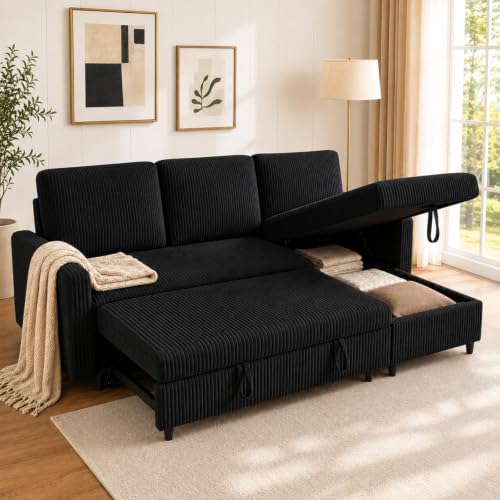
Walsunny 77" Sectional Sleeper Sofa with Pull Out Bed, Modern L-Shaped Corduroy Convertible Couch with Storage Chaise, Reversible 3-Seat Sofa Bed for Small Spaces, Apartment, Office, Black
Check price on Amazon
POYISOU Convertible Sectional Couches for Living Room, 3 Seats L Shaped Sofa with Storage Ottoman and 2 Cup Holders, Modern Corduroy Couch Small Sofas for Small Space Apartment Office, Black
Check price on Amazon
Modular Sectional Couch with Storage, 80" Cloud 3 Seater Sofa, Light Grey | Sectional Couches with Armrests Pollow, Hidden Storage Space, Modern Deep Seat Chenille Sofas for Living Room
Check price on Amazon
KEIKI 73" Convertible Pull Out Sofa Bed, Modern Corduroy Sleeper Couch with USB Charging Ports, Cup Holders, Hidden Storage and Swivel Table for Small Spaces and Movie Nights
Check price on Amazon
Yaheetech L Shaped Pull Out Sectional Sofa Bed with Storage, Black | Pull Out Sofa Bed Convertible Couch with Trundle Sleeper and Hiden Compartment for Small Spaces and Living Rooms
Check price on Amazon
Korser 61" Loveseat Sofa Couch with Storage, Modern Love Seat Couches for Living Room, Small Couch for Bedroom with USB Charging, Comfy Chenille Cloud Couch for Small Spaces, Dorm, Office, Beige
Check price on Amazon
Dreamzie 65'' Convertible Sleeper Sofa Bed with Swivel Side Table, Chenille Pull Out Couch for Living Room, Loveseat Sleeper Couch with Hidden Storage Space | Charging Port | Cup Holders, Navy Blue
Check price on AmazonMatching Storage Couches to Your Living Situation
The right storage couch depends as much on how you live as it does on the size of your room. Here are a few common scenarios and the features that tend to work best for each.
Studio apartments
In a studio, the couch often serves as the boundary between living and sleeping zones. A compact loveseat with under-seat storage keeps the footprint small while providing a place to tuck away bedding, pillows, and everyday items. A couch with a chaise section can double as a lounging spot and a subtle room divider. If you need overnight guest capacity, consider a storage couch that also converts into a bed — our guide to couches you can sleep on covers convertible options.
Dorms and student housing
Dorm rooms are tight on space and often have limited built-in storage. A storage couch or storage ottoman is a practical way to keep the room organized without adding extra furniture. Look for lightweight models that are easy to move during room inspections or end-of-year move-outs. A dorm room couch with storage can pull double duty as seating and a spot for books, snacks, and electronics.
Family rooms with kids
Families need storage that can handle toys, games, and craft supplies. A couch with a deep under-seat compartment or a pull-out drawer makes cleanup quick and keeps small items out of walkways. Choose a performance fabric that resists stains and is easy to wipe clean. If the couch will see heavy daily use, a premium-tier model with a reinforced hinge mechanism is a worthwhile investment in long-term durability.
Pet-friendly homes
If pets share your couch, look for tight-weave fabrics that resist snags and a storage compartment that closes securely so curious noses can't get into it. Removable, washable cushion covers are a practical bonus. Our guide to durable couch construction covers fabric and frame considerations for pet households in more detail.
Multipurpose rooms
When a single room serves as a living room, home office, and guest space, a storage couch helps keep the room flexible. A sleeper couch with storage combines three functions — seating, sleeping, and storage — in one piece. If that sounds like the right fit, explore couches with beds in them for models that include hidden bedding compartments. You might also consider a double bed sleeper couch if guest capacity is a priority.
Keeping Your Storage Couch in Good Condition
A storage couch has a few maintenance needs beyond regular upholstery care. The storage mechanism and compartment interior benefit from periodic attention to keep everything working smoothly.
- Clean the compartment periodically: Dust and crumbs can accumulate inside the storage area. Vacuum the interior every few months and wipe down hard surfaces with a damp cloth.
- Check the hinge and lid alignment: Over time, gas springs can lose tension and lids can shift out of alignment. Tighten any visible screws and lubricate metal hinges sparingly with a silicone-based lubricant if they start to squeak.
- Rotate and flip cushions: If your couch has removable seat cushions, rotate them regularly to distribute wear evenly. This is especially important for the cushion that sits over the storage lid, as it bears the most direct weight.
- Avoid overloading the compartment: Storage compartments are designed for household items, not heavy equipment. Keep weight within the manufacturer's recommended limit to avoid stressing the frame or hinge.
- Keep the interior dry: If you live in a humid climate, place a small moisture-absorbing packet inside the compartment to prevent mustiness. Avoid storing damp items in the storage area.
For a broader overview of upholstery cleaning methods, see our guides to fabric cleaning and dry cleaning upholstery. If your couch has leather upholstery, the leather cleaning guide covers conditioning and stain prevention.
Common Mistakes When Buying a Storage Couch
A few avoidable missteps can turn a smart purchase into a source of frustration. Here's what to watch out for.
- Skipping the doorway measurement: A couch that fits the living room but not the front door is a costly mistake. Measure every doorway and hallway turn along the delivery path before ordering.
- Overlooking the storage lid's cushion support: The seat cushion over a storage compartment needs a sturdy support panel underneath. If the lid feels flimsy or the cushion sinks when you sit on it, the couch may not hold up to daily use.
- Choosing a couch that's too large for the room: A storage couch that dominates the floor plan defeats the purpose of saving space. Stick to the two-thirds wall rule and leave room for walkways.
- Ignoring the mechanism quality: A stiff hinge or a drawer that sticks will make you avoid using the storage altogether. Test the mechanism in person if possible, or read reviews that specifically mention hinge and drawer performance.
- Forgetting about future needs: If your household is growing or you frequently host guests, a couch with both storage and a sleeper function may serve you better than a storage-only model. Think about how your needs might change over the next few years.
Frequently Asked Questions
How much weight can a storage couch compartment hold?
Weight capacity varies by model and construction tier. Entry-level models typically have lighter-duty compartment bases, while balanced and premium tiers use reinforced panels and heavier-duty hinges. Check the manufacturer's specifications for the storage compartment's weight limit and keep stored items within that range. As a general practice, avoid storing dense, heavy items like tools or large book collections in an under-seat compartment; reserve it for blankets, pillows, clothing, and lightweight household items.
Can I use a storage couch as my primary seating in a small living room?
Yes — storage couches are designed for everyday seating. The key is choosing a model with adequate cushion density and a well-supported storage lid. A balanced-tier or premium-tier couch with high-resilience foam and a reinforced lid will provide comfortable seating for daily use. If the couch will be the only seating in the room, prioritize cushion quality and frame durability over storage capacity. A couch that's uncomfortable to sit on won't be used, no matter how much it can store.
Are storage couches suitable for apartments with narrow stairwells?
It depends on the couch's dimensions and whether it ships assembled or flat-packed. Modular couches that arrive in separate boxes are generally easier to navigate through narrow stairwells and tight hallway turns. If you're ordering a fully assembled couch, measure the narrowest point of your stairwell and compare it to the couch's packaged dimensions, including any packaging thickness. Some couches can be partially disassembled — for example, legs removed or sections separated — to fit through tight spaces. Check the product details for disassembly options before ordering.
What's the difference between under-seat storage and pull-out drawer storage?
Under-seat storage uses a lift-up seat cushion or flip-open panel to access a compartment beneath the seating area. It's the most common design and works well for lightweight items you access occasionally. Pull-out drawer storage uses drawers built into the couch base that slide out on glides. Drawers are easier to access without lifting cushions and are better for heavier or frequently used items, but they require clear floor space in front of the couch to open fully. Under-seat storage is more space-efficient in tight rooms; drawer storage is more convenient for daily access if you have the clearance.
How do I keep the storage compartment from getting musty?
Moisture is the main cause of mustiness in enclosed storage compartments. Keep the compartment dry by storing only clean, dry items, and avoid placing damp towels or clothing inside. In humid climates, place a small moisture-absorbing packet or a cedar block in the compartment and replace it periodically. Vacuum the interior every few months to remove dust and debris. If the compartment has a finished interior, wipe it down with a dilute vinegar solution and let it dry completely before closing the lid. Adequate air circulation around the couch also helps — avoid pushing it flush against a wall if the room tends to be damp.
Can a storage couch double as a guest bed?
Some storage couches are designed with convertible sleeper mechanisms, but not all storage couches have this feature. If guest accommodations are important, look for a sleeper couch that also includes storage — often in the form of a bedding compartment or an under-seat storage area. Our guide to couches with beds in them covers models that combine sleeping and storage functions. Keep in mind that sleeper mechanisms add weight and complexity to the couch, so check the overall dimensions and weight capacity before choosing a combined unit for a small room.
Making Your Decision
A couch with storage is one of the most practical furniture investments you can make in a small space. It reduces clutter, frees up floor area, and keeps everyday items within easy reach without adding extra furniture. The key is to measure carefully, choose a storage mechanism that matches how you'll use the compartment, and prioritize build quality so the couch holds up over years of daily opening and closing.
Start by identifying your room's constraints — wall length, walkway clearance, and delivery path — then match those measurements to a couch type and tier that fits your household. Whether you choose a compact loveseat with under-seat storage or an L-shaped sectional with a storage chaise, the right couch will make your small living room feel more organized, more comfortable, and more like home.