
Couches with Large Ottomans: The Complete Buyer's Guide
Learn how to choose a couch-and-ottoman set that fits your room, your lifestyle, and your comfort needs — from modular systems to storage ottomans and sectional pairings.
Explore Recommended OptionsWho this guide is for: You already know you want the extra lounging surface, the flexible seating, or the built-in coffee-table function that a large ottoman provides. What you need now is a clear framework for comparing types, sizing, materials, and comfort — so you can choose with confidence and skip the trial-and-error phase.
Why Pair a Couch with a Large Ottoman?
A large ottoman turns a standard couch into a multi-function seating zone. It can serve as a footrest, an extra seat during gatherings, a soft surface for kids, or a substitute coffee table when topped with a tray. Unlike a built-in chaise, a freestanding ottoman can be repositioned as your layout changes — which matters in open-plan rooms and apartments where flexibility is a daily need.
The key advantage is versatility without sacrificing the footprint of a second sofa. For households that alternate between movie nights, informal hosting, and quiet reading, a couch with a large ottoman delivers more usable function per square foot than almost any other seating configuration. The trade-off is that you need to plan the surrounding walkway and choose an ottoman size that scales with the couch — both covered below.
Types of Couches with Large Ottomans
Not every ottoman pairing works the same way. The four configurations below cover the most common options, each suited to a different room size and usage pattern. Quality descriptors below follow a consistent tier system — entry-level, mid-range, and premium — so you can compare relative positioning without referring to any monetary figures.
Sectional with Attached Ottoman
The ottoman is integrated into the sectional frame, often at the end of an L-shape or as a corner filler. This is the most stable configuration and works well in rooms where the seating arrangement is fixed. Choose this if you want a permanent lounging extension and do not plan to rearrange frequently.
Standard Couch with Freestanding Ottoman
A traditional three-seater paired with a movable ottoman. This is the most flexible option and the easiest to reconfigure. It suits renters and anyone who likes to change layouts seasonally. The ottoman can double as a coffee table with a tray or as pull-up seating for guests.
Modular Couch with Ottoman Module
Individual modules clip or rest together, and one module functions as an ottoman. This is the best choice for open-plan spaces and multi-use rooms because you can split the set into separate seating groups. Premium modular systems tend to have more refined connectors and tighter upholstery fit.
Storage or Sleeper Ottoman Pairing
The ottoman opens to store blankets, pillows, or remotes — or converts into a sleeping surface. This configuration is ideal for small living rooms where every piece must earn its footprint. Storage mechanisms on entry-level models are usually simpler; premium models offer smoother hinges and better-lined interiors.
Sizing: Matching the Ottoman to the Couch and the Room
The most common mistake is buying an ottoman that looks proportionate in a showroom but overwhelms a living room at home. Use the proportional rules below as a starting point, then verify with actual measurements of your room's walkways and door clearances.
| Couch Width | Suggested Ottoman Width | Best For | Tier Notes |
|---|---|---|---|
| Up to 70 inches (loveseat or apartment sofa) | 24–36 inches | Compact living rooms, apartments, reading nooks | Entry-level and mid-range options are widely available in this range |
| 70–85 inches (standard three-seater) | 36–48 inches | Most family living rooms | Mid-range tier offers the broadest selection of shapes and fabrics |
| 85–110 inches (large sofa or small sectional) | 48–60 inches | Open-plan living areas, media rooms | Premium tier typically provides better cushion density and stitching |
| Over 110 inches (large sectional or modular) | 60+ inches or multiple ottomans | Great rooms, entertainment-focused layouts | High-end tier modular systems are designed for this scale |
Beyond width, check depth. A large ottoman that is deeper than the couch seat depth can block legroom when pushed against the couch. As a general rule, keep the ottoman depth within 4 to 6 inches of the couch seat depth. For walkways, leave at least 18 inches on the sides used for traffic and 14 to 18 inches between the ottoman and the couch front if the ottoman will be used as a footrest.
Upholstery and Durability: What to Look For
The ottoman takes more abuse than the couch in most homes — it becomes a footrest, a seat, a play surface, and sometimes a table. That makes upholstery choice more consequential than it appears. The table below maps common materials to typical use cases and the quality tier where each tends to perform best.
| Material | Best For | Durability Notes | Typical Tier Range |
|---|---|---|---|
| Performance fabric (solution-dyed) | Kids, pets, daily use | Resists stains and fading; tight weave reduces snags | Entry-level to premium |
| Top-grain leather | High-traffic family rooms | Wipes clean, develops patina; avoid bonded leather on ottomans that see heavy use | Mid-range to luxury |
| Microfiber | Cozy, soft-touch rooms | Good stain resistance but can mat down over time | Entry-level to mid-range |
| Velvet or velvet-blend | Formal or accent living rooms | Elegant but prone to crush marks; best in low-traffic rooms | Mid-range to high-end |
| Woven linen blends | Casual, breathable interiors | Comfortable but less forgiving of spills; removable covers are a plus | Mid-range to premium |
Also check cushion construction. High-resilience foam (often labeled HR foam) holds its shape longer than standard polyurethane foam. Premium ottomans frequently use a foam-and-fiber wrap or pocket-coil core for better support. If the ottoman has a storage lid, inspect the hinge quality — this is a common failure point on entry-level models and a noticeable upgrade point on mid-range and premium pieces.
Comfort and Functional Features That Matter
- Cushion density and recovery: Press down on the ottoman top and release. A quality cushion recovers quickly and does not bottom out. High-resilience foam and pocket-coil cores are worth prioritizing over basic foam on a piece that will be sat on daily.
- Removable, washable covers: A practical upgrade for households with kids or pets. Check whether the cover is zippered and machine-washable, and whether replacement covers are available separately.
- Storage depth and access: Storage ottomans vary widely. A shallow lid compartment suits remotes and tablets; a deep well suits blankets and pillows. Premium models often include dividers or a lined interior.
- Attachment or anti-slip base: If the ottoman will sit against the couch, a non-slip base or a simple connector keeps it from sliding on hard floors. This is especially useful on tile and laminate.
- Leg height and style: Match leg height to the couch so the ottoman top sits at or slightly below seat height for footrest use. Mismatched heights are a common source of discomfort.
- Tray compatibility: If the ottoman will double as a coffee table, choose a firm, flat top. Soft or deeply tufted ottomans are poor surfaces for trays and drinks.
Advantages of a Large Ottoman Pairing
- Flexible seating that reconfigures with the room
- Doubles as footrest, extra seat, and table surface
- Storage or sleeper options add function without extra footprint
- Easier to move than a fixed chaise
- Works in both compact and open-plan rooms with the right sizing
Trade-Offs to Consider
- Freestanding ottomans can slide on hard floors without a grip base
- Requires planned walkway clearance to avoid a cramped layout
- Storage hinges and lids are a common wear point on lower tiers
- Less structural stability than an integrated chaise
- Soft upholstery on ottomans shows wear faster than on couch seats
Buying Checklist Before You Commit
- Measure the room, not just the couch: Confirm walkway clearance, door swing, and the distance to the TV or focal point. A large ottoman changes traffic flow more than the couch does.
- Confirm the ottoman height relative to seat height: For footrest use, the ottoman top should sit at or just below the couch seat height. For table use, a slightly higher ottoman is easier to reach.
- Check the connection method: Decide whether you want the ottoman attached, tethered, or fully freestanding. Attached is more stable; freestanding is more flexible.
- Verify upholstery care instructions: Confirm whether covers are removable and whether the fabric or leather has a recommended cleaning method. This affects long-term upkeep more than the initial look.
- Inspect the storage mechanism if applicable: Open and close the lid several times. Look for smooth hinges, a soft-close feature, and a well-finished interior.
- Consider delivery and assembly: Large ottomans and sectionals can be bulky. Check doorway and hallway clearances and whether the set arrives assembled or flat-packed.
- Match the tier to your usage: A high-traffic family room justifies a mid-range or premium tier for cushion density and hinge quality. A low-traffic formal room can be well served by an entry-level or mid-range piece.
Frequently Asked Questions
What is the difference between a couch with a large ottoman and a sectional with a chaise?
A couch with a large ottoman pairs a standard or modular sofa with a freestanding or attached ottoman that can be moved, used as a footrest, extra seat, or surface. A sectional with a chaise has a fixed extended seat built into the frame, so the lounging area is permanent rather than flexible. The ottoman option suits changing layouts; the chaise option suits fixed layouts where stability matters most.
How much floor space should I leave around a large ottoman?
Plan for at least 18 to 24 inches of walkway clearance around the ottoman on the sides used for traffic. If the ottoman doubles as a coffee table, allow 14 to 18 inches between it and the couch for legroom and reach. In narrow rooms, placing the ottoman at the end of the couch instead of in front preserves the main walkway.
Can a large ottoman work in a small living room?
Yes, if it is multipurpose. A storage ottoman or a sleeper ottoman adds seating and function without the footprint of a second sofa. Choose a size proportional to the couch and keep the surrounding walkway clear. In compact rooms, an ottoman at the end of a loveseat often works better than a full-width ottoman in front.
Which upholstery works best for a family couch with a large ottoman?
Performance fabrics and top-grain leather are the most forgiving for households with kids and pets. Tight-weave fabrics resist snags, while leather wipes clean easily. Removable, washable covers are a practical bonus on ottomans that see daily use. Velvet and linen blends are better suited to lower-traffic, formal rooms.
Should the ottoman be the same height as the couch seat?
For footrest use, the ottoman top should sit at or just below the couch seat height so your legs rest naturally. For use as a coffee table, a slightly higher ottoman is easier to reach from a seated position. Matching leg height between the couch and ottoman is the simplest way to get this right.
Is a storage ottoman worth choosing over a standard ottoman?
If your living room lacks closed storage, a storage ottoman earns its footprint quickly. The key is hinge quality: entry-level storage ottomans often have simpler mechanisms, while mid-range and premium models offer smoother hinges and better-lined interiors. Inspect the lid action and interior finish before deciding.
Recommended Couches with Large Ottomans
⚠️ AFFILIATE DISCLOSURE: This website contains affiliate links. As an affiliate Associate, we earn from qualifying purchases. If you make a purchase through these links, we may receive a small commission at no additional cost to you. Read our full affiliate policy.

108'' Modular Sectional Sleeper Sofa Couches for Living Room, Dark Grey | L/U Shaped Sleeper Sofa, Pull Out Couch Bed, Hidden Storage, Modular Design, Comfy Corduroy, Removable Cover, Movable Ottoman
Check price on Amazon
ohllob 110" Cloud Sectional Couches for Living Room, Convertible L-Shape Couch with Ottoman, 3 Seater Modular Sectional Sofa, Warm White
Check price on Amazon
VYUXWO 108" Oversized Cloud Sectional Couch, Comfort U Shaped Boneless Couch for Living Room, Extra Deep Seats No Assembly, Modular Sofa, Corduroy (Dark Grey, 2 Seater + Left Facing Chaise + Ottoman)
Check price on Amazon
Boneless Ottoman, Modern Corduroy Cloud Foot Rest Foam Support, Oversized Modular Sectional Sofa Stool for Living Room, Bedroom & Small Spaces, No Assembly Required
Check price on Amazon
KEIKI 110" L-Shaped Oversized Plush Corduroy Modular Sectional Sofa with Pull-Out Bed, Convertible 6-Seater Sleeper Couch Bed with 1 Ottomans & USB & Cup Holders, Easy Assembly, for Living Room, Gray
Check price on Amazon
JINGLING 37.4" Rectangle Ottoman Foot Rest for Couch - Corduroy Upholstered Compressed Memory Foam, Cloud Ottoman for Modular Sectional, No Assembly Required, DIY Combination, Camel
Check price on Amazon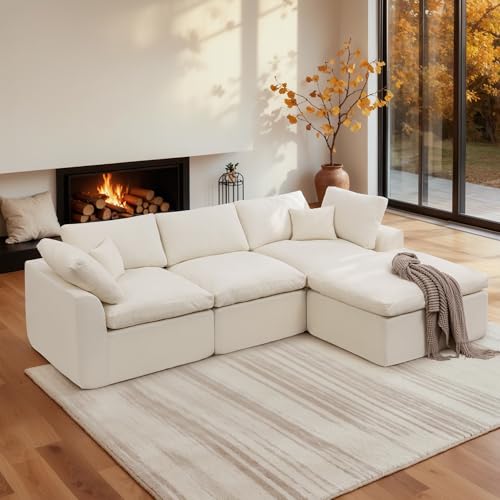
Korser 110" Cloud Sectional Couches for Living Room, Modern Modular Sectional Sofa with Ottoman, Boneless Cloud Couch with Comfy Deep Seats, Fluffy Chenille L-Shape Sofa Couch for Living Room, Beige
Check price on Amazon