
Customizable Sectionals with Recliners
Build seating that fits your room, your family, and the way you actually relax. This guide explains modular layouts, recline mechanisms, upholstery choices, and the practical details to check before you commit.
Explore Recommended ModelsWhy customizable sectionals with recliners? A standard fixed sectional forces you to adapt your room to the furniture. A modular reclining sectional flips that relationship: you choose the recline seats, corner wedges, armless chairs, chaises, and consoles, then arrange them around your floor plan. The result is seating that reclines where you need it, leaves an aisle where you need one, and can be expanded if your household changes.
What "Customizable" Actually Means
Retailers use the word loosely, so it helps to separate the levels of customization you will encounter. A sectional can be customizable in one dimension and fixed in another, and knowing the difference prevents disappointment after delivery.
Layout customization
The core of a modular system is interchangeable pieces. Common modules include a left-arm recliner, right-arm recliner, armless recliner, corner wedge, armless chair, chaise, and a console with cup holders or storage. Because the modules connect with brackets or interlocking hardware, you can build an L-shape, a U-shape, a straight sofa with recliners at each end, or a single recliner paired with a chaise. Some systems also offer a corner recliner, which places recline functionality in the wedge itself.
Upholstery and finish customization
Many manufacturers let you choose the fabric or leather grade, color, and leg finish. Performance fabrics are a frequent option for households with pets or children, while top-grain leather tends to develop a patina over time. If you plan to expand later, confirm that the upholstery line will remain in production, because dye lots and fabric runs change.
Mechanism customization
Recline can be manual (lever or push-back) or power (motorized). Power modules sometimes add a power headrest, lumbar support, or USB charging. Some systems offer both options on the same frame, so you can mix a power recliner for the primary seat with a manual recliner for occasional use.
Practical note: If you are still deciding between a reclining and non-reclining layout, compare the trade-offs in our guide to fabric sectionals with recliners, and review room-planning fundamentals in designing a living room with a sectional.
Common Configurations and Who They Suit
Most buyers fall into one of a few layout patterns. The descriptions below use a consistent tier system — entry-level, mid-range, premium, and luxury — to indicate relative market position and construction depth, not a numeric figure.
Two-seat recliner sofa with console
Two reclining seats joined by a center console with cup holders and storage. A good fit for apartments, media rooms, and couples who want recline without a full sectional footprint.
L-shaped sectional with dual recliners
Recliners at one end, a chaise or standard seats at the other. This is the most common family-room layout because it mixes relaxed seating with open access to the room.
U-shaped sectional with corner recline
Seats on three sides with recline functionality in the corner wedge. Suits large rooms and households that host often, though the layout needs generous walkway clearance.
Power reclining sectional with headrests
Motorized recline plus adjustable headrests and sometimes lumbar. The smoother positioning and charging ports appeal to buyers who use the seating daily.
Custom modular system with mixed modules
Individually specified modules, premium leather or performance fabric, reinforced frames, and extended configuration flexibility. Typically ordered through a dealer or design service.
Wall-hugger reclining sectional
The seat slides forward during recline, so the backrest can sit close to the wall. A practical answer for narrow rooms where traditional recliners would block the walkway.
If your room is particularly tight, the clearance behavior of wall-hugger mechanisms is worth studying alongside the guidance in electric wall-hugger recliners for small spaces. For larger rooms, an extra-large sectional with recliners may be a better structural match.
Manual vs. Power Recline at a Glance
| Feature | Manual recline | Power recline |
|---|---|---|
| Positioning | Discrete positions via lever or push-back | Stepless, smooth adjustment |
| Typical tier | Entry-level to mid-range | Mid-range to luxury |
| Maintenance | Fewer components; mechanism inspection | Motor and wiring checks; occasional control replacement |
| Power needs | None | Outlet access or battery pack |
| Extras | Limited | USB ports, power headrest, lumbar support |
| Best for | Occasional use, simpler setups | Daily use, family rooms, mixed seating |
Upholstery, Frame, and Cushion Considerations
Upholstery
Reclining seats place extra stress on fabric around the seat and back hinge, so the upholstery grade matters more than on a fixed sofa. Performance fabrics resist staining and pilling; leather resists odors and is easier to wipe down but shows scratches. For a deeper comparison of cover options, see durable couch fabric and custom couch upholstery.
Frame and mechanism
Look for kiln-dried hardwood or engineered hardwood frames with reinforced joints at the recline points. Heavy-duty recliner mechanisms are rated for higher cycle counts and tend to operate more quietly over time. In the mid-range tier, expect smoother mechanisms and better foam density than entry-level models; in the premium and luxury tiers, expect longer warranties on the mechanism and more consistent upholstery matching.
Cushions
High-resilience foam with a wrapped fiber layer is common and balances support with softness. Down-filled cushions feel plusher but need regular fluffing and are less common on recline seats because the cushion can shift during recline. If cushion feel is a priority, the notes in firm cushion couch and down-filled couch cushions are useful reference points.
Measurement Checklist Before You Order
Modular sectionals are large and often non-returnable once configured, so measure before ordering rather than after delivery.
- Wall length: Confirm the assembled width against the wall, including any console modules.
- Recline clearance: Traditional mechanisms need roughly six to twelve inches behind the backrest; wall-hugger designs need far less. Measure with the seats fully reclined, not just closed.
- Walkway width: Leave at least 30 inches for main paths and 18 inches for secondary access between furniture pieces.
- Doorway and stair access: Check the narrowest opening the boxes must pass through, and review fitting a couch through a door if access is tight.
- Power outlet location: Map outlet positions for each power recliner module, and decide whether a battery pack is preferable.
- Floor protection: Confirm leg type and consider felt pads, especially on hardwood or tile.
For a broader measurement framework, the first-time buyer guide covers the basics of room planning and delivery preparation.
Recommended Customizable Sectionals with Recliners
⚠️ AFFILIATE DISCLOSURE: This website contains affiliate links. As an affiliate Associate, we earn from qualifying purchases. If you make a purchase through these links, we may receive a small commission at no additional cost to you. Read our full affiliate policy.

Oversized Power Recliner Sectional Sofa with Wireless Charger,Large Reclining Sectionals Couch Set with 2 Electric Chenille Recliner,USB Type-C,Storage Consloe for Living Room,32.6" Seat Width,Gray
Check price on Amazon
Power Reclining Sectional, Sectional Recliner, Leather Reclining Sectional | Electric Reclining Couch with Storage & USB, Console, Adjustable Headrest & Cup Holders for Living Room, 5-Seater Gray
Check price on Amazon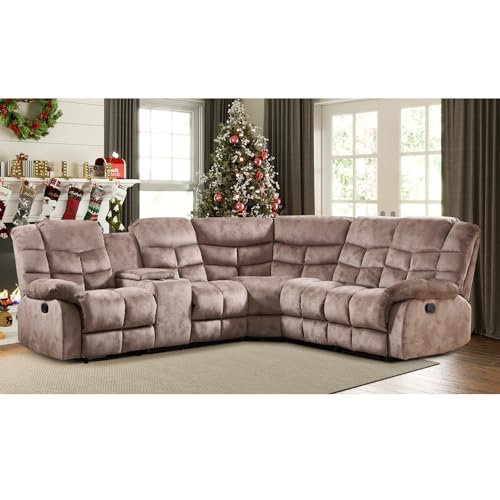
EBELLO Manual Reclining Sectional Sofa Set for Living Room, Soft Fabric Recliner Corner Sectional Couch with Center Console, Cup Holder and Storage, Brown
Check price on Amazon
140.16" Power Reclining Sofa with Wireless Charging & Heated Seats,Smart Recliner Sectional Couch,Zero Gravity Recliner Sofa,Deep Seat Cloud Couch for Living Room Home Theater,Khaki,6 Seats
Check price on Amazon
FUOROLA Power Recliner Living Room Set with LED, Breathing Leather Reclining Sectional Sofa Couches for Home Theater with Cup Holder, Storage Consloe, USB Charge
Check price on Amazon
Power Recliner Sofa, Leather Sectional Couch for Living Room, Light Grey | 3 Bluetooth Speakers & Hidden Storage, Modern L Shaped Reclining Couch with 6 Charging Ports
Check price on Amazon
EBELLO Manual Reclining L-Shaped Sectional Sofa Set, Included Soft Microfiber Corner Couch and Recliner Chair with Center Console, Cup Holders, Recliner Sectional Couches for Living Room, Grey
Check price on Amazon
LINSY Modular 3+2 Seater Recliner Sofa Set, Manual Corduroy Living Room Sectional with Flip-Down Console, Cup Holders, USB Ports & Hidden Storage, Theater Couch for Living Room, Game Room (Green)
Check price on AmazonA Simple Decision Framework
Buyers researching this category usually know they want recline, but have not settled on layout or mechanism. Work through these questions in order — each answer narrows the field.
- How many people recline at once? One recliner is enough for solo relaxation; two or more suggests a dual-recliner or L-shaped configuration.
- Is the wall behind the sectional tight? If yes, prioritize a wall-hugger mechanism or a zero-wall design.
- Will the seating be used daily? Daily use favors power recline, higher foam density, and a reinforced frame.
- Do pets or children share the room? Performance fabric and easy-clean leather reduce maintenance effort.
- Might the layout change? A modular system with continued module availability protects your investment.
For style-led buyers, the sections on fabric sectionals with a recliner and chaise and power reclining sectionals with power headrests explore the aesthetic and functional differences in more depth.
Frequently Asked Questions
What makes a sectional customizable?
A customizable sectional is assembled from modules — recliner seats, corners, armless chairs, chaises, and consoles — combined in the arrangement that fits your room. Many brands also offer upholstery, leg finish, recline mechanism, and cushion firmness choices.
Are power reclining sectionals worth it compared to manual recline?
Power recline gives smooth, stepless positioning and often adds USB charging and power headrests, which suits frequent users and family rooms. Manual recline has fewer electronic parts and is a solid choice for occasional use.
How much wall clearance does a reclining sectional need?
Traditional recliners need roughly six to twelve inches behind the backrest to recline fully. Wall-hugger and zero-wall mechanisms slide the seat forward and can reduce clearance to as little as two to four inches.
Can I add recline modules to a sectional later?
Only with a modular system designed for expansion where the manufacturer still produces matching modules and upholstery. Confirm the connector system, fabric continuity, and whether power modules can be wired into your existing layout before buying.
Ready to Configure Your Sectional?
Compare the recommended modular and reclining sectionals above, then double-check measurements and recline clearance against your room before ordering.
View Recommended Models