
Full Grain Leather Sectional with Chaise
Everything you need to know before choosing a full grain leather sectional with chaise — from leather grades and frame construction to layout planning, comfort testing, and long-term care.
Explore Recommended OptionsResearching before you buy? A full grain leather sectional with chaise is one of the most significant living room investments you can make. This guide breaks down exactly what to look for — the leather itself, the frame, the chaise configuration, the cushion construction, and how to match it to your room. Read through, compare the options, and make a confident decision.
What Makes Full Grain Leather Different
Full grain leather is the top layer of the hide, kept intact with its natural grain pattern visible. Unlike corrected-grain or bonded leather, it is not sanded down or rebuilt with synthetic binders. The fibers remain tightly interwoven, which is why full grain leather develops a patina over time and tends to resist cracking far better than lower grades. On a sectional with chaise, this matters because the chaise section receives concentrated weight and friction — the leather there needs to hold up.
If you are comparing leather types across the wider product category, our guide to a full grain leather couch explains the grading system in more detail. The same principles apply when you are evaluating a sectional. What you are looking for is tight, consistent grain, a supple hand-feel, and natural markings that vary across panels rather than a uniform, plastic-like surface.
Natural Grain Surface
The intact grain layer gives full grain leather its distinctive texture and breathability. It ages into a rich patina rather than wearing through.
Dense Fiber Structure
Tightly packed collagen fibers make full grain leather resistant to tearing and stretching under sustained load — ideal for a chaise that supports full body weight.
Long-Term Durability
With basic conditioning, full grain leather can remain supple and structurally sound for many years, making it a long-term investment for a primary living space.
Breathability
Because the grain is not sealed under a heavy synthetic coating, full grain leather breathes better than corrected-grain alternatives, staying comfortable across seasons.
Why Add a Chaise to a Leather Sectional
A chaise extends one end of the sectional into a lounge-length seat. It transforms a standard seating arrangement into something that supports full-body relaxation — reading, watching a film, or simply stretching out. In a leather sectional, the chaise becomes the most-used seat in the room, so the quality of the leather and cushion support there is critical.
The chaise also changes the footprint of the sectional. It typically projects further into the room than a standard seat, which affects walkway planning and how the piece relates to a coffee table or TV wall. If your room is on the smaller side, reviewing small space layout strategies before committing to a chaise orientation will help you avoid a cramped arrangement.
Layout tip: Place the chaise on the side of the sectional that faces the room's focal point — usually the TV or fireplace. This way the person lounging still has a clear sightline, and the chaise does not block the main traffic path into the seating zone.
Anatomy of a Quality Full Grain Leather Sectional with Chaise
Two sectionals can look similar in a showroom but differ enormously in what is underneath the leather. Understanding the internal build helps you ask the right questions and evaluate listings more critically.
Frame Construction
A hardwood frame — kiln-dried hardwood in particular — is the foundation of a sectional that will not squeak or sag over time. Look for corner blocks, reinforced joints, and a frame that feels rigid when you lift one corner. A hardwood frame couch built to these standards is far more likely to hold its shape under the daily load of a chaise. Avoid frames made primarily of particleboard or thin plywood, which tend to loosen at the joints.
Suspension System
Sinuous wire springs, pocket coils, or a webbing system determine how the seat responds over time. Eight-way hand-tied springs are the top-tier standard, but well-engineered sinuous wire systems are common and perfectly serviceable in mid-range and premium sectionals. What matters is that the suspension is evenly tensioned across the chaise — a soft spot there is a red flag.
Cushion Fill
High-resilience foam wrapped in fiber or down is the most common and practical combination. Foam density is the key metric: higher density foam retains its shape longer. On a chaise, where body weight is concentrated along the full length, a medium-firm to firm high-density foam core with a soft comfort layer prevents the "sinking hammock" effect that plagues lower-grade cushions. If you plan to use the sectional for occasional sleeping, note that a chaise is not a substitute for a dedicated sleeper — our guide to a full sleeper sofa covers that use case separately.
Common Chaise Configurations
Full grain leather sectionals with chaise generally fall into a few configurations. Choosing the right one depends on room shape and how you want to use the space.
| Configuration | Best For | Considerations |
|---|---|---|
| L-shaped with left-facing chaise | Rooms where the seating opens toward the right | Confirm left vs. right orientation by standing in the room facing the sectional |
| L-shaped with right-facing chaise | Rooms where the seating opens toward the left | Orientation is determined at purchase; measure doorways and stairwells before ordering |
| U-shaped with double chaise | Large open-plan living areas | Requires generous floor space; excellent for conversation and media viewing |
| Reclining sectional with chaise | Media rooms and lounging-focused layouts | Reclining mechanisms add depth; leave clearance behind the backrest |
If you want reclining capability alongside the chaise, our breakdown of a full grain leather reclining sectional covers the mechanism and clearance considerations in more depth. For a coordinated room, a full grain leather living room set pairs the sectional with matching accent seating.
Matching the Sectional to Your Room
Before choosing a leather, a color, or a chaise side, measure the room. A full grain leather sectional with chaise is a substantial piece; getting the scale right is the difference between a room that feels intentional and one that feels crowded.
For open-plan homes, the sectional often needs to define the living zone without walls. The open floor plan layout guide explains how to use the chaise and the back of the sectional as a soft boundary between living and dining areas.
What to Evaluate Before You Choose
When you are comparing full grain leather sectionals with chaise, the differences that matter are structural rather than cosmetic. Use the following checklist to evaluate listings and showroom models consistently. Because this category spans entry-level to luxury, the descriptors below describe relative market position rather than any specific figure.
Leather Quality Signals
Full grain leather should feel supple but substantial, with visible natural grain variation across panels. Uniform, perfectly smooth surfaces may indicate a corrected grain or a heavy surface treatment. Ask whether the leather is top-grain or full grain — the terms are sometimes used loosely, but full grain specifically means the outermost layer is intact. On the chaise, inspect the seat and back panels for consistent grain and dye penetration.
Tier Positioning
Entry-level full grain sectionals typically use thinner hides, simpler suspension, and lighter frames. Mid-range models usually step up to higher-density foam, better joint reinforcement, and more consistent hide selection. Premium and luxury tiers tend to feature thicker, more carefully matched hides, eight-way hand-tied suspension, and hardwood frames with fully reinforced corners. The chaise is where these differences become most apparent over time — a mid-range model with a well-built chaise often outperforms a higher-tier model with a poorly supported one.
Comfort Testing
Sit on the chaise the way you actually will at home — reclined, with your legs extended. Check that your lower back is supported, that the seat does not bottom out, and that the chaise cushion returns to shape when you stand. If you cannot test in person, look for detailed cushion specifications and reviews that mention long-term support rather than first-impression softness.
- Choosing by color swatch alone. Leather color varies by dye lot and lighting. Request a physical sample or confirm the return policy before committing.
- Ignoring chaise orientation. Left-facing and right-facing are not interchangeable. Measure your room and confirm the orientation before ordering.
- Overlooking the frame. A beautiful hide on a weak frame will sag. Ask about frame material and joinery explicitly.
- Skipping the delivery path check. Confirm the largest module fits through your entry and stairwell. Our delivery preparation guide covers what to measure.
- Assuming all full grain is equal. Hide thickness and selection vary widely. Ask about the tannery and the finishing process if the information is available.
Caring for Full Grain Leather on a Sectional
Full grain leather is forgiving but not maintenance-free. Dust the sectional weekly with a dry microfiber cloth. Condition the leather two to four times a year with a product formulated for full grain — avoid harsh cleaners, alcohol-based products, and silicone polishes. Keep the sectional out of direct, sustained sunlight to prevent uneven fading, and blot spills immediately rather than rubbing. For a deeper walkthrough, our leather cleaning guide and leather conditioning guide cover safe products and techniques. The chaise, being the most-used seat, benefits from more frequent conditioning along the seat and back panels.
Frequently Asked Questions
Yes, for most households. The chaise receives sustained body weight and friction, and full grain leather's dense fiber structure holds up better than corrected grain or bonded leather under that kind of use. With basic conditioning, it develops a patina rather than wearing through, which makes it a long-term investment for a primary living space.
Stand in the room facing the wall where the sectional will sit. If the chaise should be on your left, order a left-facing configuration; if on your right, order right-facing. The orientation should place the chaise so the person lounging has a clear view of the room's focal point without blocking the main walkway. Measure the chaise projection and confirm it leaves adequate path width before ordering.
It can, with careful planning. Choose a compact L-shaped configuration with a single chaise rather than a U-shape, measure the chaise projection against your walkway width, and consider a lighter leather tone to keep the room visually open. Our small space layout guide covers the measurement process in detail.
Two to four times per year is typical for a primary living room sectional. Condition more frequently on the chaise, since it is the most-used seat. Use a product formulated for full grain leather and avoid alcohol-based cleaners or silicone polishes, which can dry the hide or leave a residue.
Ask whether the frame is kiln-dried hardwood with reinforced corner joints. For cushions, look for high-density foam with a soft comfort layer, and confirm that the chaise cushion returns to shape when you stand. If you cannot test in person, look for detailed specifications and reviews that mention long-term support rather than first-impression softness.
Recommended Full Grain Leather Sectionals with Chaise
⚠️ AFFILIATE DISCLOSURE: This website contains affiliate links. As an affiliate Associate, we earn from qualifying purchases. If you make a purchase through these links, we may receive a small commission at no additional cost to you. Read our full affiliate policy.
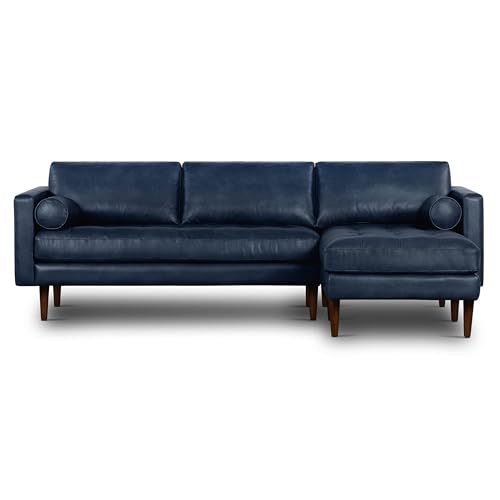
Poly & BARK Napa Right-Facing Sectional Sofa – 104.5” Italian Leather Sectional with Chaise – Midnight Blue – Full-Grain Pure-Aniline & Semi-Aniline Upholstery
Check price on Amazon
Valencia Artisan Full Leather Sofa - Pure Full Italian Nappa Leather Couch, Solid Wood Accent, Ultimate Comfort (Cognac, Left Chaise Sectional)
Check price on Amazon
POLY & BARK Napa 104.5" Right-Facing Sectional Sofa – Cognac Tan Full-Grain Pure-Aniline Italian Leather, Feather-Down Cushions, Solid Wood Frame
Check price on Amazon
SIMPLIHOME Morrison 102" Full-Grain Leather Right-Facing Sectional Sofa
Check price on Amazon
Valencia Serena 108" Full Leather Sectional Sofa with Right Bumper | Nappa 11000 Leather, Modern Low Profile Lounge Sofa | L Shaped Couch for Living Room Furniture, Cognac
Check price on Amazon
Valencia Artisan Full Leather Sofa - Left Chaise Sectional Couch - Pure Full Italian Nappa Leather Couch, Solid Wood Accent and Ultimate Comfort, Black
Check price on Amazon
Hydeline Bella 100% Leather Sectional Sofa with Left Chaise, 101.5", Cognac
Check price on Amazon
Left-Facing Tan Genuine Full Grain Leather Sectional Sofa with Chaise | Solid kiln-dried eucalyptus frame, tapered legs, foam cushioning, and coil spring seats for four.
Check price on AmazonReady to Compare Your Options?
Review the recommended full grain leather sectionals with chaise above, or explore our related guides on leather grades, room layout, and long-term care.
Explore Recommended Options