
Living Room Sectionals with Recliners
Everything you need to choose a reclining sectional that fits your space, your seating habits, and your long-term comfort. From seat configurations and upholstery to power mechanisms and wall clearance, this guide walks you through the decisions that matter most.
Explore Recommended OptionsWhy this guide exists: A reclining sectional is one of the most-used pieces of furniture in a home, yet the buying process is full of trade-offs. Layouts, recline mechanisms, fabric durability, and room dimensions all interact. The sections below break down each decision in plain language so you can compare models with confidence and choose a sectional that suits the way your household actually lives.
What Makes a Reclining Sectional Different?
A standard sectional offers generous seating and a defined footprint. A reclining sectional adds movable backrests and footrests to one or more seats, turning a fixed seating arrangement into a multi-position lounge. The result is a piece that serves both as everyday living room seating and as a spot for movie nights, reading, and recovery days.
The key difference is mechanical rather than visual. Each reclining seat includes a mechanism, a footrest, and often a reinforced frame section to support the motion. That added hardware influences how the sectional is assembled, how much depth it needs when fully reclined, and how it should be maintained over time. Understanding these mechanics early makes the rest of the buying decision much clearer.
Reclining sectionals are commonly available in leather, performance fabric, and standard upholstery. They can be configured as L-shaped layouts, U-shaped arrangements, or straight rows with a chaise on one end. Many shoppers comparing living room sectional sets with recliners are really comparing how many seats recline, how deep the reclined footprint becomes, and which upholstery holds up best to daily use.
Seating Count and Reclining Positions
Most reclining sectionals offer between two and four reclining seats. A three-seat configuration with two recliners and one stationary seat is a common middle ground: it keeps the overall footprint manageable while giving the most-used seats a reclining function. Larger layouts may include a reclining seat on each end plus a stationary corner, which is useful for conversation-centered rooms.
- Two-recliner layout: Best for couples or smaller households where two primary seats do most of the work.
- Three-recliner layout: Suits families and frequent hosting, but requires more wall length and more clearance for the reclined depth.
- Chaise-plus-recliner layout: Combines a fixed chaise lounge with one or more reclining seats, balancing relaxation styles.
- Power headrest models: Add adjustable head and neck support, which is especially useful for taller users or people who read and watch television from a reclined position.
Popular Configurations for Living Room Sectionals with Recliners
The configuration you choose determines both how the sectional looks and how people move through the room. The most common arrangements are the L-shaped layout, the U-shaped layout, and the chaise-extended layout. Each has a distinct traffic pattern and a different relationship to focal points such as a television or fireplace.
| Configuration | Best For | Space Consideration | Typical Tier |
|---|---|---|---|
| L-shaped with end recliners | Open living rooms with a corner television | Needs wall length on two adjacent sides | mid-range |
| U-shaped with two recliners | Large rooms and dedicated media spaces | Requires generous floor depth and clear walkways | premium |
| Chaise plus recliner | Mixed-use rooms where one person lounges fully | Chaise adds length but not reclined depth | mid-range |
| Straight sofa with reclining ends | Narrow rooms and apartments | Simplest footprint; watch reclined depth at each end | entry-level |
| Modular reclining sectional | Rooms that may be rearranged later | Flexible but each module needs its own clearance | premium |
If your room is on the smaller side, a straight reclining sofa or a compact L-shape is often easier to place than a full U-shape. If the room is large and television-focused, a U-shape or a wide L-shape makes better use of the space. For rooms that need to serve double duty, a sectional with a pull-out or sleeper function can be worth considering; our guide to a large sectional couch that turns into a bed covers the trade-offs between seating and sleeping capacity.
Recommended Living Room Sectionals with Recliners
⚠️ AFFILIATE DISCLOSURE: This website contains affiliate links. As an affiliate Associate, we earn from qualifying purchases. If you make a purchase through these links, we may receive a small commission at no additional cost to you. Read our full affiliate policy.

EBELLO Manual Reclining Sectional Sofa Set for Living Room, Soft Fabric Recliner Corner Sectional Couch with Center Console, Cup Holder and Storage, Brown
Check price on Amazon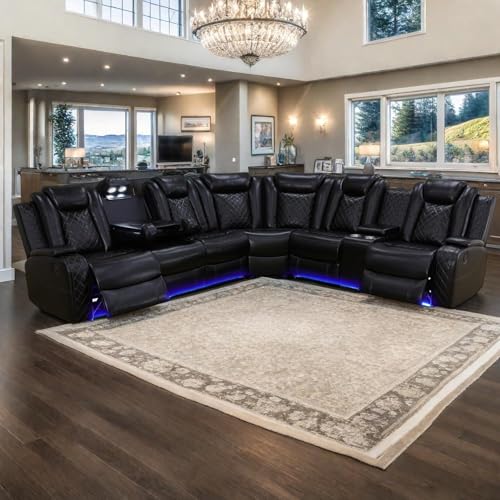
Power Recliner Sofa Sectional Sofa with LED Light for Living Room, Air Leather Reclining Corner Sectional Sofa Set, Cup Holder, Storage Console for Home Theater Seating (Black, Sectional)
Check price on Amazon
Reclining Sectional sofa, Reclining Sofa, Leather Sectional, Beige Brown | Power Reclining Sofa with Storage & USB, Adjustable Headrest & Cup Holders, Leather Sectional Couches for Living Room
Check price on Amazon
EBELLO Manual Reclining Sectional Sofa Set for Living Room, Soft Fabric Recliner Corner Sectional Couch with Center Console, Cup Holder and Storage, Grey
Check price on Amazon
EBELLO Fabric L-Shaped Reclining Sectional Sofa Couch for Living Room, Manual Recliner Oversized Sofa, with Padded Headrest, 2 Cup Holders, Storage Space, 5-Seater Home Furniture Set, Grey
Check price on Amazon
Power Reclining Sectional, Sectional Recliner, Leather Reclining Sectional | Electric Reclining Couch with Storage & USB, Console, Adjustable Headrest & Cup Holders for Living Room, 5-Seater Gray
Check price on Amazon
Power Reclining Sectional, Sectional Recliner, Leather Reclining Sectional | Electric Reclining Couch with Storage & USB, Console, Adjustable Headrest & Cup Holders for Living Room, 5-Seater Brown
Check price on Amazon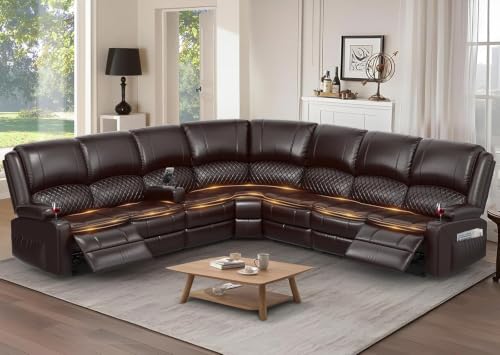
Manual 7 Seater Reclining Sectional Sofa Set | Home Theater Seating with Removable Console, Recliner Sectional Couch with Storage, Reclining Sectional Couch Set with USB
Check price on AmazonPower vs. Manual Reclining Mechanisms
The recline mechanism is the part of the sectional you will interact with every day, so it deserves careful attention. Manual recliners use a handle or lever to release the footrest and backrest. Power recliners use an electric motor controlled by a button panel, handset, or app. Both approaches work well when the hardware is well built, but they suit different households.
Manual Reclining
- Fewer electronic components, so fewer things to repair over the life of the sectional.
- Operates without power, which is useful during outages or in rooms with limited outlets.
- Smooth on well-built mechanisms but can require more effort on entry-level hardware.
- Usually lighter, which makes rearranging the sectional easier.
Power Reclining
- Provides smooth, gradual motion and precise positioning.
- Often includes USB charging ports, adjustable headrests, and memory presets on higher tiers.
- Requires access to an outlet and adds a small amount of electronic complexity.
- Premium and luxury tiers frequently pair power recline with wireless controls and battery backup options.
For households with older adults or anyone who has difficulty with a manual lever, power recline is usually the more comfortable choice. For households that prefer simplicity and fewer maintenance points, a manual mechanism from a reputable mid-range or premium manufacturer is a solid choice. A leather reclining sectional with power recline is a common combination because the leather and the motor both contribute to the perception of long-term quality.
Choosing Upholstery: Leather, Performance Fabric, and More
Upholstery decides how the sectional feels, how it ages, and how much effort it takes to keep clean. Three categories cover most of the market: leather, performance fabric, and standard fabric. The right choice depends on the household, the room's climate, and how the sectional will be used.
| Upholstery | Strengths | Watch-Outs | Tier Range |
|---|---|---|---|
| Leather | Wipes clean easily, resists odors, develops a lived-in patina | Can feel cool at first; scratches show on some finishes | mid-range to luxury |
| Performance fabric | Stain-resistant, soft hand-feel, good for families and pets | Requires manufacturer-approved cleaners; not all performance fabrics are equal | mid-range to premium |
| Standard woven fabric | Wide range of colors and textures; comfortable | Stains more readily; less forgiving with pets | entry-level to mid-range |
| Velvet or textured fabric | Rich appearance; comfortable in cooler rooms | Shows crushed pile; needs regular brushing | mid-range to premium |
Leather remains a popular choice for reclining sectionals because it pairs naturally with the long-term investment that a powered sectional represents. A leather sectional with reclining seats tends to hold its shape well, and spills wipe up with a damp cloth. For households with young children or pets, performance fabric often feels like the more forgiving option. Our guide to leather couches with built-in recliners goes deeper into leather grades, finishes, and care routines.
Sizing and Space Planning Before You Commit
The most common regret after buying a reclining sectional is underestimating the reclined footprint. A seat that looks compact upright can extend significantly when the footrest is raised. Before ordering, measure three things: the available wall length, the reclined depth of each seat, and the walkway clearance you want to preserve.
Wall Clearance
Traditional recliners need roughly 12 to 18 inches behind the backrest to fully recline. Wall-hugger and zero-wall mechanisms reduce that requirement to about 4 to 6 inches by sliding the seat forward instead of tilting the backrest rearward. If your sectional must sit close to a wall, confirm the mechanism type before you buy. A leather reclining sectional for small spaces typically uses a wall-hugger design for exactly this reason.
Traffic Flow and Walkways
Plan for at least 30 to 36 inches of walkway between the reclined footrests and any other furniture or doorway. In tighter rooms, a chaise-plus-recliner layout often works better than a full U-shape because the chaise occupies floor space only in one direction. The living room layout guide covers traffic patterns in more detail and is worth reading before finalizing a configuration.
Doorways and Delivery Path
Measure door widths, hallway turns, and stairwell clearances before ordering. Many reclining sectionals ship in modular pieces, but the largest module still needs to fit through the delivery path. Confirm the return policy and delivery terms so that a tight doorway does not become a problem after the sectional arrives.
Comfort and Build Quality: What to Inspect
Two sectionals can look identical in a showroom and feel completely different after a year of daily use. The differences usually come down to frame construction, cushion density, and the quality of the recline mechanism. These are the details worth checking before you commit.
Frame and Suspension
- Frame material: Hardwood or engineered hardwood frames resist warping better than softwood frames. Ask for the frame material if it is not listed.
- Joint construction: Corner blocks, dowels, and reinforced joints indicate a sturdier build than stapled joints.
- Suspension: Sinuous wire springs are common and reliable; pocketed coils and eight-way hand-tied springs appear on higher tiers and tend to hold their shape longer.
Cushion Foam and Fill
- High-resilience foam: Retains shape well and is the baseline for mid-range and premium sectionals.
- Foam density: Higher density generally means better long-term support, though very firm foam may not suit everyone.
- Down and fiber wraps: Add softness but require regular fluffing; often found on premium and luxury tiers.
- Removable covers: Useful for cleaning and replacement; check whether the reclining seats have removable covers, since the mechanism complicates removal.
Recline Mechanism Quality
- Smoothness: A well-built mechanism moves without jerking or binding.
- Weight rating: Check the per-seat weight rating, especially for larger households.
- Warranty: Mechanism warranties vary widely; a longer warranty on the motor and frame is a useful signal of build confidence.
- Noise: Power mechanisms should operate quietly; manual mechanisms should not creak during motion.
Practical Tip: Sit in Every Seat
If you can visit a showroom, sit in each reclining seat rather than only the display model's front position. Check that the footrest locks securely, that the backrest returns smoothly, and that the seat height works for the people who will use it most. If you are buying online, read reviews that specifically mention the mechanism and cushion support after several months of use.
Integrating a Reclining Sectional into Your Living Room Style
Reclining sectionals have historically carried a reputation for bulky silhouettes, but modern designs are considerably more streamlined. Clean lines, tailored cushions, and a lower visual profile are now common across tiers. The goal is to choose a sectional that supports the room's style rather than dominating it.
Neutral Upholstery and Color
Neutral upholstery such as warm grey, sand, or soft beige keeps the sectional visually quiet and makes it easier to update the room's accent colors over time. A light grey sectional couch with chaise is a versatile starting point because it works with both warm and cool palettes. If you prefer a bolder statement, a deeper tone can anchor the room, but check how the color reads under the room's natural and artificial lighting.
Pillows, Throws, and Texture
Reclining sectionals offer a large upholstered surface, so textiles do a lot of the styling work. A few well-chosen throw pillows and a textured throw add contrast without interfering with the recline motion. Keep pillows small enough that they do not block the footrest or the backrest's travel path. Our guides to throw pillows and living room decor cover color pairings and texture mixing.
Rugs and Tables
An area rug defines the seating zone and helps the sectional feel intentional rather than floating. Size the rug so that the front legs of the sectional sit on it, or so that the rug extends at least a few inches beyond the reclined footrests. Coffee and end tables should leave room for the footrests to extend without collision. The living room coffee and end tables guide covers proportion and placement.
Household Considerations: Pets, Kids, and Multi-Use Rooms
How a household uses a living room should shape the choice of sectional. A room used mainly for adult relaxation has different requirements from a room that doubles as a play area or a pet hangout. The table below summarizes common scenarios and the features that tend to work best.
| Household Scenario | Recommended Features | Upholstery Direction |
|---|---|---|
| Pets that share the couch | Tight-weave upholstery, removable covers where possible, manual or simple power recline | Leather or performance fabric |
| Young children | Stain-resistant fabric, rounded corners, easy-clean footrest tops | Performance fabric |
| Frequent overnight guests | Sectional with sleeper or pull-out function in addition to reclining seats | Leather or performance fabric |
| Home theater or gaming room | Power recline, adjustable headrests, USB ports, cup holders on premium models | Leather |
| Small apartment living room | Wall-hugger mechanism, compact L-shape, fewer reclining seats | Leather or performance fabric |
If the room needs to serve as both seating and sleeping space, a leather sectional with sleeper and recliner combines two functions in one footprint, though the sleeper mechanism adds weight and complexity. For rooms where the sectional will be the primary seating but guests are occasional, a simpler reclining layout plus a separate sleeper sofa may be more practical.
A Practical Buying Checklist
Before ordering, run through the following checklist. It is organized around the decisions that most often cause regret when they are skipped.
Before You Order
- Measure wall length, reclined depth, and walkway clearance.
- Confirm the recline mechanism type and the required wall clearance.
- Check door widths and the delivery path into the room.
- Decide how many seats need to recline.
- Choose upholstery based on household use, not only appearance.
- Verify the frame material, suspension type, and cushion foam density.
- Review the warranty terms for the frame, mechanism, and motor.
- Confirm the return policy and delivery terms.
After Delivery
- Test every reclining seat through its full range of motion.
- Check that the power supply reaches an outlet without stretching the cord.
- Keep the mechanism area free of debris and pet hair.
- Follow the manufacturer's cleaning guidance for the upholstery.
- Register the warranty if registration is required.
Common Mistakes to Avoid
- Ignoring reclined depth: The most frequent error. Tape the reclined footprint on the floor before ordering.
- Choosing upholstery by appearance alone: A fabric that looks perfect in a showroom may not suit a household with pets or young children.
- Buying the largest configuration the room can hold: A sectional should leave comfortable walkways and room for other furniture.
- Skipping the mechanism test: Sit in each reclining seat and operate it fully before purchase, especially if buying in person.
- Overlooking maintenance: Reclining mechanisms and leather upholstery both benefit from simple, regular care. Our couch care and maintenance section covers routine cleaning and protection.
Frequently Asked Questions
What is the difference between power and manual reclining sectionals?
Manual recliners use a lever or handle and rely on body weight and spring tension, while power recliners use an electric motor controlled by buttons or a handset. Power models offer smoother motion and often include USB ports and adjustable headrests, while manual models have fewer electronic components to maintain.
How much wall clearance does a reclining sectional need?
Traditional recliners need roughly 12 to 18 inches of clearance behind the backrest to fully recline. Wall-hugger or zero-wall mechanisms reduce this to as little as 4 to 6 inches, making them suitable for tighter living rooms.
Is leather or fabric better for a reclining sectional?
Leather is easier to wipe clean and resists odors, making it a strong choice for households with pets or frequent snackers. Performance fabric offers a softer hand-feel and better stain resistance than standard fabric, but requires more careful cleaning. Both are durable when well constructed.
How do I measure a living room for a reclining sectional?
Measure the available wall length, then add the reclined depth of each seat plus walkway clearance. Confirm door widths and hallway turns before ordering, and tape out the footprint on the floor to visualize traffic flow.
Can a reclining sectional work in a small living room?
Yes. Wall-hugger mechanisms, compact L-shapes, and layouts with fewer reclining seats make it possible to fit a reclining sectional into a smaller room. The key is to measure the reclined depth rather than only the upright footprint, and to keep walkways clear.
Ready to Compare Reclining Sectionals?
Review the recommended options above, then use the sizing and checklist sections to narrow your shortlist to the configuration that fits your room and household.
View Recommended Options