
Reclining Sectional with Adjustable Headrest: The Complete Comfort Guide
Learn how an adjustable headrest sectional can reduce neck strain, improve posture, and deliver personalized comfort for every seat in your living room.
Explore Recommended ModelsWhy this guide matters: A reclining sectional already offers generous seating and relaxation, but the addition of an adjustable headrest turns a good couch into a genuinely ergonomic piece of furniture. This guide breaks down how headrest mechanisms work, which configurations suit different rooms and body types, and what to inspect before you commit. Whether you are upgrading a family room or furnishing a dedicated media space, understanding these details helps you choose with confidence.
What Is a Reclining Sectional with Adjustable Headrest?
A reclining sectional with adjustable headrest is a multi-seat sofa that combines two independent mechanisms: a reclining seat that tilts the backrest and raises a footrest, and an articulated headrest panel that pivots forward or backward at the top of the backrest. The headrest adjustment is separate from the main recline, so you can set your seat angle for lounging while fine-tuning the headrest to support your neck at a reading angle, a television-viewing angle, or a fully reclined resting angle.
These sectionals typically come in L-shaped or U-shaped configurations with three to six seats. At least one seat, and often every seat in a power model, includes the adjustable headrest feature. Manual versions use a ratcheting hinge that clicks into preset positions; power versions use a small motor controlled by a button or switch, frequently integrated into the same control panel that operates the recline. If you are comparing broader seating categories, our overview of reclining sofas explains how sectionals differ from standard reclining couches in footprint and seating capacity.
How the Adjustable Headrest Mechanism Works
The headrest panel is mounted on a hinge or a pair of pivot arms at the top of the backrest. In a manual system, a friction or ratchet hinge holds the panel at a chosen angle until you push it to a new position. In a power system, a linear actuator or small motor moves the panel in response to a button press, often with a smooth, continuous range of motion rather than discrete clicks.
The key design detail is the pivot point. A well-engineered headrest pivots near the top of the shoulder line so that the panel follows the natural curve of the neck rather than pushing the head forward. Low-quality mechanisms pivot too low and create a gap between the headrest and the upper back, which defeats the purpose of the feature. When shopping, sit in the seat, recline it, and move the headrest through its full range to check that it stays in contact with your neck and upper shoulders at every angle.
Key Benefits of an Adjustable Headrest Sectional
Personalized Neck Support
Every household member can set the headrest to their own preferred angle. Taller users tilt it back; shorter users bring it forward to avoid the head being pushed into an unnatural position.
Reduced Strain During Long Sessions
Reading, watching a film, or working on a laptop for extended periods puts stress on the cervical spine. A properly angled headrest keeps the head aligned over the shoulders and reduces forward head posture.
Better Television and Reading Angles
When the seat is reclined, the natural line of sight changes. An adjustable headrest lets you tilt the head support to match your gaze rather than craning your neck toward a screen or a book.
Multi-User Flexibility
In a family room, seats are shared. Independent headrest adjustment means a child, a tall adult, and a guest with neck sensitivity can all use the same sectional comfortably in the same evening.
Improved Posture for Napping
A headrest that can be angled slightly forward supports the head during an upright nap and prevents the chin-to-chest slump that causes stiffness on waking.
Refined Aesthetic Options
Modern adjustable headrests are integrated into the backrest profile and do not look like add-on hardware. If you prefer a cleaner silhouette, see our guide to a reclining sectional that doesn't look like one.
Market Tiers: What to Expect at Each Level
Adjustable headrest sectionals span a wide range of construction quality and mechanism sophistication. Rather than focusing on figures, it helps to understand what each market tier typically delivers so you can match the product to your expected use and household demands.
| Tier | Best For | Typical Mechanism & Build | Upholstery & Frame |
|---|---|---|---|
| Entry-Level | Guest rooms, occasional use, first apartment | Manual ratchet headrest; basic push-back recline; fewer recline positions | Bonded leather or basic microfiber; engineered wood frame; foam cushions with lower density |
| Mid-Range | Primary family room, daily use by two to four people | Manual or entry power headrest; smooth glide recline with multiple stop points | Top-grain leather or performance fabric; hardwood frame in key stress areas; higher-density foam |
| Premium | Dedicated media room, daily intensive use, larger households | Power headrest with independent control; power recline with memory positions; USB charging | Full-grain leather or premium performance fabric; kiln-dried hardwood frame; pocket-coil or high-resilience foam |
| Luxury | Custom installations, high-end living spaces, long-term ownership | Dual-motor power headrest and recline; app or remote control; articulating lumbar integration | Aniline or semi-aniline leather; bench-made hardwood frame; hand-tied springs; customizable modular configuration |
As a general rule, mid-range models offer a noticeably smoother headrest hinge and a more supportive seat cushion than entry-level pieces. Premium and luxury tiers add independent motor control, better foam density, and frame construction that holds its shape over many years of daily use. If your household uses the sectional every evening, the jump to the premium tier is usually the more efficient long-term investment.
Buying Checklist Before You Commit
- Measure the recline clearance. Standard recliners need several inches behind the backrest; wall-hugger designs need very little. Confirm the exact figure for the model you are considering.
- Test the headrest pivot point. Sit in the seat and move the headrest through its full range. It should stay in contact with your neck at every angle.
- Check whether the headrest is independent. On some models the headrest moves only when the seat reclines. You want a headrest that adjusts separately.
- Decide between power and manual. Power offers smoother positioning but adds electronic components. Manual is simpler and has fewer failure points.
- Confirm the seat depth and height. A deep seat suits tall users; a shallower seat with a forward-tilting headrest suits shorter users. Match the geometry to the primary users.
- Inspect the upholstery at friction points. The headrest hinge and seat edges see the most wear. Tight-weave fabrics and full-grain leather hold up best.
- Check the frame material. Kiln-dried hardwood in the reclining seat box is a sign of durable construction; particle board is a warning sign.
- Verify the configuration. Left-arm, right-arm, and armless pieces determine how the sectional fits your room. Measure doorways and stairwells before ordering.
- Review the warranty on the mechanism. Recline and headrest motors are the most likely components to need service. A strong mechanism warranty is a meaningful signal.
- Consider power access. Power headrest sectionals need an outlet near the sofa. Plan the cord route or choose a model with a battery backup option.
Choosing the Right Configuration for Your Room
The shape of your room and the way you use it should drive the configuration. An L-shaped sectional with a chaise on one end works well in open-plan living areas where the sofa defines the seating zone. A U-shaped configuration surrounds a coffee table and suits dedicated conversation or media rooms. If floor space is limited, a compact L-shape with a single reclining seat and two stationary seats preserves walkway width; our guide to a reclining sectional for small spaces covers the trade-offs in more detail.
If you want the reclining comfort extended across the whole sofa, look for a model where every seat reclines and every headrest adjusts. If only one or two seats will be used for lounging, a mixed configuration with stationary end seats can reduce the mechanism count and simplify maintenance. For households that frequently host overnight guests, a reclining sectional with pull-out bed adds a third function without sacrificing the headrest feature.
Manual vs Power Adjustable Headrests
Manual headrests use a ratcheting or friction hinge. They require no electricity, have very few moving parts, and are simple to operate by hand. The trade-off is that the adjustment is usually discrete rather than continuous, and reaching behind the head to change the angle can be awkward while seated.
Power headrests use a small motor and a control button. They offer smooth, continuous movement and are easy to adjust without changing posture. Many premium models pair the power headrest with a power recline and a USB charging port, creating a single control panel for the whole seat. Power mechanisms add electronic components that can fail, so check the warranty coverage on the motor specifically. If you want the headrest to move in tandem with the seat, look at a reclining sectional with power headrest; if you prefer independent manual control, a manual adjustable headrest model remains the simpler choice.
Ergonomics: Matching the Headrest to Your Body
The headrest is only one part of an ergonomic seating system. It works best when the seat depth, seat height, backrest angle, and lumbar support are also suited to the user. A headrest that is perfectly angled cannot compensate for a seat that is too deep or a backrest that forces the pelvis into a posterior tilt.
For most adults, the ideal headrest angle in an upright seated position is slightly forward of vertical, so the panel meets the curve at the base of the skull. When the seat is reclined, the headrest can tilt further back to keep the head supported without pushing the chin toward the chest. If you have existing neck or shoulder tension, test the sectional in a reclined position for several minutes before deciding; the headrest should feel supportive rather than corrective. Pairing the headrest with a model that includes lumbar support gives the best overall spinal alignment.
Upholstery and Material Considerations
The headrest panel is a high-contact area, and the hinge point creates a small gap where dust and debris can collect. Tight-weave performance fabrics and top-grain leather are the most practical choices because they resist abrasion and are easy to wipe clean. Loose-weave linen and heavily textured bouclé look appealing but can snag on the hinge hardware and show wear quickly at the pivot point.
Leather is a strong option for households with children or pets because it does not trap hair and is simple to wipe down. Performance fabric offers a softer hand and better stain resistance than standard fabric, making it a good middle path. Whatever material you choose, confirm that the headrest panel uses the same upholstery as the rest of the sofa rather than a vinyl substitute, which is a common cost-reduction measure in entry-level models.
Common Mistakes to Avoid
- Ignoring recline clearance. Buying a standard recliner for a room that only supports a wall-hugger design leaves the sofa unusable in its reclined position. Measure first.
- Assuming the headrest is independent. On some sofas the headrest only moves when the seat reclines. If you want to read upright with a forward-tilted headrest, confirm the independence before ordering.
- Skipping the in-person test. Headrest comfort is highly individual. A model that feels supportive for one person can push another person's head forward. Sit in the exact configuration you intend to buy.
- Overlooking the mechanism warranty. Recline and headrest motors are the first components to need service. A short mechanism warranty shifts repair risk onto you.
- Choosing fabric by look alone. A beautiful loose-weave fabric can wear through at the headrest hinge within a year of daily use. Prioritize abrasion resistance at the contact points.
- Forgetting the outlet. Power headrest models need a nearby power source. If the sofa floats in the middle of the room, plan the cord route or choose a battery-backup model.
- Buying for the room instead of the users. A deep seat with a low headrest pivot suits tall users but can be uncomfortable for shorter household members. Match the geometry to the primary users.
Caring for the Adjustable Headrest Mechanism
The headrest hinge is a low-maintenance component, but a few habits extend its life. Keep the pivot area free of crumbs and pet hair by vacuuming the seam between the headrest panel and the backrest every few weeks. If the manual hinge begins to feel loose, check the manufacturer's guidance before applying any lubricant; some ratchet mechanisms are designed to run dry and lubricant can attract dust.
For power headrests, avoid holding the control button at the end of travel for extended periods, which can strain the motor. If the headrest stops responding, check the power connection and the control panel before assuming a motor failure. Upholstery care follows the same rules as the rest of the sofa: blot spills rather than rubbing, and use a cleaner approved for the specific fabric or leather type. Our broader couch care and maintenance resources cover stain treatment and leather conditioning in more detail.
Recommended Reclining Sectionals with Adjustable Headrest
⚠️ AFFILIATE DISCLOSURE: This website contains affiliate links. As an affiliate Associate, we earn from qualifying purchases. If you make a purchase through these links, we may receive a small commission at no additional cost to you. Read our full affiliate policy.

Reclining Sectional sofa, Reclining Sofa, Leather Sectional, Beige Brown | Power Reclining Sofa with Storage & USB, Adjustable Headrest & Cup Holders, Leather Sectional Couches for Living Room
Check price on Amazon
Power Reclining Sectional, Sectional Recliner, Leather Reclining Sectional | Electric Reclining Couch with Storage & USB, Console, Adjustable Headrest & Cup Holders for Living Room, 5-Seater Gray
Check price on Amazon
Power Reclining Sectional, Sectional Recliner, Leather Reclining Sectional | Electric Reclining Couch with Storage & USB, Console, Adjustable Headrest & Cup Holders for Living Room, 5-Seater Brown
Check price on Amazon
Power Recliner Sectional Sofa, Leather Recliner Sofa with Storage Console/Cup Holder, Reclining Sectional Couch with Adjustable Headrest, Living Room Furniture Set for Living Room/House/Apt, Orange
Check price on Amazon
Power Reclining Sectional Sofa with Bass Speakers, Oversized Leather Electric Recliner Couch Set with Adjustable Headrests, Cup Holders and Storage Console for Living Room, Home Theater & Office
Check price on Amazon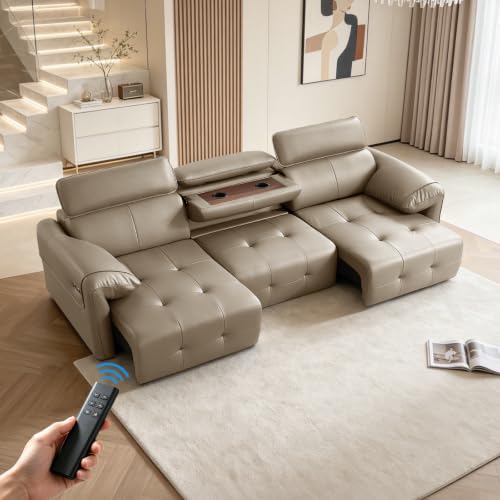
VASOENY 112" Genuine Leather Power Reclining Sectional Sofa with Adjustable Headrests | Electric Pull Out Sleeper Sofa Bed, Home Theater Seating with Drop-Down Table, Cup Holders & USB/Type-C Ports
Check price on Amazon
ORRD Oversized Modular Sectional Sofa with 2 Power Reclining, Electric Recliner Couch with Storage Console and Adjustable Headrest, Faux Leather 5 Seat Corner Sofa for Living Room-Dark Brown
Check price on Amazon
ERYE L-Shaped 3 Seat Sectional Sofa with Power Reclining & Adjustable Headrest, 113" Oversized Left Facing Corner Recliner Sofa Leather Upholstered Tufted Couch for Living Room
Check price on AmazonFrequently Asked Questions
What is a reclining sectional with adjustable headrest?
It is a multi-seat sofa that combines a reclining seat mechanism with an independently articulated headrest panel. The headrest tilts forward or backward to support the neck and head at a personalized angle, separate from the main recline. This lets you set the seat for lounging while fine-tuning the headrest for reading, watching television, or resting.
Are power adjustable headrests better than manual ones?
Power adjustable headrests offer smoother, more precise positioning via a button or switch, and they often integrate with power recline systems and USB charging. Manual adjustable headrests use a ratcheting hinge that is simpler, requires no electricity, and has fewer electronic components that could fail. The better choice depends on your preference for convenience versus mechanical simplicity and your willingness to manage a power connection.
Can an adjustable headrest help with neck pain?
Yes. An adjustable headrest lets you align the panel with the natural curve of your neck, reducing forward head posture that often causes strain during long sitting sessions. Combined with proper lumbar support and a reclined seat angle, it can significantly improve comfort for people with neck or shoulder tension. It is not a medical device, however, and persistent pain should be evaluated by a healthcare professional.
How much space does a reclining sectional need?
A standard reclining sectional typically needs several inches of clearance behind the backrest when fully reclined, depending on the mechanism. Wall-hugger or zero-wall recliners require very little clearance, making them suitable for smaller living rooms. Always measure your room and check the manufacturer's recline clearance specification before purchasing.
What upholstery works best for a reclining sectional with adjustable headrest?
Performance fabrics, top-grain leather, and tight-weave microfiber are excellent choices because they resist wear at high-friction points like the headrest hinge and seat edges. Leather is easy to wipe clean, while performance fabric offers stain resistance and a softer hand. Avoid loose-weave fabrics that can snag on mechanical parts and show wear quickly at the pivot point.
Can I use a reclining sectional with adjustable headrest in a small room?
Yes, provided you choose the right configuration. A compact L-shaped sectional with a wall-hugger recline mechanism and a single reclining seat can fit in a small living room without blocking walkways. Measure the recline clearance and the walkway width before ordering, and consider an armless piece that can be added later if your space changes. For more on compact layouts, see our guide to a reclining sectional for small spaces.
Ready to Choose Your Reclining Sectional?
Use the checklist above to narrow your options, then explore the recommended models to compare configurations, headrest types, and upholstery options that match your room and household.
View Recommended Sectionals