
RV Couches That Turn Into Beds: The Complete Guide
Everything you need to know about choosing a sleeper couch for your camper, motorhome, or van conversion — mechanisms, sizing, mattress types, and layout planning.
Why this guide exists: An RV sleeper couch has to do two jobs at once — a comfortable daytime lounge and a dependable overnight bed — inside a footprint measured in inches. This guide walks you through the mechanisms, measurements, and material choices that separate a well-planned purchase from a costly mistake.
Why an RV Sleeper Couch Is Different
A standard living room sleeper sofa is built around generous floor space and a stable foundation. An RV couch that turns into a bed operates under entirely different constraints: the floor is thinner, the wall behind it may be a slide-out, and the couch itself often has to be secured while the vehicle is moving. That changes everything from the frame construction to the way the mechanism locks.
The first distinction is weight. Every pound added to an RV affects payload capacity, fuel efficiency, and handling. RV sleeper couches are typically built with lighter frames and thinner foam than residential equivalents. The trade-off is that entry-level models may feel firmer or less plush than a living room sofa — which is normal, not a defect.
The second distinction is deployment clearance. A residential pull-out can extend into open floor space without concern. In an RV, the couch may sit beside a dinette, a galley, or a slide-out wall. If you are planning a camper layout around a convertible couch, the broader RV couch bed overview is a useful companion read before you commit to a mechanism type.
The third distinction is anchoring. Couches in motorhomes and travel trailers generally need to be fastened to the floor or wall so they do not shift during travel. Some models ship with mounting brackets; others require you to source hardware that matches your floor construction. Confirm this before ordering, because a couch that cannot be secured safely is not a viable option no matter how comfortable it is.
Sleeper Mechanisms Explained
There are four dominant mechanisms in the RV sleeper couch category. Each has a distinct deployment pattern, and each suits a different floor plan. Understanding these before you shop is the single most important step in narrowing your options.
Jackknife Sofa
The seat cushion and backrest fold flat toward each other, forming a sleeping surface roughly the width of the couch. No hidden platform extends outward, so it needs very little floor clearance. Ideal for tight slide-outs and van conversions. The sleeping surface is shorter and firmer than a pull-out, and the hinge line is noticeable under a thin mattress.
Pull-Out / Hide-A-Bed
A folded platform slides outward from beneath the seat, and the backrest drops down to complete the bed. This produces a flatter, longer sleeping surface than a jackknife. It requires clear floor space in front of the couch equal to the deployed depth, so it works best when the couch faces an open aisle or a slide-out area.
Tri-Fold Sofa
Three hinged panels unfold forward in sequence, converting the couch into a low platform bed. Tri-fold designs are popular in van conversions and smaller Class B motorhomes because they deploy without a separate mechanism frame. The trade-off is a lower sleeping height and a firmer surface, which many travelers address with a topper.
Air Mattress Sleeper
The couch hides an integrated air mattress that inflates when needed and deflates for storage. This eliminates the metal bar and spring feel common to traditional mechanisms and offers the most even sleeping surface. Air mattress systems sit in the mid-range to premium tiers and require access to power for the pump. Replacement mattresses are available if the original loses integrity; see the RV air mattress for pull-out couch guide for fit considerations.
If the couch will double as the primary guest bed, the pull-out and air mattress designs are usually the stronger choices. If it is an occasional overflow bed in a compact camper, a jackknife or tri-fold keeps the floor plan open and the weight down. For a direct comparison of how these translate into full sleeping surfaces, the roll-out couch bed breakdown walks through deployment geometry in more detail.
Mechanism Comparison Table
The table below summarizes how each mechanism performs across the factors that matter most in an RV. Tier labels describe relative market positioning and build complexity, not any numeric figure.
| Mechanism | Best For | Floor Clearance Needed | Sleeping Surface Feel | Typical Tier |
|---|---|---|---|---|
| Jackknife sofa | Tight slide-outs, vans, occasional guests | Minimal — folds in place | Firmer, shorter, visible hinge line | Starter to mid-range |
| Pull-out / hide-a-bed | Motorhomes with open aisle space | Full deployed depth in front | Flatter and longer, may show support bar | Mid-range to premium |
| Tri-fold sofa | Class B vans, compact trailers | Forward unfolding path | Low platform, firm, topper-friendly | Essential to mid-tier |
| Air mattress sleeper | Primary guest bed, frequent overnight use | Full deployed depth in front | Even, no bar, adjustable firmness | Premium to high-end tier |
Editorial note: If the couch will be used as a bed more than a few nights per year, weight the sleeping surface quality heavily. A firm hinge line that is tolerable for one weekend becomes a genuine problem over a two-week trip.
Mattress Types and Comfort
The mechanism determines where the bed goes; the mattress determines whether anyone actually sleeps well on it. RV sleeper couches generally use one of four mattress constructions, and each behaves differently over time.
Fold-Out Foam Pad
The most common construction in jackknife and entry-level pull-out couches. A thin polyurethane foam pad folds with the mechanism. It is light and requires no inflation, but it compresses quickly under regular use. A mattress topper meaningfully improves comfort on this type, and many owners replace the original pad after a season or two.
Inner-Spring Sleeper Mattress
Found in mid-range pull-out couches, this is a compact coil mattress designed to fold into the couch frame. It provides more support than a foam pad but is heavier and can develop pressure points where the frame bars sit. Check whether the coils are wrapped, since wrapped coils tolerate folding better over time.
Memory Foam Sleeper
Increasingly common in premium tier models, memory foam sleeper mattresses conform to the body and fold without the hard bar sensation of coil designs. They are heavier, which matters for payload planning, and they benefit from being allowed to fully expand after deployment.
Integrated Air Mattress
An air chamber replaces the foam or coil layer entirely. Firmness is adjustable, storage is compact, and the sleeping surface is the most even of the four. The pump requires power, and the mattress needs protection from punctures. Replacement chambers are available, though fit must match the specific couch model — the RV pull-out couch mattress replacement guide covers how to verify compatibility.
Across all four types, the practical upgrade path is similar: confirm the mattress dimensions, add a breathable topper, and use a fitted protector. A protector also simplifies cleaning when the couch serves double duty as a lounge.
Measuring Your RV Space
Measurement errors are the leading cause of returns in this category. RV interiors are irregular — walls taper, slide-outs have trim, and doorways are narrower than the rooms behind them. Work through the following checks in order before ordering anything.
- Wall length and depth: Measure the wall the couch will sit against, and the depth from that wall to the nearest obstruction such as a dinette or galley counter.
- Deployed depth: Measure the floor space available in front of the couch. Compare it to the couch's fully open depth, not its closed footprint.
- Height clearance: Confirm the couch backrest fits below windows, overhead cabinets, and slide-out trim.
- Delivery path: Measure the entry door width, hallway width, and any tight turns between the door and the installation spot.
- Sleeping surface length: Compare the deployed bed length to the tallest sleeper who will use it. Jackknife sofas are frequently shorter than pull-out beds.
- Securing points: Identify where the couch can be anchored to the floor or wall, and confirm the couch includes or accepts mounting hardware.
Record both closed and open dimensions for every candidate model in a single note before comparing them. This prevents the common mistake of evaluating couches by their closed size while ignoring whether the bed can actually extend. If your floor plan is genuinely tight, the sectional couch for studio apartment guide contains scaling principles that transfer well to compact RV interiors.
Layout and Installation Tips
Placement decisions made early are difficult to reverse once the couch is anchored. A few layout principles make the difference between a couch that feels integrated and one that constantly gets in the way.
Face the Open Side
Orient the couch so the bed deploys into the most open floor area. In slide-out equipped motorhomes, this usually means facing the couch toward the slide-out opening rather than toward a fixed cabinet wall.
Keep the Deployment Zone Clear
Avoid placing a coffee table, ottoman, or storage bin directly in the bed's path unless it can be moved easily. A lightweight, movable table is a better companion to a sleeper couch than a fixed one.
Match the Couch to the Room's Function
If the couch anchors a lounge area with a television, reclining loveseat configurations may suit the space better than a sleeper. The RV reclining loveseat with heat and massage overview is worth reviewing if seating comfort during the day outweighs overnight sleeping capacity.
Plan the Anchor Before the Couch Arrives
Confirm the floor construction — plywood, composite, or metal subframe — and have the correct fasteners ready. Anchoring to a slide-out floor may require different hardware than anchoring to the main chassis floor. Never rely on friction alone to hold a couch in place while the vehicle is moving.
Care and Maintenance
RV furniture lives in a harsher environment than living room furniture: temperature swings, humidity, road vibration, and constant loading and unloading. A simple maintenance routine extends the life of both the upholstery and the mechanism.
- Lubricate the mechanism at the manufacturer's recommended interval and inspect hinges for wear before each long trip.
- Vacuum the fold creases regularly, since crumbs and grit accelerate wear on folding surfaces.
- Use a fitted protector on any couch that doubles as a bed, especially with an air mattress.
- Ventilate after trips to prevent trapped moisture in foam and fabric, which can lead to mildew.
- Store the couch in its closed position during travel, and confirm the mechanism locks before departure.
- Inspect upholstery seams periodically, particularly along the fold lines where stress concentrates.
For a broader treatment of upholstery cleaning and stain treatment across couch types, the main couch care and maintenance section covers fabric-specific methods that apply equally to RV interiors.
Ready to Compare RV Sleeper Couches?
Browse curated options for RV couches that turn into beds, filtered for compact footprints and reliable sleeper mechanisms.
Explore Available OptionsRecommended RV Couches That Turn Into Beds
⚠️ AFFILIATE DISCLOSURE: This website contains affiliate links. As an affiliate Associate, we earn from qualifying purchases. If you make a purchase through these links, we may receive a small commission at no additional cost to you. Read our full affiliate policy.

Dreamzie 65'' Convertible Sleeper Sofa Bed with Swivel Side Table, Chenille Pull Out Couch for Living Room, Loveseat Sleeper Couch with Hidden Storage Space | Charging Port | Cup Holders, Grey
Check price on Amazon
Insdq 90" Sleeper Sofa, 3-IN-1 Pull Out Sofa Bed for Bedroom Living Room | With Storage Space, USB Charging, Cup Holder and Side Pockets, Shift-free Cushions Filled by Foam and Springs Core
Check price on Amazon
KEIKI 73 Inch Corduroy Sleeper Sofa Bed, 3-in-1 Pullout Futon Couch with Charging Ports, Storage Armrests and Rotating Side Table for Studio Apartment, RV, Guest Room or Office
Check price on Amazon
65'' Sleeper Sofa Pull Out Couches for Apartments,RV (Chenille,Grey) | 3-in-1 Convertible Sofa Bed, Cup Holder, Storage Armrests,Rotatable Table, USB Charging Ports
Check price on Amazon
Gizoon 63.6" Convertible Sofa Bed, 3-in-1 Couch Bed, Small Sleeper Sofa | Futon, Sleeper Sofa Bed for Small Spaces Apartment Living Room, Side Pockets, Storage Armrests, 5 Adjustable Backrest, Grey
Check price on Amazon
Wakefit 58in Sleeper Sofa Bed, Convertible Pull Out Couch Bed Full Size Corduroy Fabric Loveseat for Living Room, Apartment, Office(Darkgrey)
Check price on Amazon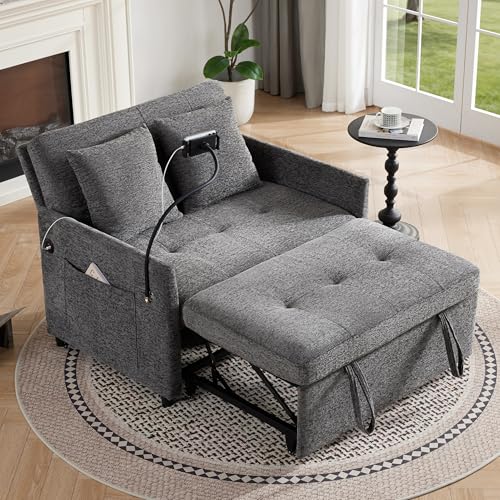
Loveseat Sleeper Sofa Convertible Sofa Bed, Pull out couch, Dark Grey | 3 in 1 couch bed with Phone Holder, Futon Sofa Bed with USB and Type-C Ports for Living Room, Adjustable Backrest
Check price on Amazon
IZLKQC 75'' Folding Sleeper Sofa Bed, Memory Foam Boneless Couch | Full Size Guest Bed Mattress, Modern 2-in-1 Floor Deep Seat Sleeper Sofa with 4 Pillows and Blanket | Corduroy Gray
Check price on AmazonFrequently Asked Questions
What is the difference between a jackknife sofa and a pull-out couch in an RV?
A jackknife sofa folds flat forward, with the seat and backrest meeting to form a sleeping surface. A pull-out couch extends a hidden platform outward or upward from beneath the seat. Jackknife designs are simpler and lighter, while pull-out designs often provide a flatter, larger sleeping area.
How do I measure for an RV couch that turns into a bed?
Measure the available wall length, the depth of the slide-out or floor space, and the height clearance. Then measure doorways and hallway turns along the delivery path. Compare these figures against both the closed and fully deployed dimensions of the couch.
Can I replace the mattress in an RV sleeper couch?
Yes. Many RV sleeper couches accept replacement mattresses or air mattresses designed for the specific mechanism. Check the mechanism type and frame dimensions before ordering, and confirm the replacement fits both the folded and deployed positions. The mattress replacement guide covers the verification steps.
Are RV couches that turn into beds comfortable for everyday sleeping?
Comfort depends on the mattress type and mechanism. Air mattress and memory foam designs tend to offer better support for nightly use, while thin fold-out foam pads suit occasional guests. Adding a mattress topper can improve comfort on most designs.
Do RV sleeper couches need to be anchored to the floor?
Yes. A couch in a moving vehicle must be secured so it does not shift during travel. Most RV sleeper couches include mounting brackets, but the correct fasteners depend on your floor construction. Confirm the anchoring method before installation.
Can a sleeper couch work in a van conversion?
Yes, with careful measurement. Tri-fold and jackknife designs are the most common choices in van conversions because they deploy without requiring a large clear zone in front of the couch. Pull-out designs are viable in wider van layouts where the bed can extend into the aisle.
Related RV and Sleeper Couch Guides
If you are still refining the broader floor plan around your convertible couch, these related guides are worth reading next:
- RV couch bed overview — how convertible seating fits into camper layouts.
- Roll-out couch guide — deployment and clearance considerations for roll-out mechanisms.
- Roll-out couch bed breakdown — sleeping surface geometry compared.
- RV air mattress for pull-out couch — fit and inflation guidance.
- RV pull-out couch mattress replacement — verifying compatibility before ordering.
- Sectional couch that turns into a bed — if a larger sectional layout is on the table.
- Sectional couch that pulls out into bed — pull-out configurations for larger interiors.
- Sectional couch with pull-out bed — feature comparisons across models.
- Sectional couches that turn into beds — broader category overview.
Once the couch is in place, the next considerations are the surrounding layout and decor. The living room layout section covers traffic flow and focal point planning that applies to RV interiors as well as stationary homes, and the couch decor and styling section offers ideas for finishing the space without adding clutter.