
Couch Covers for Odd Shaped Couches: The Complete Fit Guide
Curved sectionals, angled armrests, chaise wedges, and one-of-a-kind silhouettes don't have to be a covering nightmare. Learn how to measure, select, and secure a cover that truly fits an irregular sofa.
Why this guide matters: Standard slipcovers are drafted for boxy, symmetrical frames. An odd shaped couch — whether it's a rounded mid-century piece, an asymmetrical modular build, or a chaise with a sculpted back — needs a different approach. This guide walks you through the fit logic, fabric behavior, and anchoring techniques that make a cover look intentional rather than improvised.
Why Odd Shaped Couches Resist Standard Covers
Most mass-produced couch covers assume a rectangular footprint: four straight sides, flat seat cushions, and squared arms. When the frame deviates from that template, the cover either bunches at the corners, rides up over the arms, or leaves exposed upholstery at the curves. The problem is structural, not cosmetic.
An odd shaped couch typically falls into one of these categories, and each demands a distinct covering strategy:
- Curved or rounded frames — barrel backs, kidney-shaped sofas, and crescent sectionals where a flat cover cannot follow the arc.
- Angled and wedge profiles — chaise wedges, corner wedges, and asymmetrical arms that create irregular seam lines.
- Reclining or articulated sections — covers must accommodate moving parts; the approach differs from static frames, similar to what you'd consider with covers designed for reclining couches.
- Pillow-back and loose-cushion designs — the back rest is a stack of cushions rather than a fixed panel, which changes how a cover anchors; see our notes on covers for pillow-back couches.
Recognizing which category your sofa belongs to is the single most important step before shopping. It determines whether a stretch cover can work, whether you need a multi-piece assembly, or whether a custom or semi-custom solution is the realistic path.
Measure First: The Odd Shape Measurement Method
Standard measuring instructions (back height, seat width, arm-to-arm) assume straight lines. For an irregular couch, you need to capture the widest points and the depth changes along the silhouette. Use a soft tailor's tape and record the following:
- Maximum overall width — measure across the widest part of the frame, not the seat.
- Maximum overall depth — from the front-most point of the seat or chaise to the deepest point of the back.
- Back height at the highest point — curved backs often peak at the center.
- Arm height and arm width — measure each arm separately; asymmetrical designs differ left to right.
- Seat depth at the front edge and at the back edge — tapered seats change dimension along the depth.
- Chaise extension length — if present, measure from the main seat edge to the chaise tip.
Write these numbers down and compare them against the cover's stated range. A cover that matches your maximum width but not your depth will pull tight at the back and wrinkle at the front. For a broader refresher on general sizing logic, the couch cover size guide explains how manufacturers translate frame dimensions into cover sizes.
Fabric Behavior: What Stretches, What Drapes
On a standard rectangular sofa, fabric choice is mostly about look and durability. On an odd shaped couch, fabric mechanics determine whether the cover can physically conform to the frame. There are two broad families:
High-stretch knits and spandex blends
These conform to curves and angled corners because the fabric itself deforms. They work best on rounded backs and tapered seats. The trade-off is that very high stretch can thin out over time and may show the underlying upholstery color through lighter tones. Look for a fabric with moderate four-way stretch rather than maximum elasticity.
Woven fabrics with drape
Cotton, linen blends, and chenille drape rather than stretch. They suit frames with loose cushions and pillow backs, where you can tuck fabric into the seams between cushions. They will not conform to a hard curved arm without a tailored seam, so they're best paired with a multi-piece cover or a custom fit.
If your sofa is both curved and reclining, prioritize stretch with reinforced seams; the combination of articulation and curvature is the hardest case. Our guide to covers for curved sectionals with recliners goes deeper into that specific scenario.
Cover Styles Ranked by Fit Difficulty
Not all cover constructions handle irregular geometry equally. The table below maps common cover styles to the frame types they realistically fit.
| Cover Style | Best For | Fit Confidence on Odd Shapes | Notes |
|---|---|---|---|
| One-piece stretch slipcover | Rounded backs, tapered seats, modest curves | Moderate to good | Works when the frame is continuous; struggles with deep chaise wedges. |
| Two-piece (seat + back) stretch cover | Pillow-back and loose-cushion frames | Good | Separate pieces follow cushion breaks; see pillow-back cover guidance. |
| Modular multi-panel cover | Sectionals, L-shapes, wedge configurations | Good to very good | Each panel covers a segment; the most adaptable off-the-shelf option. |
| Fitted/elastic-corner cover | Rectangular frames with minor irregularity | Low to moderate | Relies on square corners; slips on strong curves. |
| Custom-tailored cover | Any frame, including extreme asymmetry | Excellent | Made to your measurements; the reliable route for unusual silhouettes. |
If your piece is L-shaped rather than continuously curved, a segmented approach is often the best balance of fit and effort; the L-shaped couch cover guide explains how to divide the frame into coverable zones. For cushions that are themselves irregular, covers for L-shaped cushions addresses the cushion-level fit problem.
Anchoring Techniques for Irregular Frames
Even a well-sized cover will shift on an odd shaped couch unless you anchor it deliberately. The goal is to create tension points that match the frame's geometry rather than fighting it.
- Tuck into cushion breaks. On pillow-back sofas, push fabric into the gap between the seat and back cushions; the cushions themselves become the anchor.
- Use the foam noodle trick. Rolled foam or pool noodles pushed into the seat-back crease hold stretch fabric in place without visible clips.
- Add elastic straps underneath. For chaise wedges and angled seats, a strap from front hem to rear hem prevents the cover from riding up.
- Secure at the arms with twist pins or hook-and-loop tabs. Asymmetrical arms need independent anchoring on each side.
- Weight the hem on curved fronts. A slightly weighted hem keeps fabric from curling away from a rounded seat edge.
Waterproof and washable covers have additional anchoring considerations because the backing fabric is often slicker. If you need spill protection on an irregular frame, review waterproof sectional covers and washable couch covers for the fastening details that matter.
When to Choose Custom vs Off-the-Shelf
The decision comes down to how far your frame deviates from a rectangle and how visible the misfit would be in your room.
Starter Tier
Off-the-shelf stretch covers in a two-piece or modular format. Suitable when the irregularity is mild — a slight curve or a single angled arm.
Balanced Tier
Multi-panel modular covers or semi-custom covers sized to your measurements. Handles L-shapes, wedges, and reclining sections well.
Top-Tier
Fully custom-tailored covers drafted from your sofa's dimensions. The dependable route for strong curves, asymmetry, and unusual silhouettes.
Custom tailoring is a long-term investment in appearance and fit, but it isn't always necessary. A modular off-the-shelf cover can look deliberate on a gently curved sofa if the fabric is chosen well and the anchoring is disciplined. The key is honesty about how irregular your frame really is.
Styling an Odd Shaped Couch Once Covered
A cover that fits well is only half the result. On irregular silhouettes, styling does the work of making the cover read as intentional design rather than a protective layer.
- Let the silhouette speak. On a curved sofa, avoid heavy throws that flatten the arc; a single folded blanket on one arm preserves the shape.
- Use cushion breaks as design lines. Anchor color or pattern at the seams rather than across the whole surface.
- Keep patterns proportionate. Large-scale prints can distort on stretch fabric over curves; small or medium patterns hold their geometry better.
- Coordinate with the room's anchor pieces. If the cover is neutral, let a rug or artwork carry the visual weight.
If visual quality is your primary concern, the guide to couch covers that actually look good covers fabric weight, color behavior, and seam placement in more detail. For households with pets, pair your chosen cover with the anchoring guidance in waterproof covers for pets.
Recommended Couch Covers for Odd Shaped Couches
⚠️ AFFILIATE DISCLOSURE: This website contains affiliate links. As an affiliate Associate, we earn from qualifying purchases. If you make a purchase through these links, we may receive a small commission at no additional cost to you. Read our full affiliate policy.
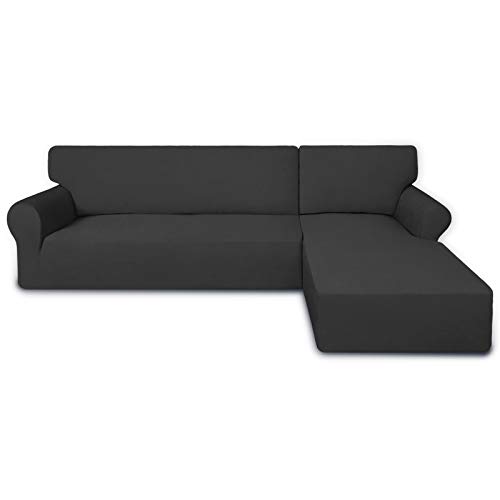
PureFit Super Stretch Sectional Couch Covers - 2 pcs Spandex Non Slip, with Elastic Bottom for L Shape Sectional Sofa Couches, Great for Kids & Pets (3 Seat Sofa + 3 Seat Chaise, Dark Gray)
Check price on Amazon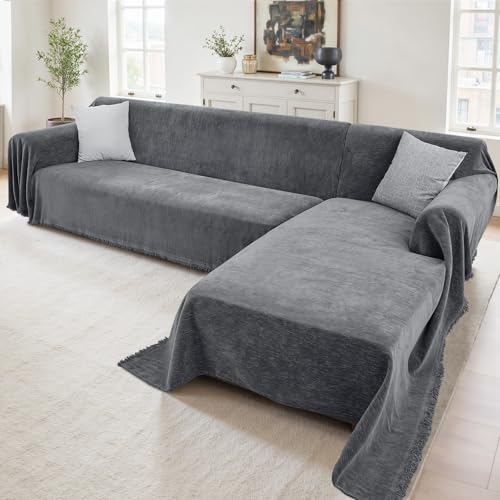
Houmiggle 2 Pieces Sectional Couch Covers L Shaped Cover XL Dark Gray | Washable L Shaped Sectional Sofa Cover, Anti-Hair, Stain & Wear Resistant, Easy Care & Installation 71" x 110" + 71" x 118"
Check price on Amazon
HOMERILLA 2 Piece Sectional Couch Cover For L Shape Sofa Dark Grey XL | Washable Fabric, Anti-Pet Hair, Stain & Wear Resistant, Multiuse Sofa Blanket Protector, Pet Friendly Easy Installation
Check price on Amazon
LA MEACK Couch Cushion Covers for Sectional Sofa L Shape Washable Separate Seat Chaise Couch Cover Stretch Sofa Slipcovers with 2 Pcs Pillowcases(2 Seater + 1 Chaise, Dark Grey)
Check price on Amazon
Deep Dream Sectional Couch Covers U Shape, 3 Pieces Waterproof Sofa Cover for Sectional Sofa, Non Slip U Shaped Couch Cover with Chaise Lounge for Dogs Pets, Dark Grey (2PCS 110"x63" + 1PCS 90"x71")
Check price on Amazon
Easy-Going Stretch Couch Covers for Sofa Washable Large Dark Gray | 1-Piece Sofa Covers for 3 Cushion Couch Furniture Protector Couch Slipcover Soft with Elastic Bottom for Kids Pets
Check price on Amazon
Sofa Shield Couch Covers with Strap, Sectional Corner, Charcoal | Reversible Furniture Protector, Stain and Tear Resistant Cushion Cover, Machine Washable Pet Slipcover, Cats Sectional Corner
Check price on Amazon
Jcones 4 Piece T Cushion Sofa Slipcovers Stretch Couch Cover Furniture Covers with 3 Individual T Cushion Covers, Machine Washable for Living Room (Light Gray, 3 Cushions)
Check price on AmazonA Practical Decision Checklist
Before you commit to a cover, run through these questions. If you answer "no" to more than one, reconsider the format rather than the fabric.
- Have I measured the maximum width, depth, and height — not the average?
- Does the cover's stated size range include my maximum dimension with at least a small margin?
- Is the fabric's stretch profile compatible with my frame's curvature?
- Does the cover construction (one-piece, two-piece, modular) match my cushion layout?
- Do I have a realistic anchoring plan for the arms, seat crease, and hem?
- If the frame is strongly irregular, have I compared custom tailoring against off-the-shelf options?
Frequently Asked Questions
Can a standard stretch cover fit a curved sofa?
Often yes, but with caveats. A one-piece stretch cover can follow a gentle curve if the fabric has moderate four-way stretch and the frame has no deep wedges. Strongly curved or barrel-backed sofas usually need a two-piece or modular cover so the fabric can follow the arc in segments.
How do I keep a cover from slipping on an angled arm?
Anchor each arm independently with twist pins or hook-and-loop tabs, and tuck the fabric into the arm-to-seat seam. If the arm is asymmetrical, treat each side as a separate fitting problem rather than applying a symmetrical solution.
Is a custom cover worth it for an unusual sofa?
For strongly irregular frames — deep chaise wedges, pronounced curves, reclining sections — a custom cover is the most reliable route to a clean fit. For mild irregularity, a modular off-the-shelf cover with disciplined anchoring can look deliberate and cost considerably less in effort.
What about covers for a chaise or wedge section?
Treat the chaise as its own coverable zone. A multi-panel modular cover lets you fit the main seat and the chaise extension separately, which avoids the tug-of-war that happens when a single cover tries to span both. If your cushions are themselves L-shaped, review covers for L-shaped cushions.
Will a cover hide the original upholstery completely?
It depends on the fabric's opacity and the original color. Light covers over dark upholstery can show through under tension on curves. Choose a denser knit or a woven fabric with a backing if full coverage is the goal.
Do I need a waterproof cover for an odd shaped couch?
Only if spill or pet protection is a priority. Waterproof backing adds slickness that complicates anchoring on curved frames, so budget extra attention to straps and tucks. If you do need protection, review waterproof sectional covers for fastening details.
Ready to Cover Your Odd Shaped Couch?
Compare stretch, modular, and custom-fit options in one place, then match the cover format to your frame's geometry.
Explore Cover Options