
Sectional with Pull Out Bed and Storage
One piece of furniture, three jobs done well. Learn how a pull-out sectional with hidden storage solves guest sleeping, daily lounging, and living room organization without sacrificing floor space.
EXPLORE RECOMMENDED MODELSWhy this combination matters: A sectional with a pull out bed and storage is the most space-efficient multi-function couch category available today. Instead of buying a sofa, a guest mattress, and a storage bench separately, you get all three in a single footprint. This guide explains mechanisms, mattress types, storage layouts, sizing rules, and maintenance so you can choose with confidence before you buy.
What Is a Sectional with Pull Out Bed and Storage?
A sectional with pull out bed and storage is a couch that combines an L-shaped or U-shaped seating arrangement with two additional functions: a fold-out sleeping surface and integrated compartments beneath the seats or chaise. In practice, this means one piece of furniture serves as your main living room seating, your guest bed, and your hidden storage zone for blankets, pillows, board games, and other items that otherwise clutter the room.
The category has grown quickly because it answers a very specific homeowner problem: small and medium living rooms need to do more with less. A standard sofa plus a separate sleeper and a storage bench would consume three times the floor area. A sectional with pull out bed and storage collapses all three functions into a single footprint, and modern mechanisms have become smooth enough that converting from seating to sleeping takes only a few seconds.
There are important trade-offs to understand. The storage compartments reduce the depth available for mattress mechanisms, so pull-out beds in storage sectionals are usually thinner than dedicated sleeper couches. The frame also needs to be sturdier than a standard sectional because it must support both the bed mechanism and the weight of stored items. Buyers who understand these trade-offs are far more satisfied with their purchase.
How the Pull-Out and Storage Mechanisms Work
Understanding the mechanics helps you judge quality when comparing models. The two systems work independently but share the same frame, which is why the frame quality matters more here than on a simple sofa.
Pull-Out Bed Mechanisms
Three mechanism families dominate the market:
- Fold-out metal frame with mattress attached: The mattress folds into thirds and sits on a hinged steel frame. When extended, the frame unfolds to create a full-length sleeping surface. This is the most common design because it is compact when closed and works well alongside under-seat storage.
- Pull-out drawer frame (trundle style): A separate frame slides out from the base of the sofa. The mattress may be stored folded inside or may inflate when deployed. This design leaves more room for the storage compartments inside the main body.
- Click-clack and pop-up systems: The seat back folds down flat, or the seat lifts and rotates into a bed. These are simpler mechanically, but they usually produce a firmer, flatter sleeping surface and offer less storage underneath.
Entry-level models typically use lighter-gauge steel and simpler hinge joints. Mid-range and premium tiers move to reinforced steel rails, anti-sag bars, and smooth-glide bearings. High-end tier and commercial-grade models may use welded frames rated for daily conversion. When comparing, check the mechanism's rated cycle count and the weight capacity specified by the manufacturer.
Storage Configurations
Storage in these sectionals usually appears in one or more of these locations:
- Chaise storage: A lift-top lid on the chaise section, often the largest single compartment.
- Under-seat drawers: Pull-out drawers beneath the main sofa cushions, ideal for bedding and pillows.
- Ottoman storage: Flip-top or lift-top compartments on the ottoman section, useful for remotes, throws, and small items.
- Armrest and back compartments: Smaller pockets for magazines, chargers, and accessories.
Lift-top lids with gas struts are the most convenient because they hold themselves open while you load them. Drawers on metal glides are easier on your back than lifting lids. Combined configurations that place the largest storage in the chaise and smaller storage in the seats tend to offer the best balance of capacity and mechanism clearance.
Types of Pull-Out Sectionals with Storage
Configuration drives how well the couch fits your room and how the bed and storage functions behave in daily use. Here are the main shapes and their practical strengths.
L-Shaped Sectional with Pull-Out Bed and Storage
The most popular configuration. The L-shape defines a seating zone while the chaise provides the primary storage compartment. The pull-out bed usually extends from the main sofa section rather than the chaise, which keeps the sleeping surface straight. This works well in open-plan rooms and medium living rooms where a clear corner exists.
U-Shaped Sectional with Pull-Out Bed and Storage
U-shaped models maximize seating and often place storage in both end sections. The trade-off is a larger footprint and more complex assembly. They suit large rooms and family spaces where the couch doubles as a conversation hub. Check that the pull-out mechanism extends into open floor space rather than against a wall or coffee table.
Sectional with Chaise and Pull-Out Bed
A chaise-and-bed combination places the storage compartment inside the chaise and the sleeping surface on the opposite side. This is the most ergonomic layout for daily use because the chaise becomes the primary storage access point, while the bed extends from the seat section. Models like the sectional with chaise and pull out bed are especially common in apartment living rooms.
Reclining Sectional with Hide-a-Bed and Storage
Reclining sectionals add powered or manual recliners to the seating mix. Adding storage and a hide-a-bed to a reclining frame increases mechanical complexity, so mid-range and premium tiers are strongly recommended here. Reclining models are best for rooms with generous clearance behind the seats. If you want recliners on both ends, review sectional with recliners on each end for compatible layouts.
Modular Sectional with Pull-Out Bed and Storage
Modular pieces let you rearrange seating over time and often include storage modules that lock together. They are flexible for renters and growing families, but the connection hardware between modules should be inspected for durability, especially where the pull-out bed frame joins adjacent seats.
| Configuration | Best For | Storage Position | Tier Notes |
|---|---|---|---|
| L-shaped sectional | Medium living rooms, open-plan spaces | Chaise + under seats | Essential to premium tiers widely available |
| U-shaped sectional | Large rooms, family gathering spaces | Both end sections | Mid-range and high-end tier recommended |
| Chaise + pull-out bed | Apartments, daily lounging plus guest use | Inside chaise | Balanced to premium tiers |
| Reclining sectional | Home theater and relaxation spaces | Under seats, console, chaise | Premium and high-end tier recommended |
| Modular sectional | Renters, evolving layouts | Per-module compartments | Mid-range to top-tier modular systems |
Mattress Types and Comfort Tiers
The mattress is the single biggest determinant of whether guests sleep well. Because storage compartments take up space inside the frame, pull-out mattresses in storage sectionals are usually thinner than dedicated sleeper mattresses. Knowing what each tier offers helps you set realistic expectations.
Innerspring Mattresses (Entry-Level to Mid-Range)
Traditional coil mattresses remain common in entry-level models. They are lightweight, fold easily, and are simple to replace. The downside is that thin coil mattresses can transmit motion and may develop pressure points over time. Look for models with a quilted top layer and a coil count appropriate for the sleeper's weight.
Memory Foam and Gel Foam (Mid-Range to Premium)
Foam mattresses have become the standard in mid-range and premium tiers because they fold into smaller volumes, sleep cooler when gel-infused, and provide better contouring support for occasional guests. A foam mattress of at least 4.5 to 5 inches thick is a reasonable target for guest comfort. Higher-density foam resists bottoming out and tends to last longer across conversion cycles.
Air-Over-Coil and Hybrid Systems (High-End Tier)
Some high-end tier and professional-grade models pair an air chamber with a coil base, letting you adjust firmness. These systems are heavier and require more maintenance, but they deliver the closest experience to a dedicated guest bed. They are a worthwhile investment for households that host overnight guests frequently.
Whatever the mattress type, confirm that the mattress is replaceable and that replacement sizes are standardized. Proprietary mattress shapes are difficult to source later, which shortens the effective lifespan of the entire couch.
Sizing, Layout, and Clearance Rules
Measurement mistakes are the leading cause of returns in this category. The pull-out bed adds a large moving footprint, and the storage function adds weight, so plan the room before you plan the couch.
Measure the Room in Three Zones
- Wall zone: The length of the wall where the sectional will sit, including any windows, vents, and outlets.
- Extension zone: The open floor area in front of the couch where the bed will deploy. Most pull-out beds need 30 to 36 inches of clearance, and full-size models may need more. Measure from the front edge of the couch to the nearest obstruction.
- Walkway zone: Maintain at least 30 inches of walkway around the seating group, and 36 inches in primary traffic paths.
Check the Delivery Path
Sectionals with storage frames are heavy and often ship in multiple boxes. Measure doorways, hallway widths, stairwell turns, and elevator dimensions. A couch that cannot pass through the entry is a couch that gets returned. Removable backs and modular connections help, so confirm whether the model can be partially disassembled.
Balance the Seating and Sleeping Footprints
A pull-out bed must be at least as long as the tallest regular user. Standard full-size pull-outs run about 75 inches, while queen-size mechanisms approach 80 inches. Storage depth also matters: a deep chaise storage compartment reduces the legroom available for the seated position opposite it. Sketch the layout to scale before ordering, and place the bed extension zone so it does not block the room's main traffic path.
| Room Size | Recommended Configuration | Bed Extension Clearance | Storage Priority |
|---|---|---|---|
| Small (under 150 sq ft) | L-shaped with chaise storage | 30 inches minimum | Chaise lift-top |
| Medium (150–250 sq ft) | L-shaped or chaise + pull-out | 32–36 inches | Under-seat drawers + chaise |
| Large (over 250 sq ft) | U-shaped or modular | 36 inches or more | Multiple compartments |
Upholstery Materials and Durability
The fabric or leather you choose interacts with both functions of this couch. The bed mechanism causes repeated friction at the fold seams, and the storage compartments create extra edges that see wear. Material selection should account for both.
Performance Fabric
Performance fabric is the most practical choice for family homes and pet owners. Tight weaves resist snagging, and stain-resistant finishes make cleanup easier around a couch that doubles as a guest bed. Look for fabrics rated for heavy-duty use, and confirm whether the covers are removable and washable.
Leather and Faux Leather
Leather offers excellent durability and a premium look, but it can be slick on a sleeping surface and feels colder in winter. Top-grain leather is the most durable natural option. Faux leather is easier to clean but can crack at fold points over time. For leather models, prioritize reinforced stitching along the bed fold seams.
Velvet and Textured Fabrics
Velvet looks luxurious and feels warm, but it shows crush marks where the bed frame folds and requires more careful cleaning. If velvet is your style, choose a performance-velvet blend and vacuum the storage compartments regularly to prevent dust from settling into the pile.
Machine-Washable Covers
Covers that can be removed and machine-washed are a major advantage on a couch used for sleeping and storage, since both functions attract dust and odor. Check whether the manufacturer supplies replacement covers and whether the zippers are rated for repeated removal. Models built with machine washable covers make long-term maintenance much easier.
Who Should Choose This Configuration
This couch category is not for everyone. It solves specific problems well, and it introduces specific compromises. Here is an honest breakdown.
Strong Fits
- Apartment dwellers and small-home owners: The combination of seating, guest bed, and storage in one footprint is the category's core advantage. Models like the small sectional with storage and pull out are designed specifically for these rooms.
- Frequent hosts with occasional overnight guests: A pull-out bed that deploys in seconds beats inflating an air mattress every visit.
- Families who need organized living rooms: Hidden storage absorbs blankets, toys, and media accessories that would otherwise clutter the seating area.
- Renters who want flexibility: A single multi-function piece moves more easily than three separate furniture items.
Weaker Fits
- Households needing a nightly sleeping surface: Pull-out mattresses are built for occasional use. Frequent sleepers should prioritize a high-end tier model with a thick foam or hybrid mattress, or choose a dedicated bed instead.
- Rooms with tight floor space in front of the couch: The bed extension needs clearance. If furniture or walkways block that zone, the sleeping function becomes impractical.
- Buyers who prefer minimal maintenance: Storage compartments and folding mechanisms require periodic vacuuming, lubrication, and inspection.
If your primary need is guest sleeping with less storage, a simpler sectional with pull out bed may be a better match. If your primary need is storage with occasional sleeping, a sectional couch with ottoman storage might suit you better. The three-in-one configuration makes the most sense when all three functions will be used regularly.
Buying Checklist Before You Order
Use this checklist to evaluate any model you are considering. Each item maps to a common source of buyer regret.
- Frame construction: Look for kiln-dried hardwood or furniture-grade plywood with reinforced corner blocks. Metal rails should be at least mid-range gauge steel on pull-out models.
- Mechanism rating: Check the manufacturer's stated weight capacity and conversion cycle rating. Premium and high-end tier models should specify both.
- Mattress thickness and type: Confirm the mattress is at least 4.5 inches thick for guest comfort, and that replacement mattresses are standardized and available.
- Storage access: Prefer lift-top lids with gas struts or drawers on metal glides. Test the opening path to ensure the lid or drawer clears nearby furniture.
- Dimensions and clearance: Verify room measurements, delivery path, and bed extension clearance with the numbers from the product specification sheet, not the marketing photos.
- Upholstery durability: Match the material to your household. Performance fabric for families and pets, leather for low-maintenance durability, washable covers for allergy-sensitive homes.
- Assembly and delivery: Confirm whether the couch ships assembled or in boxes, and whether in-home delivery includes setup. Heavy storage sectionals benefit from professional assembly.
- Warranty coverage: Check whether the frame, mechanism, and mattress have separate warranty periods. The mechanism and mattress are the most likely failure points.
Buyers who are earlier in the research process may benefit from comparing this configuration against broader options in sectional couches for sale or reviewing the wider sectional couch with sofa bed category before committing.
Care and Maintenance
A three-function couch lasts longer when each function gets its own maintenance routine. Build these habits into your regular cleaning schedule.
Pull-Out Mechanism Care
- Extend and retract the bed fully every few weeks to keep the hinges moving freely.
- Lubricate metal rails and pivot points with a dry silicone lubricant according to the manufacturer's schedule. Avoid oil-based lubricants that attract dust.
- Inspect welds and hinge plates for cracks or loose bolts, especially at the fold seams.
- Do not exceed the rated weight capacity of the bed mechanism, and discourage children from jumping on the extended frame.
Storage Compartment Care
- Vacuum compartments monthly with a brush attachment to prevent dust and lint buildup.
- Store bedding in breathable cotton bags rather than sealed plastic, which traps moisture.
- Respect the manufacturer's weight limits for stored items. Overloading lifts or drawers can warp the frame.
- Air out the compartments seasonally to prevent stale odors, especially in humid climates.
Upholstery and Mattress Care
- Vacuum the mattress surface and rotate it periodically if the design allows.
- Clean spills immediately and blot rather than rub, especially on velvet and textured fabrics.
- Keep the couch out of direct sunlight to slow fading, and use a fabric protector appropriate for the upholstery type.
- For deeper cleaning, use a steamer suited to the fabric and follow the care code on the manufacturer's label.
Recommended Sectionals with Pull-Out Bed and Storage
⚠️ AFFILIATE DISCLOSURE: This website contains affiliate links. As an affiliate Associate, we earn from qualifying purchases. If you make a purchase through these links, we may receive a small commission at no additional cost to you. Read our full affiliate policy.

Marsail 110" Modular Sectional Sleeper Sofa, Pull Out Sofa Bed with Storage | 7 Seat Comfy Cloud Sofas for Living Room, Chenille Sectional Couches with USB Ports & Cup Holders, Dark Gray
Check price on Amazon
WUNSTANTE Sectional Sleeper Sofa with Pull Out Bed, Plush Corduroy 7 Seat Modular Sectional Sofa with Storage Chaise and Adjustable Backrest, Cloud Couches for Living Room, Apartment, Dark Grey
Check price on Amazon
108'' Modular Sectional Sleeper Sofa Couches for Living Room, Dark Grey | L/U Shaped Sleeper Sofa, Pull Out Couch Bed, Hidden Storage, Modular Design, Comfy Corduroy, Removable Cover, Movable Ottoman
Check price on Amazon
WUNSTANTE Sectional Sleeper Sofa with Pull Out Bed, Plush Corduroy 5 Seat Modular Sectional Sofa with Storage Chaise and Adjustable Backrest, Cloud Couches for Living Room, Apartment, Dark Grey
Check price on Amazon
108'' Sectional Couches for Living Room, Sectional Sleeper, Black | L/U Shaped Sleeper Sofa, Pull Out Couch Bed, Hidden Storage, Modular Design, Comfy Corduroy, Removable Cover, Movable Ottoman
Check price on Amazon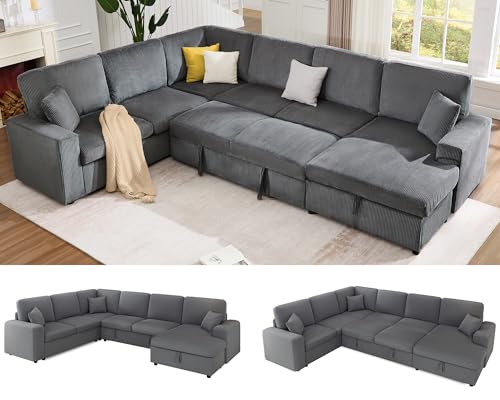
Jocisland 130" Sofa Bed, Sectional Sleeper, Pull Out Couch with Storage | Dual Storage Design, U Shaped Sofa, 7-Seater Sofa Bed for Living Room & Guest Bedroom-Corduroy Grey
Check price on Amazon
Ihanherry 86" Modular Sectional Sofa with Pull Out Bed, 4-Seater L Shaped Sectional Sleeper Couch with Storage Ottoman, Chenille Convertible Couches for Living Room, Apartment (Green)
Check price on AmazonFrequently Asked Questions
What is a sectional with pull out bed and storage?
A sectional with pull out bed and storage is a multi-function couch that combines three features in one footprint: extended L-shaped or U-shaped seating, a fold-out sleeping surface for overnight guests, and built-in compartments beneath the seats for storing bedding, pillows, and living room essentials.
How much floor space does a sectional with pull out bed and storage require?
Most models need roughly 100 to 130 inches of wall length along the main seating run, plus clearance of 30 to 36 inches in front of the pull-out mechanism. Always measure your room, doorways, and stairwell turns before ordering, and allow extra room for the bed to extend fully.
What mattress types are used in pull out sectional beds?
Entry-level models often use standard innerspring mattresses, while mid-range and premium tiers increasingly feature memory foam or gel-infused foam mattresses. Foam options tend to be more supportive for occasional guests, while high-end tier models may include air-over-coil systems or upgraded quilted mattresses.
Where is the storage located on these sectionals?
Storage is typically placed in three locations: beneath the chaise lounge, inside the ottoman section, and under the main sofa seats. Lift-top lids, pull-out drawers, and flip-up bench compartments are the most common mechanisms. Some models combine multiple storage zones for maximum organization.
Are sectional pull out beds comfortable for daily sleeping?
Pull out beds are designed primarily for occasional guests. For nightly sleeping, choose a premium or high-end tier model with a thick foam mattress, a sturdy metal mechanism, and a supportive frame. Even then, frequent sleepers may prefer a dedicated mattress for long-term comfort.
How do I maintain the pull out mechanism and storage compartments?
Vacuum storage compartments monthly to prevent dust buildup, lubricate metal rails and hinges according to the manufacturer's schedule, and avoid overloading storage bins beyond the rated weight. Keep the pull-out bed extended occasionally to air out the mattress and check for fabric wear.
Ready to Choose Your Sectional?
A sectional with pull out bed and storage is a long-term investment that pays off in daily convenience and guest readiness. Use the checklist above, measure carefully, and choose a tier that matches how often you will actually use each function. When you are ready to compare models, the recommended section above shows current options that match this category.
VIEW RECOMMENDED MODELS