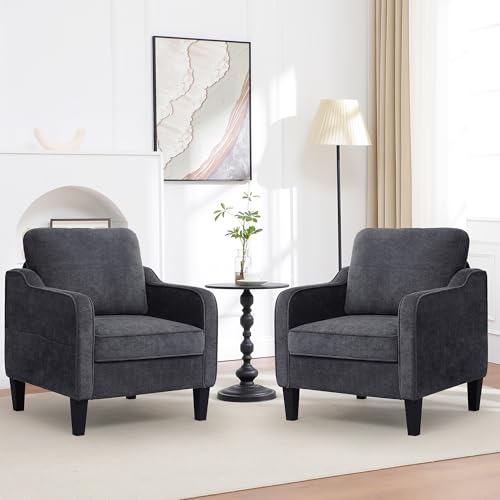
What Counts as a "Set" of Accent Chairs?
A set of accent chairs for a living room usually means two matching or closely coordinated chairs placed together or flanking a focal point. Sets are typically sold as a pair, and they come in three broad formats:
- Matching pair: Two identical chairs — same frame, fabric, and finish. This is the most symmetrical, traditional choice and works well in formal living rooms or as a sofa flanker.
- Coordinated pair: Two chairs that share a frame or silhouette but differ in upholstery or finish. This adds subtle visual interest while keeping a unified feel.
- Mixed pair: Two chairs of complementary style, such as one armchair and one slipper chair, unified by color family or material. This is the most design-forward option and suits eclectic or transitional spaces.
Before you shop, decide which format fits your room's personality. If you are also furnishing the rest of the seating area, it helps to think of the pair as part of a larger coordinated couch set so the proportions and palette stay consistent.
Accent Chair Styles: Which Set Suits Your Living Room?
The style of your accent chairs should relate to your sofa and the room's architecture, but it does not need to match exactly. The most successful living rooms mix one or two style families rather than repeating the same look everywhere.
1. Mid-Century Modern Accent Chairs
Clean lines, tapered wooden legs, and a low profile define this style. Mid-century pairs look excellent beside a streamlined sofa and work in both small apartments and open-plan rooms. They are a popular choice because they feel light and airy while still offering solid support.
2. Traditional and Rolled-Arm Chairs
Rolled arms, skirted bases, and plush cushions give a classic, welcoming feel. A matching pair of rolled-arm chairs is ideal for flanking a fireplace or creating a formal seating arrangement. If you prefer a softer, more tailored look, skirted chairs in a coordinated fabric can unify a room beautifully — similar to how skirted couches soften a living room's lines.
3. Modern and Contemporary Chairs
Sleek frames, metal legs, and bold geometric shapes suit contemporary interiors. These chairs often come in leather or performance fabric and are a strong choice if your sofa is minimal and angular. A pair placed side by side creates a sculptural seating moment.
4. Club Chairs
Deep, low, and boxy, club chairs are exceptionally comfortable and read as substantial. A pair of club chairs is a classic library or den choice and can anchor a conversation area in a large living room. They work especially well with leather upholstery.
5. Slipper and Armless Chairs
Slipper chairs have no arms, which makes them easy to tuck into tight corners or use as pull-up seating. A pair of slipper chairs is a smart solution for narrow living rooms where full armchairs would crowd the walkway.
6. Swivel and Reclining Accent Chairs
Swivel chairs let guests turn toward the conversation or the TV, while reclining accent chairs add lounge comfort. These are practical choices for family living rooms. If comfort is a priority across the whole seating area, it is worth comparing reclining options for the sofa too.
Upholstery Materials: Comfort, Durability, and Upkeep
The upholstery you choose affects how the chairs feel, how long they last, and how much maintenance they need. Here is how the main options compare for a living room set:
| Material | Best For | Durability Tier | Upkeep |
|---|---|---|---|
| Performance fabric | Families, pets, high-traffic rooms | Mid-range to premium | Easy — spot clean |
| Velvet | Formal or glam living rooms | Mid-range | Moderate — brush and vacuum |
| Linen and cotton blends | Casual, relaxed interiors | Entry-level to mid-range | Moderate — professional clean |
| Leather | Long-term use, classic rooms | Mid-range to luxury | Easy — wipe and condition |
| Faux leather | Rentals, easy-clean spaces | Entry-level | Easy — wipe clean |
| Bouclé | Textured, modern interiors | Mid-range to premium | Moderate — gentle vacuum |
If you are weighing leather against fabric for the whole room, our guide on whether to get a leather couch covers the trade-offs in more depth. For accent chairs, a practical approach is to choose the same material family as your sofa but a contrasting color or texture, so the pair reads as intentional rather than accidental.
Sizing and Proportions: Getting the Set Right
Accent chairs that are too large will crowd a living room, while chairs that are too small can look lost. Use these guidelines when you measure:
- Seat height: Aim for 17–19 inches from floor to seat for comfortable sitting. This pairs well with standard sofa seat heights.
- Seat width: 20–24 inches per chair is comfortable for most adults. Two chairs placed side by side should leave at least 4–6 inches between them.
- Overall width: A standard accent chair is roughly 26–34 inches wide. Check that a pair fits your wall or bay window without blocking walkways.
- Depth: 30–38 inches is typical. Deeper club chairs need more clearance behind them.
- Walkway clearance: Leave at least 30–36 inches for main traffic paths and 18 inches for secondary paths between furniture.
In small living rooms, a pair of compact chairs can be more flexible than a second sofa. If space is tight, explore layout ideas for a small living room and pair the chairs with a slim sofa or loveseat. A small loveseat plus two accent chairs is a classic balanced arrangement for compact rooms.
Placement and Arrangement Ideas
Where you place your set of accent chairs determines how the room functions. These arrangements work well in most living rooms:
Arrangement 1: Flanking the Sofa
Place the two chairs symmetrically at either end of the sofa, angled slightly inward. This frames the seating area and works in both large and medium rooms. It is the most balanced, traditional layout.
Arrangement 2: Conversation Pair
Place both chairs side by side facing the sofa, creating an L-shaped conversation zone. This is ideal for hosting and makes the room feel social. Keep a walkway of at least 30 inches between the chairs and the sofa.
Arrangement 3: Focal Point Accent
Set the pair against a window, beside a fireplace, or in a reading corner. This is a good option in open-plan rooms where you want to define a secondary zone without adding another sofa.
Once the chairs are placed, add a slim side table between them or beside the pair to make the arrangement functional. A set of side tables for the living room is a natural companion to accent chairs, giving guests a place for drinks and books. If you prefer a single table, a small accent table can fit neatly between two chairs without blocking the flow.
Color and Fabric Coordination with Your Sofa
Accent chairs are a chance to introduce a second color or texture into the room. Consider these strategies:
- Monochrome layering: Choose chairs in a lighter or darker shade of your sofa color. This keeps the room cohesive while adding depth.
- Complementary contrast: Pick a color opposite your sofa on the color wheel — for example, sage green chairs against a warm neutral sofa — for a balanced, lively look.
- Pattern as the accent: If your sofa is solid, patterned accent chairs can carry the room's personality. If your sofa is patterned, keep the chairs solid.
- Neutral anchor: In a colorful room, a neutral accent chair pair calms the palette and adds a resting point for the eye.
If you are furnishing a small living room and want the option of a coordinated couch and chair package, a small couch set for the living room can simplify the buying process and guarantee a cohesive palette.
Comfort and Build Quality Checklist
Accent chairs are used daily in most homes, so comfort and construction deserve real attention. Use this checklist when comparing options:
- Frame: Solid hardwood frames (kiln-dried) are more durable than particleboard. Look for corner blocks and reinforced joints.
- Seat cushion: High-resilience foam or pocket-spring construction holds its shape longer than low-density foam.
- Suspension: Sinuous springs or eight-way hand-tied springs offer better support than webbing.
- Fabric rub count: For living room use, a higher rub count indicates better abrasion resistance. Performance fabrics are a strong choice for family rooms.
- Legs and glides: Solid wood legs with floor-protecting glides reduce scratching and wobble.
- Weight capacity: Check the stated capacity and look for reinforced leg mounting, especially on budget-friendly frames.
If you plan to pair the chairs with a new sofa, compare construction quality across both so the seating feels consistent. Our guide to sets of two chairs for the living room explores smaller pairings in more detail.
Budget Planning Without the Guesswork
Accent chair sets span a wide range of the market, from entry-level frames to premium designer pieces. Instead of focusing on a specific number, use these tiers to plan your purchase relative to the rest of your room:
- Entry-level tier: Typically engineered wood frames, basic foam, and standard fabric. Suitable for guest rooms or short-term furnishing.
- Mid-range tier: Hardwood frames, better foam density, and performance or leather upholstery. The best balance of durability and design for most households.
- Premium tier: Kiln-dried hardwood, hand-finished details, and high-grade upholstery. A long-term investment for a primary living room.
- Luxury tier: Designer frames, custom upholstery options, and meticulous joinery. Chosen for statement pieces and long-term use.
A useful rule is to spend more on the pieces you sit in daily. If the accent chairs will be used for reading and conversation every evening, a mid-range or premium set usually proves more efficient in the long run than an entry-level pair that needs replacing.
Accent Chairs vs. Other Seating Options
If you are deciding between a pair of accent chairs and another seating format, this comparison can help:
| Option | Best For | Trade-Off |
|---|---|---|
| Set of accent chairs | Conversation zones, flexible layouts, visual balance | Less lounging space per seat than a sofa |
| Loveseat | Compact rooms, couples, secondary seating | Fixed orientation, less flexible than two chairs |
| Chaise lounge | Relaxing, reading, stretching out | Takes more floor depth; not ideal for conversation |
| Recliner | TV viewing and comfort | Needs clearance behind for reclining |
| Small sectional | Maximizing seating in a corner | Less flexible if you rearrange often |
In many rooms, the best outcome is a combination: a sofa or sectional as the main anchor, plus a set of accent chairs for flexibility. If your room is on the smaller side, a small sectional with chaise and sleeper can cover seating and guest needs while the accent chairs provide the finishing layer.
Matching Accent Chairs to Different Room Types
Small Living Rooms
Choose armless or slim-arm chairs with tapered legs to keep sightlines open. Place them perpendicular to the sofa rather than in front of it. A pair of swivel chairs works well because guests can turn without the chairs needing to be repositioned.
Open-Plan Rooms
Use the accent chair pair to define a boundary between the living zone and the dining or kitchen zone. Place the chairs with their backs to the adjacent area to create a visual wall without blocking light.
Formal Living Rooms
Symmetry is your friend. A matching pair of rolled-arm or club chairs flanking a fireplace or bay window creates a polished, traditional composition. Coordinate with the sofa's upholstery family for a cohesive look.
Family Rooms
Prioritize performance fabric, sturdy frames, and easy-clean surfaces. Swivel or reclining accent chairs add function, and a pair placed near the sofa creates extra seating for movie nights.
Common Mistakes to Avoid
- Buying chairs that are too large: Measure the room and walkways before ordering. Oversized chairs make a room feel cramped even when they look good in a showroom.
- Ignoring seat height: Chairs that are much lower or higher than the sofa can feel awkward in a conversation grouping.
- Mismatched scale with the sofa: Very delicate chairs next to a bulky sofa look unbalanced. Match visual weight, not just color.
- Forgetting the walkway: Two chairs placed side by side can block traffic if they are not measured against your room's flow.
- Skipping fabric samples: Color and texture look different in natural light. Request swatches where possible.
Care and Maintenance for Accent Chair Sets
Regular care keeps accent chairs looking their best and extends their usable life:
- Vacuum upholstery every two to four weeks with a soft brush attachment.
- Rotate and flip seat cushions where possible to distribute wear.
- Keep chairs out of direct sunlight to prevent fading, especially with natural fabrics.
- Treat spills promptly with a clean, dry cloth and the manufacturer's recommended cleaner.
- Condition leather chairs every six to twelve months to prevent cracking.
- Check and tighten leg bolts periodically, especially in households with children.
For deeper cleaning guidance, our couch care and maintenance section covers fabric, velvet, and leather methods in detail.
Frequently Asked Questions
Should accent chairs match the sofa exactly?
No. Exact matching can make a room feel flat. Instead, coordinate by color family, scale, or material. A coordinated pair — same silhouette, different shade — is usually the most design-friendly approach.
How far apart should two accent chairs be placed?
Leave about 4–6 inches between two chairs placed side by side, and keep at least 30 inches of clear walkway in front of them. If the chairs flank a side table, allow enough room to reach the table comfortably.
Are accent chairs comfortable for everyday use?
Many are, especially club chairs and swivel chairs with high-resilience foam and supportive frames. If daily use is the goal, prioritize seat depth, cushion density, and a solid hardwood frame over decorative details.
What is the best fabric for accent chairs in a family home?
Performance fabrics are the most practical choice. They resist stains and are easy to spot clean. Leather and faux leather are also good options for busy households because they wipe clean easily.
Can I use accent chairs in a small living room?
Yes. Armless slipper chairs and slim-arm chairs are particularly space-efficient. Place them perpendicular to the sofa and choose a light color to keep the room feeling open. Always measure walkways before ordering.
How do I choose between a set of accent chairs and a loveseat?
Choose accent chairs if you want flexibility, easy rearranging, and a conversation-focused layout. Choose a loveseat if you need a fixed two-person seat and prefer a more anchored arrangement. A small two-person couch can be a good compromise in tighter rooms.
Ready to Compare Accent Chair Sets?
Explore the curated selection below to compare styles, materials, and configurations for your living room.
Explore Options