
Small Sectional That Turns Into a Bed: The Complete Buyer's Guide
One piece of furniture, two essential functions. Learn how to choose a compact sectional sleeper that fits your space, hosts overnight guests comfortably, and holds up to daily life.
Jump to Buying CriteriaA small sectional that turns into a bed solves a problem that many compact homes face: how to seat a group comfortably during the day and still offer a proper place to sleep at night. Unlike a standard sofa bed, a sectional configuration adds a chaise or corner extension, giving you more seating capacity in an L-shaped footprint that often fits better against walls and in corners than a long, straight couch.
If you are in the research stage, you already know you want convertible functionality. What you likely still need is clarity on sizing, mattress construction, conversion mechanisms, and how to verify that a specific model will actually fit your room and your doorway. This guide walks through each of those decision points in the order you will encounter them when shopping.
For readers who want to explore related configurations before committing, our overview of small couch that turns into a bed options covers the broader category, while this page focuses specifically on sectional layouts.
What Exactly Is a Small Sectional Sleeper?
A small sectional sleeper is a compact sectional sofa — typically 70 to 90 inches wide on its longest side — with a built-in conversion feature. The conversion usually takes one of three forms:
- Pull-out mechanism: A metal frame slides out from under the seat, unfolding a mattress that is stored inside the sofa body. This is the most traditional sleeper design.
- Fold-down or flip-down design: The backrest folds flat or the seat flips forward to create a sleeping surface. These tend to be lighter and require less mechanical hardware.
- Modular conversion: Individual modules reconfigure into a bed, often by removing back cushions and joining two pieces. Popular in modern modular collections.
The term "small" is relative, but in this category it generally means the unit fits a room under roughly 150 square feet without dominating the floor plan. Many models in this size class are designed specifically for apartments, studios, guest rooms, and home offices that double as overnight accommodations.
Why Choose a Sectional Over a Standard Sleeper Sofa?
The sectional format offers practical advantages that a straight sofa bed cannot match in a compact room:
- Corner efficiency: An L-shape uses the corner of a room, which is often dead space with a rectangular sofa.
- More seating per square foot: A chaise section seats two or three people in the footprint of a single armchair plus sofa combination.
- Defined living zones: In open-plan studios, the sectional itself creates a visual boundary between the living area and sleeping or dining zones.
- Better guest experience: A dedicated chaise gives daytime guests a lounge spot, and the sleeper function gives overnight guests a flat surface rather than a cramped pull-out.
That said, sectionals are not automatically the right answer. If your room is extremely narrow, a small L-shaped couch without sleeper function may be easier to place. The sleeper mechanism adds depth and weight, so confirm your room can accommodate the deployed bed before choosing this category.
Sizing: The Numbers That Matter
Sizing is where most buyers make costly mistakes. A sectional sleeper has three distinct footprints you must measure: the assembled sofa footprint, the deployed bed footprint, and the delivery path.
1. Assembled Footprint
Measure the length of the longest side, the depth of the chaise or corner, and the overall height including back cushions. Leave at least 18 inches of walkway clearance around the unit so the space does not feel cramped. In a small room, a sectional placed against two walls with a 30-inch walkway on the open sides usually works well.
2. Deployed Bed Footprint
When the bed extends, you need clearance in front of the sofa. Pull-out models typically need 5 to 7 feet of open floor space, depending on mattress length. Fold-down models need less — usually 3 to 4 feet — because the sleeping surface extends forward rather than sliding out. Measure from the front edge of the sofa to the nearest wall, coffee table, or doorway.
3. Delivery Path
This is the measurement buyers forget. A sectional that fits perfectly in the room may not fit through the front door, hallway, stairwell, or elevator. Measure the narrowest point of every passage and compare it to the delivered dimensions — not the assembled dimensions. Many compact models ship with removable legs or split backs precisely to clear tight entries. Our guide to sectionals that fit through small doorways explains how to verify this before ordering.
Quick reference for typical small sectional sleeper sizes:
• 2-piece L-shape: roughly 75–85 in wide × 55–60 in deep (chaise side) × 33–36 in tall
• Bed deployment clearance: 60–80 in in front of the unit for pull-out; 36–48 in for fold-down
• Recommended room size: at least 10 × 12 ft for comfortable circulation around a deployed bed
Mattress Types in Small Convertible Sectionals
The mattress is the single biggest factor in how comfortable your guests will be. Compact sleepers use thinner mattresses than standard beds, so material choice matters more than thickness.
| Mattress Type | Typical Thickness | Best For | Considerations |
|---|---|---|---|
| Memory foam | 3–5 in | Occasional guests, back sleepers | Conforms well; can feel warm; needs a breathable cover |
| High-density foam | 4–6 in | Frequent use, combination sleepers | Firmer support; resists bottoming out better than low-density foam |
| Pocket-coil hybrid | 5–7 in | Daily sleeper use, couples | Heavier unit; better edge support; usually found in mid-range and premium models |
| Air-over-foam | 4–6 in | Adjustable firmness preference | Requires inflation; less common in compact sectionals |
| Futon-style cotton/foam | 4–6 in | Lightweight fold-down designs | Firmer feel; may compress over time; good for occasional use |
If the sleeper will be used regularly — say, a studio where the bed is deployed nightly — prioritize a high-density foam or pocket-coil hybrid. For guest rooms used a few times a year, memory foam or a futon-style mattress is usually sufficient. Buyers who want a more plush sleeping surface should look at models described as sleeper sectional with memory foam mattress, which tend to combine a thicker foam layer with a supportive base.
Conversion Mechanisms Compared
The mechanism determines how easy the conversion is, how much floor space you need, and how durable the unit will be over time. Here is how the main types compare:
Pull-Out (Innerspring or Foam)
A metal frame unfolds from the sofa body. This is the most common sleeper design and generally offers the thickest mattress. Pull-out models are heavier and require more clearance in front. They are best for rooms where the bed will be deployed occasionally and where the sofa sits parallel to a wall with open floor in front.
Fold-Down / Flip-Down
The backrest folds flat or the seat flips forward to create the bed. These are lighter, require less clearance, and are easier for one person to operate. The trade-off is a thinner mattress and a sleeping surface that may have a slight hinge line in the middle. Fold-down designs are ideal for very small rooms and for buyers who will convert the bed frequently.
Modular Conversion
Individual modules detach and reconfigure into a bed. This offers flexibility but requires more manual effort and storage space for any unused pieces. Modular designs are best for buyers who plan to rearrange the room seasonally or move frequently.
Mechanism tip: Regardless of type, test the conversion in the showroom or watch a video of the conversion before ordering online. A mechanism that looks simple in photos can require significant strength or floor clearance in practice.
Buying Criteria: What to Evaluate Before You Commit
When comparing models, evaluate them on these dimensions. The descriptors below use a consistent tier system — entry-level, mid-range, premium — rather than numeric figures, so the comparison stays relevant regardless of market fluctuations.
| Tier | Typical Build | Best For | What to Expect |
|---|---|---|---|
| Entry-level | Particleboard frame, foam cushions, basic metal mechanism | Guest rooms, occasional use, renters | Lighter weight, simpler hardware; may need more frequent tightening |
| Mid-range | Hardwood or plywood frame, high-density foam, reinforced mechanism | Primary living rooms, regular guest use | Better cushion retention, smoother conversion, more upholstery options |
| Premium | Kiln-dried hardwood, pocket-coil or hybrid mattress, heavy-duty steel mechanism | Daily sleeper use, long-term investment | Superior support, quieter operation, longer warranty coverage |
Frame and Joint Construction
Look for kiln-dried hardwood or furniture-grade plywood. Corner blocks, doweled joints, and reinforced brackets indicate sturdier construction. A sleeper sofa carries more mechanical stress than a standard sofa, so frame quality matters more here than in other furniture categories.
Cushion and Upholstery Durability
High-density foam wrapped in a fiber or down-alternative layer offers a balance of support and comfort. For households with pets or children, performance fabrics and washable covers are worth prioritizing. Our guide to sectional with washable covers explains which fabric types hold up best to frequent cleaning.
Storage Integration
Many compact sleepers include a storage chaise or under-seat compartment. This is valuable in small rooms where every cubic foot counts. If you plan to store bedding, pillows, or seasonal items, look at models with a lift-up chaise or a pull-out drawer. The sectional with storage and pull-out bed configuration is a common and practical combination.
Warranty and Replacement Parts
Check whether the mechanism and mattress are covered separately from the frame and upholstery. A strong warranty on the mechanism signals that the manufacturer expects the hardware to last. Confirm that replacement mattresses are available for your model, since mattress wear is the most common reason a sleeper becomes uncomfortable.
Layout Ideas for Small Rooms
Placement determines whether a sectional sleeper feels spacious or cramped. These layouts work well in compact rooms:
- Corner anchor: Place the sectional in the corner with the chaise extending along the longer wall. This frees the center of the room for a coffee table and a walkway to the door.
- Room divider: In a studio, float the sectional so the back faces the sleeping area. The sofa defines the living zone, and the sleeper deploys into the living side when guests arrive.
- Wall-parallel with open center: Place the sofa against the longest wall with the chaise at one end. Keep the center of the room open so the bed can extend without moving furniture.
Before finalizing placement, tape the sofa footprint and the deployed bed footprint on the floor with painter's tape. Walk through the room for a few days. This low-effort test reveals circulation problems before the furniture arrives. For more layout guidance, see our collection of small living room couch ideas for small spaces.
How to Test Comfort Before Buying
Comfort is subjective, but a few objective checks narrow the field quickly:
- Sit for at least 10 minutes in the showroom — short sits hide cushion problems.
- Lie on the deployed bed for 5 minutes. Check for a center bar, hinge line, or thin spots.
- Operate the conversion yourself. If it requires two people or significant force, it will be inconvenient in daily use.
- Check seat depth. A depth of 20–22 inches suits most adults; deeper seats favor taller users but can feel unsupportive for shorter ones.
- Confirm back height. A backrest under 30 inches may not support the head and neck for long sitting sessions.
If you are shopping online, look for retailers with generous return windows and read reviews that mention the conversion mechanism specifically. Buyers who mention squeaking, sticking, or sagging are flagging issues that stock photos will not reveal.
Common Mistakes to Avoid
- Ignoring the deployed footprint: The sofa fits, but the bed does not. Always measure both.
- Skipping the delivery-path check: A sectional can clear a doorway only if the delivered dimensions — not the assembled dimensions — fit through the narrowest point.
- Choosing a mattress you have not tested: A thin mattress feels different after five minutes versus five hours.
- Overlooking mechanism maintenance: Sleeper hardware needs periodic lubrication and bolt checks. Factor that into your ownership expectations.
- Buying for the sofa only: The best sleeper sectional balances daytime seating comfort with nighttime sleeping support. Do not compromise one for the other.
If your room is unusually tight, consider a narrower configuration such as a small sectional couch with pull-out bed that trades chaise depth for a shorter overall length. Conversely, if you have slightly more room and want a reclining seat as well, a small sectional with chaise and recliner adds another function without changing the footprint dramatically.
Recommended Small Sectionals That Turn Into a Bed
⚠️ AFFILIATE DISCLOSURE: This website contains affiliate links. As an affiliate Associate, we earn from qualifying purchases. If you make a purchase through these links, we may receive a small commission at no additional cost to you. Read our full affiliate policy.

Trygoal 95" King Size Sofa Bed, 3-in-1 Convertible Pull Out Couch, Couch with Side Pocket, Couch that Turns into Bed, Sleeper Sofa Bed for Living Room, Apartment, Small Space, Blue
Check price on Amazon
Trygoal Queen Sofa Bed, 3-in-1 Convertible Pull Out Couch, Corduroy Couch with Pull Out Bed, Couch that Turns into Bed, Sleeper Sofa Bed for Living Room, Apartment, Small Space, Grey
Check price on Amazon
Trygoal Queen Sofa Bed, 3-in-1 Convertible Pull Out Couch, Corduroy Couch with Pull Out Bed, Couch that Turns into Bed, Sleeper Sofa Bed for Living Room, Apartment, Small Space, Blue
Check price on Amazon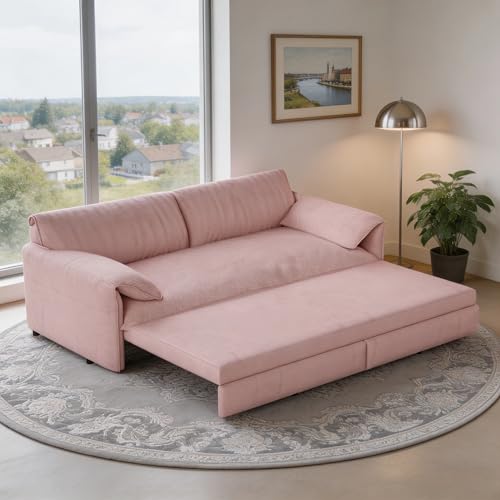
Trygoal 66" Queen Sofa Bed, 3-in-1 Convertible Pull Out Couch, Velvet Couch with Side Pocket, Couch that Turns into Bed, Sleeper Sofa Bed for Living Room, Apartment, Small Space, Pink
Check price on Amazon
Alexent Sleeper Sofa with Pull Out Bed, Storage Chaise Small Sectional Sofa Lounge Couch 3 Seater Reversible Chaise for Living Room Bedroom Apartment
Check price on Amazon
71 Inch Queen Pull Out Sleeper Sofa Bed L Shape Storage Couch Dark Green | Sectional Chaise Convertible Daybed|Modular Small Apartment|Living Room Ottoman Couch Sofa|Boneless Pullout Storage Sleeper
Check price on Amazon
2 in 1 Convertible Sleeper Sofa Bed, Futon Couches for Living Room with Side Pocket | Detachable Backrest | Velvet Fabric | Pull Out Couch | Small Loveseat | Sectional Sofa Bed (Gray, 2 Seat)
Check price on Amazon
Trygoal 95" King Size Sofa Bed, 3-in-1 Convertible Pull Out Couch, Couch with Side Pocket, Couch that Turns into Bed, Sleeper Sofa Bed for Living Room, Apartment, Small Space, Camel
Check price on AmazonFrequently Asked Questions
Most compact models occupy roughly 30 to 40 square feet when configured as a sofa. When the bed is deployed, plan for additional clearance of about 5 to 7 feet in front of the unit for the pull-out or fold-down mechanism to extend fully.
A pull-out sectional uses a metal frame that slides out from beneath the seat cushions, typically revealing a full-size mattress. A fold-down model collapses the backrest or flips the seat forward to create a sleeping surface. Fold-down designs tend to be lighter and easier to move, while pull-out designs usually offer a thicker mattress.
Many compact models are designed with removable legs, modular connectors, or split backs that allow them to pass through doorways as narrow as 29 inches. Always measure the narrowest point of your entry path and compare it against the delivered dimensions, not the assembled footprint.
Memory foam and high-density foam mattresses are the most common choices because they fold and compress without permanent creasing. Innerspring mattresses are less common in compact units due to thickness constraints, though some premium models use pocket-coil hybrids for better support.
Inspect and lubricate the folding or sliding mechanism every six months, and tighten any bolts that may have loosened through use. Regular maintenance keeps the conversion smooth and extends the life of the hardware, especially in households that deploy the bed frequently.
Related Guides
Ready to Compare Models?
Browse our curated selection of compact sectional sleepers above, and check availability for the configuration that matches your room.
View Recommended Models