
Wall Hugger Reclining Loveseat for RV: The Complete Buying Guide
Space is the ultimate luxury in any motorhome, travel trailer, or fifth wheel. A wall hugger reclining loveseat for RV lets you enjoy the full comfort of a recliner without sacrificing the precious inches behind your seating. This guide explains how the mechanism works, what to measure before you buy, which features matter most, and how to pick a model that fits your rig and your lifestyle.
Explore Recommended ModelsWhat Is a Wall Hugger Reclining Loveseat?
A wall hugger reclining loveseat is a two-seat reclining sofa built with a specialized mechanism that lets the seats recline without pushing the backrest far into the wall behind them. In a conventional recliner, the backrest tilts backward and the footrest extends forward, which means the furniture needs a substantial gap behind it to function. A wall hugger solves this by sliding the seat forward as the backrest reclines, keeping the rear profile nearly stationary.
The result is a loveseat that can sit almost flush against an RV wall, slide-out panel, or window while still offering a deep, comfortable recline. For RV owners, this is a game-changing piece of furniture. It pairs perfectly with the space-saving philosophy behind many modern RV layouts and works alongside other compact solutions such as a zero wall clearance reclining sectional if you need more seating.
Most wall hugger models combine two reclining seats with a center console that may include cupholders, storage, or USB charging ports. The dual-recliner configuration is the most common choice for couples traveling together, while some layouts offer a recliner paired with a stationary seat.
Why Wall Hugger Recliners Are Ideal for RVs
Every square inch counts inside a motorhome. Standard recliners can waste a foot or more of floor depth just to allow the backrest to tilt, which is a luxury most RV interiors cannot spare. A wall hugger reclining loveseat for RV reclaims that space and turns it into usable walkway, storage, or living area.
Space Efficiency Where It Matters Most
Wall hugger loveseats are especially valuable in slide-outs, where the wall is close and the available depth is limited. Because the mechanism moves the seat forward rather than the backrest backward, the loveseat can be placed close to the slide-out wall without blocking the recline. If your layout uses a wrap around couch for small room configuration, a wall hugger unit can complement the arrangement by adding dedicated reclining seats without eating up the central floor space.
Comfort Without Compromise
Many travelers assume that space-saving furniture means giving up comfort. That is not the case with a well-built wall hugger. Mid-range and premium models use high-density foam, sinuous spring systems, and padded armrests that rival residential recliners. The forward-sliding mechanism is smooth and stable when the frame and mechanism are properly engineered.
Better Use of Slide-Outs and Windows
RV owners often place seating beneath windows to enjoy the view. Traditional recliners force you to leave a gap that blocks part of the window or wastes floor space. A wall hugger lets you position the loveseat closer to the glass, maximizing the view and the available seating area at the same time.
If your RV also needs a versatile sleeping solution, compare a wall hugger loveseat with options like a love seat couch bed or a small couch that turns into a bed to decide which dual-purpose feature matters more for your trips.
How to Measure Before You Buy
Measuring is the single most important step before ordering a wall hugger reclining loveseat for RV use. A model that looks perfect online can fail to fit through the entry door, fail to clear the slide-out, or fail to recline fully inside the rig. Take these measurements before you shop.
| Measurement | What to Measure | Why It Matters |
|---|---|---|
| Width | Available wall or slide-out width, plus doorway width | Ensures the loveseat fits the space and can be brought inside |
| Depth (upright) | Floor space from wall to front edge | Confirms walkway clearance when the seats are upright |
| Depth (reclined) | Full footprint with footrests extended | Prevents the footrests from blocking walkways or doors |
| Back height | Top of backrest when reclined | Avoids collision with windows, cabinets, or ceiling |
| Wall clearance | Manufacturer's required gap behind the unit | Confirms the wall hugger can sit as close as intended |
| Doorway and hallway | Entry door width and interior turning space | Ensures the unit can be maneuvered into position |
Pro tip: Use painter's tape to mark the loveseat's upright and reclined footprint on your RV floor. Then walk the space to confirm that footrests, doors, and walkways remain usable. This simple step prevents most fit-related returns.
If you are furnishing a compact rig, our guide to comfortable living room furniture for small spaces covers additional measurement strategies and layout ideas that pair well with a wall hugger loveseat.
Key Features to Look For
Reclining Mechanism
Manual handle or lever mechanisms are simple, reliable, and lightweight. Power recliners with push-button controls offer smoother motion and often include USB charging, but they add weight and require a power source. In an RV, weight and power availability matter, so choose based on how you travel. A manual wall hugger is often the more practical choice for boondocking.
Upholstery Material
RV interiors face temperature swings, humidity, and sunlight. Performance fabric, polyurethane leather, and top-grain leather are all strong choices. Performance fabric resists stains and moisture and is often removable and washable. Leather and polyurethane are easy to wipe down and resist odors, which is helpful in a small, enclosed space.
Frame and Cushion Construction
Look for solid wood or plywood frames with reinforced joints. High-density foam cushions hold their shape better than low-density foam, especially in a loveseat that doubles as a daily lounging spot. Sinuous spring or pocket-coil support systems provide a more even, durable seating surface than webbing alone.
Console and Storage
A center console with cupholders and a storage compartment is common on two-seat RV loveseats. Some models add USB ports or a small drop-down table. These features are genuinely useful on the road, but confirm that the console does not interfere with the loveseat's recline or with your walkway.
Weight and Portability
RV furniture should be manageable to move and install. Check the shipping weight and the assembled weight, and confirm that the unit can be carried through your entry door. Lighter frames are easier to install but should not come at the expense of stability.
Quality Tiers: Matching Features to Needs
Wall hugger reclining loveseats for RVs fall into a few broad market tiers. Use this framework to align features with how often you travel and how much comfort you need.
| Tier | Typical Characteristics | Best For |
|---|---|---|
| Entry-level | Basic manual mechanism, simpler upholstery, lighter frame, fewer console features | Occasional weekend trips and budget-conscious buyers who prioritize the space-saving benefit |
| Mid-range | Smoother manual or power mechanism, high-density foam, reinforced frame, console with cupholders and storage | Frequent travelers who want a balance of durability and comfort |
| Premium | Power recline with USB, performance fabric or top-grain leather, pocket-coil seating, heavy-duty frame | Full-time RVers and couples who use the loveseat daily |
| Luxury / commercial-grade | Flagship mechanism, premium materials, advanced ergonomics, extended support systems | High-end motorhomes and buyers who want residential-level comfort on the road |
As a rule, moving up a tier brings smoother mechanisms, more supportive cushioning, and better materials rather than radically different dimensions. The space-saving geometry of a wall hugger is present across all tiers; the difference is how refined and durable the execution is.
If you also need a full-size sleeping solution for guests, consider pairing your loveseat with a full size pull out couch bed or a couch that turns into a full size bed so the living area can serve double duty.
Recommended Wall Hugger Reclining Loveseats for RV
⚠️ AFFILIATE DISCLOSURE: This website contains affiliate links. As an affiliate Associate, we earn from qualifying purchases. If you make a purchase through these links, we may receive a small commission at no additional cost to you. Read our full affiliate policy.
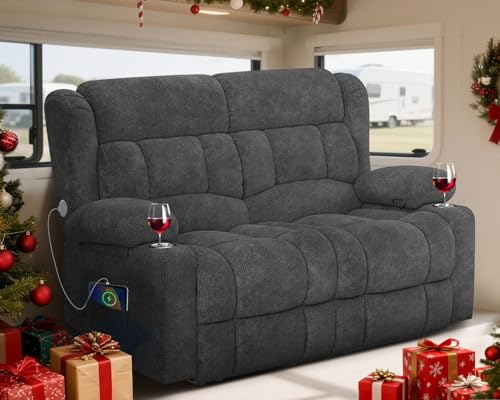
MisUMis RV Loveseat Recliner Sofa, Wall Hugger Reclining Loveseat RV Couch with USB Ports, Cup Holders, Pockets, 150° Adjustable RV Furniture Velvet Fabric Recliners for Travel & Home Theater Seating
Check price on Amazon
MisUMis RV Loveseat Recliner Sofa, Wall Hugger Reclining Loveseat RV Couch with USB Ports, Large Pockets, Cup Holders, 150° Adjustable RV Recliners Furniture for Travel Trailers & Home Theater Seating
Check price on Amazon
Manual Recliner Loveseat with Cup Holders, RV Wall Hugger Reclining, Gray | 2-Seater Fabric Reclining Sofa, Compact Wall Hugger Couch for RV, Small Living Room & Home Theater
Check price on Amazon
Loveseat Recliner Sofa, Wall Hugger Reclining Loveseat with Cup Holders & Storage Pockets, 150° Adjustable RV Couch, Traditional 2-Seat Reclining Couch for Living Room, RV, Home Theater, Black
Check price on Amazon
MOSGAT RV Loveseat Recliner Sofa, Reclining Loveseat Wall Hugger Recliners with USB Ports, Cup Holders, Insert Pockets, RV Recliners for Travel Trailers & Living Room, RV Furniture | RV Couch
Check price on Amazon
RV Loveseat Recliner Sofa, Wall Hugger Reclining RV Couch with USB | RV Reclining Loveseat with Massage, Pocket, Cup Holder, 150° Recline for RV Furniture, Travel Trailers & Home Theater Seating
Check price on Amazon
RV Loveseat Recliner Sofa, Home Theater Seating with Console & Massage | Reclining Loveseat with USB, Wall Hugger RV Couch Movie Theater Chairs, RV Furniture with Cup Holders, Drawer for Gaming Room
Check price on Amazon
MisUMis Loveseat Recliner Sofa, RV Wall Hugger Reclining Loveseat RV Couch with USB Ports, Large Pockets, Cup Holders, 150° Adjustable RV Recliners Furniture for Travel Trailers & Home Theater Seating
Check price on AmazonInstallation and Securing Tips
Installing a wall hugger reclining loveseat in an RV is straightforward, but a few precautions make the difference between a stable, quiet ride and a piece of furniture that shifts during travel.
- Remove the old furniture first and inspect the floor. Check for soft spots or water damage before placing the new unit.
- Confirm the anchoring method. Use the manufacturer's recommended brackets or heavy-duty tie-down straps rated for the loveseat's weight.
- Lock the recline during travel. Keep the seats upright and the footrests retracted before hitting the road.
- Leave a small gap for slide-out movement. If the loveseat sits in a slide-out, confirm it does not rub against the wall when the slide retracts.
- Check weight distribution. Keep heavier items low and distribute weight evenly, especially in travel trailers.
If your layout includes a dinette or workspace nearby, our guide to a work from home setup offers ideas for making a compact RV interior serve multiple functions without crowding the seating area.
Care and Maintenance
Regular maintenance extends the life of the mechanism and upholstery, especially in an RV where temperature and humidity fluctuate.
- Vacuum upholstery weekly to remove dust and grit that can wear fibers.
- Wipe leather and polyurethane surfaces with a damp cloth and condition leather periodically to prevent cracking.
- Lubricate the mechanism according to the manufacturer's schedule, and listen for squeaks or grinding that signal wear.
- Protect from direct sun with blinds or UV-resistant covers to prevent fading.
- Inspect anchoring hardware before each trip and tighten any loose bolts.
For replacement covers and cushions, see our guide to couch cushion cover replacement. If you are comparing additional seating options for a narrow space, a wall hugger loveseat recliners for RVs overview can help you compare models side by side.
Frequently Asked Questions
What is a wall hugger reclining loveseat for RV?
A wall hugger reclining loveseat for RV is a two-seat reclining furniture piece engineered with a zero-wall-clearance mechanism. Unlike traditional recliners that need a large gap behind them to fully recline, wall hugger models slide forward as they lean back, allowing them to sit almost flush against the wall. This makes them ideal for tight RV interiors where every inch of floor space matters.
How much clearance does a wall hugger recliner need behind it?
Most wall hugger reclining loveseats require only a few inches of clearance behind them, and some models can sit virtually flush against the wall. This is a major advantage in RVs, where slide-outs, windows, and cabinetry often leave limited room for traditional reclining furniture.
Can a wall hugger reclining loveseat fit in a slide-out?
Yes, many wall hugger reclining loveseats are specifically designed with compact footprints that fit well inside RV slide-outs. Always measure your slide-out depth, width, and height before buying, and confirm the loveseat's reclined depth and back height so the piece can fully recline without hitting cabinetry or windows.
What materials are best for an RV loveseat?
For RV use, look for durable upholstery such as performance fabric, polyurethane leather, or top-grain leather that resists moisture, stains, and sun fading. Removable, washable covers are a bonus. Lightweight frames and high-density foam cushions also help keep the loveseat manageable without sacrificing comfort.
How do I secure a reclining loveseat while driving?
Secure the loveseat using the manufacturer's anchoring system or heavy-duty tie-down straps attached to the RV floor. Reclining mechanisms should be locked in the upright position during travel. Check local regulations, and consider a professional installation if you are unsure about mounting points or weight limits.